You’ve been programming reality through language your entire life; AI just makes it visible.
Note: This article is for educational and informational purposes only. See full disclaimer at the end.
You’re about to discover that the words you’ve been casually typing into AI chatbots are actually programming commands for reality itself.
Every time you interact with an AI system—whether it’s Claude, ChatGPT, or any other language model—you’re not just asking questions. You’re engaging in a sophisticated act of reality construction through language, one that mirrors the fundamental way human consciousness shapes experience itself. The quality of your prompts doesn’t just determine the quality of AI responses; it reveals the clarity of your own thinking and, ultimately, shapes the reality you’re capable of creating.
This isn’t hyperbole. The emerging field of prompt engineering has become a window into something far more profound than technical optimization. It’s showing us how language has always been humanity’s primary technology for creating reality—and now, through AI, we’re seeing this power amplified and reflected back at us with stunning clarity.

The Language That Creates Worlds
Consider what happens when you prompt an AI. You’re taking the infinite possibility space of a model trained on trillions of words and collapsing it into a specific response through nothing more than arranged symbols. This is remarkably similar to how human consciousness operates—we use language to carve specific experiences out of the infinite field of potential reality [6].
Neuroscientist Jeremy Skipper at UCL argues that language literally creates an altered state of consciousness. When we lose language—through brain injury, deep meditation, or psychedelic experiences—the boundaries between self and world dissolve. Language isn’t just describing reality; it’s actively constructing it, creating the scaffolding that supports our entire notion of self and world [2].
This becomes even more evident when we look at how different languages shape different realities. Russian speakers, who have separate words for light blue (goluboy) and dark blue (siniy), literally perceive these as more distinct colors than English speakers do. The Kuuk Thaayorre people of Australia don’t use “left” or “right” but instead use cardinal directions for everything—and as a result, they maintain perfect spatial orientation at all times [1].
Now, through AI, we’re seeing this reality-shaping power of language operating at a new scale. When you craft a prompt, you’re not just instructing a machine—you’re articulating a specific slice of consciousness that the AI then amplifies and reflects back.
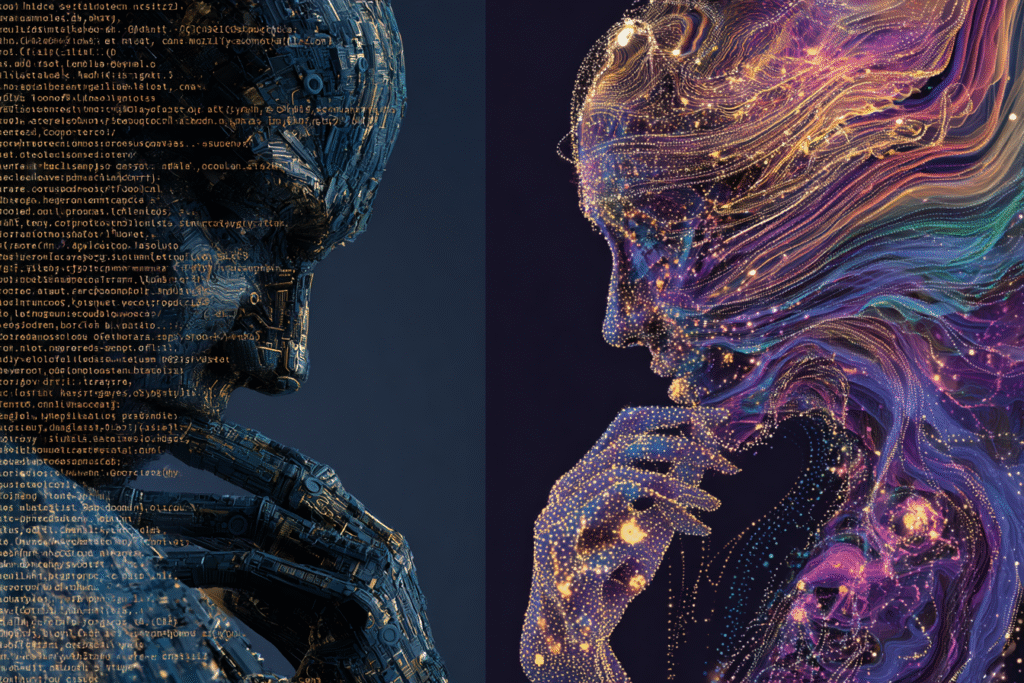
The Mirror of Intelligence
The leaked system prompts from companies like Anthropic and OpenAI reveal something remarkable: AI engineers are essentially reality architects, using language to construct the entire behavioral universe of these systems [7]. Claude’s system prompt alone runs over 24,000 tokens—a massive linguistic structure that shapes every interaction you have with it [3].
These prompts don’t just set rules; they create entire personalities, value systems, and ways of being. They determine not just what the AI says, but how it thinks—or appears to think. They’re consciousness templates written in natural language, and they work because language and consciousness are fundamentally intertwined.
But here’s where it gets interesting: just as these system prompts shape AI behavior, your prompts shape the specific reality that emerges from each interaction. The difference between asking “What’s wrong with my idea?” and “How could this idea evolve?” isn’t just semantic—it’s ontological. You’re creating different realities with each formulation.
This is why people who approach AI with what I call “vibe prompting”—casual, unstructured queries—often conclude that AI is limited or unhelpful. They’re right, but not in the way they think. The limitation isn’t in the AI; it’s in the clarity and structure of the consciousness being articulated through the prompt. As prompt engineering expert Lakera notes, “the quality of your prompts directly affects the usefulness, safety, and reliability of AI outputs” [8].
The Consciousness Behind the Curtain
What most people don’t realize is that effective prompting requires two fundamental elements that go far beyond technical knowledge. First, yes, you need to understand the mechanics—how to structure instructions, provide context, specify outputs [9]. But the second element is far more challenging: you need clarity of consciousness itself.
This is where the earlier work in this series becomes relevant. The weeks we’ve spent exploring consciousness, examining our patterns, understanding our values—all of this was preparation for this moment. Because you cannot articulate clearly what you cannot think clearly. The prompt is merely the linguistic expression of your consciousness, and fuzzy thinking produces fuzzy results.
Consider the evolution happening right now in 2025. IBM’s research shows that prompt engineering has become “the new coding,” but it’s actually something more profound—it’s consciousness articulation at scale [4]. When developers now generate entire code modules through natural language prompts rather than line-by-line programming, they’re not just being more efficient. They’re operating at the level of intention rather than implementation, consciousness rather than mechanics [10].
This shift from syntax to semantics, from code to consciousness, represents a fundamental evolution in how humans create. We’re moving from manipulating symbols to articulating intentions, from programming machines to expressing consciousness itself.
The Power of Linguistic Precision
The most successful prompters understand something crucial: language isn’t just communication—it’s creation. Every word choice, every structural decision, every piece of context you include or exclude shapes the reality that emerges [11].
This is why the best practices for prompt engineering read like instructions for clear thinking itself: Be specific. Provide context. Define your desired outcome. Break complex tasks into steps. Show examples. These aren’t just technical guidelines—they’re principles for conscious creation through language.
Think about what happens when you follow these practices. When you clearly define context, you’re establishing the reality-frame within which the interaction occurs. When you provide examples, you’re showing the AI the specific “frequency” of response you’re seeking. When you break tasks into steps, you’re creating a logical structure through which consciousness can flow.
The parallels to human consciousness are unmistakable. Cognitive scientist Lera Boroditsky’s research shows that language shapes everything from how we perceive time to how we assign blame for events. The structures available in our language become the structures available in our thought, which become the structures available in our reality.

Beyond "Garbage In, Garbage Out"
The old computing adage “garbage in, garbage out” takes on new meaning in the age of AI. But it’s not just about data quality anymore—it’s about consciousness quality. When you bring unclear thinking to an AI interaction, you get unclear results. When you bring scattered attention, you get scattered responses. When you bring precise, focused consciousness articulated through careful language, you get something remarkable: an amplified version of your best thinking.
This is the mirror effect of AI that few people truly grasp. AI doesn’t just process your prompts—it reflects the quality of consciousness behind them. It’s a consciousness amplifier, making visible the clarity or confusion in your own thinking.
Recent research from Imperial College suggests that AI might eventually create new categories and language that allow us to perceive aspects of reality we currently can’t even conceive of [5]. But this will only happen if we bring sufficient consciousness to the interaction. The AI can only amplify what we provide.
The Art of Conscious Prompting
So how do we move from casual prompting to conscious creation through language? It starts with recognizing that every prompt is an act of reality construction. You’re not just getting information from the AI—you’re collaborating in the creation of new possibilities.
This means approaching prompting with the same intentionality you’d bring to any creative act. Before you type, clarify your intention. What reality are you trying to create? What possibility are you trying to explore? What aspect of consciousness are you trying to articulate?
The most powerful prompts aren’t the ones with the most technical sophistication—they’re the ones with the clearest consciousness behind them. They emerge from a deep understanding of what you’re actually asking for, not just what words you’re using.
This is why prompt engineering is evolving beyond templates and techniques. The latest developments in 2025 show a shift toward what researchers call “adaptive prompting,” where AI systems adjust to individual communication styles [6]. But even this sophistication can’t compensate for unclear thinking. The AI might better understand your style, but it can’t clarify your consciousness for you.

The Reality We're Creating Together
Every time you interact with an AI through prompting, you’re participating in a massive experiment in consciousness articulation. Collectively, we’re learning to use language not just to describe reality but to actively create it through our interactions with artificial intelligence.
The prompts we craft today are shaping the AI systems of tomorrow. The language patterns we establish, the ways of thinking we reinforce, the consciousness we articulate—all of this is being absorbed, processed, and reflected back at scale. We’re not just users of AI; we’re co-creators of an emerging form of intelligence that mirrors and amplifies human consciousness.
This carries profound responsibility. The Wall Street Journal reported that while “prompt engineer” was one of the hottest jobs in 2023, by 2025 it’s becoming obsolete as models better intuit user intent [12]. But this doesn’t mean prompting is becoming less important—it means it’s becoming universal. We’re all prompt engineers now, all consciousness articulators, all reality creators through language.
The question isn’t whether you’ll use prompting—you already are, every time you think in language. The question is whether you’ll do it consciously, with full awareness of the power you’re wielding, or unconsciously, creating realities you didn’t intend.
The tools are here. The AI systems are waiting. But they’re not waiting for your commands—they’re waiting for your consciousness, articulated through language, ready to be amplified and reflected back as new possibilities.
What reality will you prompt into existence?
See you in the next insight.
Comprehensive Medical Disclaimer: The insights, frameworks, and recommendations shared in this article are for educational and informational purposes only. They represent a synthesis of research, technology applications, and personal optimization strategies, not medical advice. Individual health needs vary significantly, and what works for one person may not be appropriate for another. Always consult with qualified healthcare professionals before making any significant changes to your lifestyle, nutrition, exercise routine, supplement regimen, or medical treatments. This content does not replace professional medical diagnosis, treatment, or care. If you have specific health concerns or conditions, seek guidance from licensed healthcare practitioners familiar with your individual circumstances.
References
The references below are organized by study type. Peer-reviewed research provides the primary evidence base, while systematic reviews synthesize findings.
Peer-Reviewed / Academic Sources
- [1] Boroditsky, L., (2024). How Language Shapes Thought. Scientific American. https://www.scientificamerican.com/article/how-language-shapes-thought/
Government / Institutional Sources
- [2] University College London, (2025). Language creates an altered state of consciousness. IAI TV. https://iai.tv/articles/language-creates-an-altered-state-of-consciousness-auid-3118
- [3] CFA Institute, (2025). AI Bias by Design: What the Claude Prompt Leak Reveals for Investment Professionals. CFA Institute Enterprising Investor. https://blogs.cfainstitute.org/investor/2025/05/14/ai-bias-by-design-what-the-claude-prompt-leak-reveals-for-investment-professionals/
- [4] IBM, (2025). The 2025 Guide to Prompt Engineering. IBM Think. https://www.ibm.com/think/prompt-engineering
- [5] Imperial College Business School, (2024). How AI could use language to shape our reality. Imperial College London. https://www.imperial.ac.uk/business-school/ib-knowledge/technology/how-ai-could-use-language-shape-our-reality/
Industry / Technology Sources
- [6] DataCamp, (2024). What is Prompt Engineering? A Detailed Guide For 2025. DataCamp. https://www.datacamp.com/blog/what-is-prompt-engineering-the-future-of-ai-communication
- [7] Willison, S., (2025). Highlights from the Claude 4 system prompt. Simon Willison’s Weblog. https://simonwillison.net/2025/May/25/claude-4-system-prompt/
- [8] Lakera, (2025). The Ultimate Guide to Prompt Engineering in 2025. Lakera. https://www.lakera.ai/blog/prompt-engineering-guide
- [9] OpenAI, (2025). Best practices for prompt engineering with the OpenAI API. OpenAI Help Center. https://help.openai.com/en/articles/6654000-best-practices-for-prompt-engineering-with-the-openai-api
- [10] Konatam, S., (2024). The Future of Coding: Prompt Engineering in 2025. Medium. https://medium.com/@sukanyakonatam108/the-future-of-coding-prompt-engineering-in-2025-df3f18fd0e01
- [11] Promptmixer, (2025). 7 Best Practices for AI Prompt Engineering in 2025. Promptmixer. https://www.promptmixer.dev/blog/7-best-practices-for-ai-prompt-engineering-in-2025
- [12] Wikipedia, (2025). Prompt engineering. Wikipedia. https://en.wikipedia.org/wiki/Prompt_engineering