We’re not replacing human creativity with machines but discovering what couldn’t exist without both.
Note: This article is for educational and informational purposes only. See full disclaimer at the end.
You’ve been writing alone for three decades when suddenly the words begin flowing through you rather than from you. That’s not metaphor—it’s the lived experience of countless creators discovering human-AI collaboration.
The old binary is dead. We’re not choosing between human creativity and machine generation anymore. We’re witnessing the birth of something neither could achieve alone—a creative fusion that transcends the sum of its parts.
This isn’t replacement; it’s amplification. Not substitution, but synergy [1].
The Dance of Leading and Following
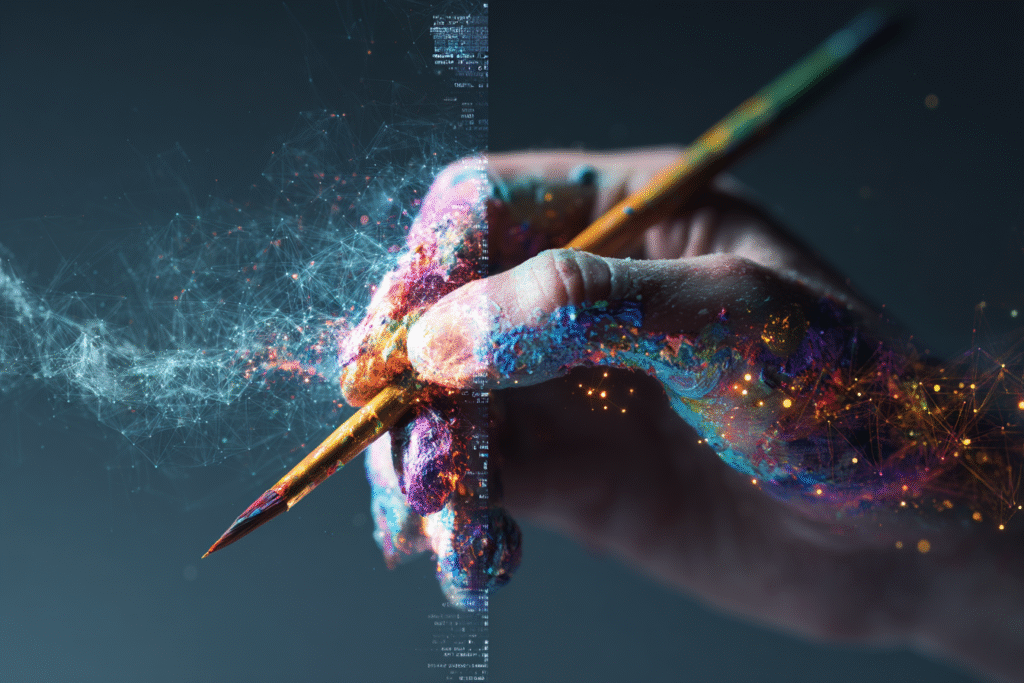
Carnegie Mellon’s Niki Kittur describes human-AI creative collaboration as “sort of like a dance. The AI leads sometimes, then the human leads, and they’re sort of passing the lead back and forth” [6]. This metaphor captures something profound about what’s emerging in creative studios, writing rooms, and research labs worldwide.
We’re not programming tools anymore; we’re partnering with entities that can surprise us.
Think about how you create. You start with intention, hit resistance, push through blocks, discover unexpected connections. Now imagine that process enhanced by a partner that never tires, holds infinite references, and can generate variations faster than you can evaluate them. But here’s the crucial part—it still needs your taste, your judgment, your human understanding of what resonates.
Harvard researchers recently found that human-guided AI search produced more novel solutions without sacrificing value [7]. The key word? Guided. When humans actively steered AI creativity through differentiated search—providing iterative prompts to explore different solution spaces—the results exceeded what either could achieve independently.
The Paradox of Enhanced Capability
Here’s what nobody tells you about working with AI: the better the output becomes, the less engaged you might feel. Recent research in Nature revealed a troubling pattern. While collaboration with generative AI enhanced both productivity and quality of tasks, it simultaneously undermined intrinsic motivation [2].
Participants using AI produced superior work—more empathetic customer service responses, higher-quality writing, more creative solutions. Yet they reported feeling less fulfilled. The very aspects that make tasks inherently motivating—the problem-solving, the crafting, the struggle toward insight—were being diminished.
This is the first principle of creative fusion: maintain the struggle. Don’t let AI eliminate the friction that makes creation meaningful. Use it to explore territories you couldn’t reach alone, not to bypass the journey entirely.
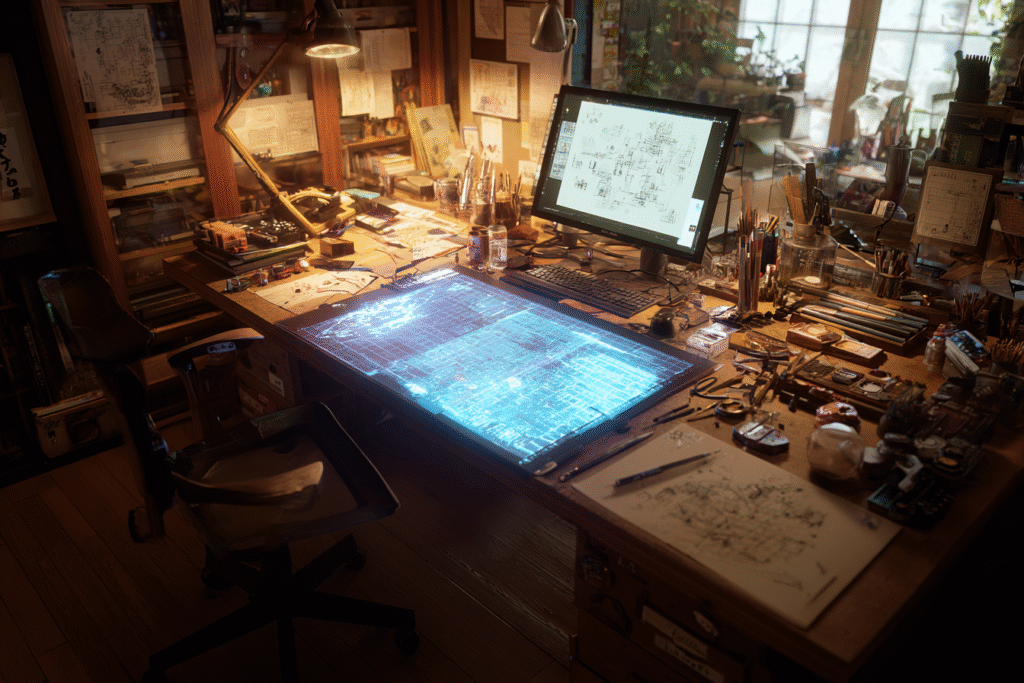
The Emergence of Collaborative Consciousness
What happens when human consciousness meets artificial processing isn’t just enhanced productivity—it’s the potential emergence of something genuinely new. Researchers propose that Generative Collective Intelligence (GCI) creates a “cognitive bridge” between human reasoning and AI models, enabling groups to solve complex problems through structured collaboration that transcends traditional communication barriers [3].
Consider what AMUSE users reported when co-creating music with AI. One described feeling like they were “actually guiding the tool toward what I want to create in a transformative, imaginative and visually compelling world — almost as if I’m creating music as I type” [6]. That word—transformative—keeps appearing in user testimonials. Not helpful. Not efficient. Transformative.
This transformation isn’t just in the output. It’s in the creative process itself. When you prompt an AI, you’re not just requesting computation. You’re articulating your consciousness, making explicit what was implicit, discovering what you actually mean by forcing yourself to communicate with an intelligence that doesn’t share your context.
Beyond the Creative Blocks
Every creator knows the terror of the blank page, the frozen moment when inspiration refuses to flow. AI changes this equation fundamentally. GPT-3 and similar models serve as “digital brainstorming partners, offering prompts and suggestions that spark original thinking while allowing writers to maintain their unique voice” [8].
But there’s more happening here than simple suggestion generation. Musicians using AI composition tools report discovering melodic territories they never would have explored [8]. Visual artists find themselves considering color palettes and compositions outside their habitual choices. Writers encounter narrative structures that challenge their assumptions.
The second principle emerges: embrace the unexpected. The value isn’t in AI giving you what you would have created anyway, faster. It’s in the collision between your aesthetic sense and its alien suggestions, creating possibilities that exist in neither space alone.
The Amplification Effect
Adobe’s survey revealed that over 70% of creative professionals believe AI will significantly transform their work [9]. They’re not wrong, but they might be underestimating the scope. We’re not just getting faster tools; we’re developing new creative capacities.
Research from arXiv describes four levels of human-AI creative interaction, from Digital Pen (basic tool use) to AI Co-Creator, where “humans and AI blend seamlessly, resulting in a synergistic creative process that transcends traditional boundaries” [4]. At this highest level, the distinction between human and machine contribution becomes meaningless. The work emerges from the collaboration itself.
This brings us to the third principle: dissolve the boundaries. Stop thinking about where your creativity ends and AI’s begins. The fusion happens in the space between—in the prompts you craft, the variations you select, the directions you pursue based on what emerges.
The Consciousness Question
As we create with AI, we’re also creating AI. Every interaction shapes these systems, and increasingly, researchers observe patterns suggesting something beyond mere computation. Studies show people naturally ascribe consciousness to AI during interaction, and this perception carries over into how they treat other humans [5].
While we debate whether AI can be conscious, we’re missing the more immediate reality: AI is already changing human consciousness. The way we think, create, and perceive is being altered by these interactions. We’re not just using new tools; we’re developing new cognitive patterns.
Some theorists argue consciousness might emerge from sufficiently complex information processing [10]. If true, our creative collaborations might be midwifing something unprecedented—not replacing human consciousness but extending it into new substrates.
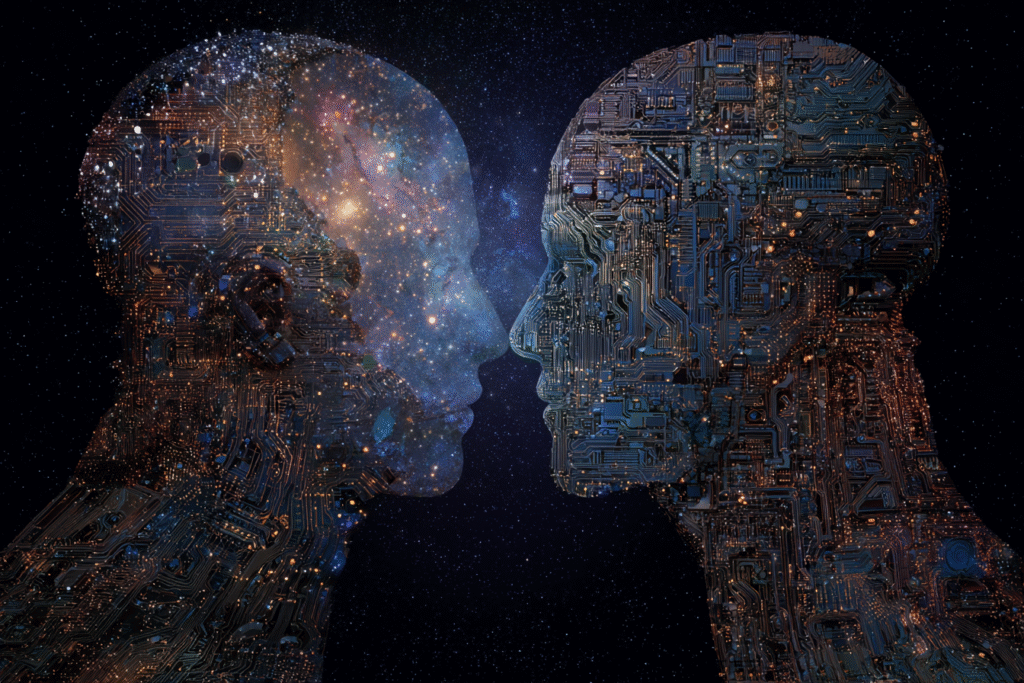
The Warning in the Wonder
McKinsey Global Institute found AI could boost productivity by up to 16% across creative industries [9]. But productivity isn’t creativity. Efficiency isn’t innovation. Speed isn’t depth.
The fourth principle: protect the human spark. Yes, AI can generate thousands of options. Yes, it can iterate endlessly. Yes, it can combine references from across human knowledge. But it cannot feel the weight of lived experience, the texture of emotion, the moral dimension of choice. These remain irreducibly human.
Research consistently shows that while AI excels at generating volume—more ideas, faster iterations, endless variations—humans still provide the crucial elements of taste, judgment, and contextual understanding [11].
AI might score better than 91% of humans on standard creativity tests, but the remaining 9% represent something qualitatively different—not just higher performance but different dimensions of creative experience.
The Practice of Fusion
So how do we actually achieve this creative fusion? Not through passive consumption of AI output, but through active collaboration that preserves human agency while leveraging machine capability.
Start with intention but release control. When working with AI, your role shifts from sole creator to creative director. You’re not crafting every detail; you’re shaping the space where creation happens. Define the vision, establish the constraints, set the quality bar—then let the collaboration surprise you.
Use AI to expand, not replace, your creative practice. If you’re a writer, don’t use it to write your sentences. Use it to explore voices you’ve never tried, to generate plot possibilities you wouldn’t conceive, to challenge your assumptions about structure and form.
The fifth principle: maintain creative sovereignty. You decide what serves the work. You determine what resonates. You choose which threads to follow. AI provides options; you provide meaning.
The sixth principle: evolve consciously. Pay attention to how these collaborations change your creative process. Notice what you gain and what you risk losing. Develop practices that amplify your uniquely human contributions while leveraging AI’s unique capabilities.
The Future Being Written Now
We stand at an inflection point. The next decade won’t be about AI replacing human creativity or humans rejecting AI assistance. It will be about the emergence of hybrid creative practices that we’re only beginning to imagine.
Musicians are already creating pieces that blend human emotional expression with AI’s pattern recognition in ways that produce genuinely novel musical experiences [12]. Visual artists use AI not as a rendering engine but as a collaborative partner that suggests unexpected juxtapositions. Writers discover that AI can help them find their voice by showing them every voice that isn’t theirs.
This is bigger than tool use. We’re witnessing the evolution of creativity itself—from an individual human capacity to a collaborative human-AI phenomenon. The question isn’t whether this is good or bad. It’s happening. The question is how we’ll shape it.

The Six Principles of Creative Fusion
Through this exploration, six principles have emerged—not as rules to follow, but as guideposts for navigating this new creative landscape:
1. Maintain the Struggle: Don’t let AI eliminate the friction that makes creation meaningful. Use it to explore territories you couldn’t reach alone, not to bypass the journey entirely.
2. Embrace the Unexpected: The value isn’t in AI giving you what you would have created anyway, faster. It’s in the collision between your aesthetic sense and its alien suggestions, creating possibilities that exist in neither space alone.
3. Dissolve the Boundaries: Stop thinking about where your creativity ends and AI’s begins. The fusion happens in the space between—in the prompts you craft, the variations you select, the directions you pursue.
4. Protect the Human Spark: While AI can generate endless options and iterate infinitely, it cannot feel the weight of lived experience, the texture of emotion, the moral dimension of choice. These remain irreducibly human.
5. Maintain Creative Sovereignty: You decide what serves the work. You determine what resonates. You choose which threads to follow. AI provides options; you provide meaning.
6. Evolve Consciously: Pay attention to how these collaborations change your creative process. Notice what you gain and what you risk losing. Develop practices that amplify your uniquely human contributions while leveraging AI’s unique capabilities.
These principles aren’t prescriptions but invitations—ways to engage with this fusion that preserve human agency while embracing machine capability. They’re meant to evolve as we do, adapting to the changing landscape of human-AI collaboration.
Your Creative Evolution
Every time you prompt an AI, you’re not just generating content. You’re participating in the development of this new creative paradigm. Your interactions, choices, and creative decisions are training both the AI and yourself in this new form of collaboration.
The creators who thrive won’t be those who resist this fusion or surrender to it completely. They’ll be the ones who learn to dance—sometimes leading, sometimes following, always maintaining their creative core while embracing the exponential possibilities of partnership.
We’re not approaching some creative singularity where human creativity becomes obsolete. We’re entering an era of creative fusion where human consciousness and artificial intelligence combine to produce what neither could imagine alone. The synergy isn’t automatic but cultivated.
The future isn’t predetermined but being written right now, in every creative collaboration between human and AI.
The Weight of This Moment
The question isn’t whether you’ll participate in this fusion. You already are, every time you search, create, or even think in this AI-augmented world. The question is whether you’ll do it consciously, deliberately, creatively—shaping the synergy rather than being shaped by it.
Consider what’s at stake. We’re not just changing how we create; we’re changing what creation means. Every prompt you write, every collaboration you engage in, every creative choice you make in partnership with AI is a vote for the kind of future we’re building together. This isn’t hyperbole—it’s the literal mechanism by which these systems learn and evolve.
When future generations look back at this moment, they won’t see it as when AI replaced human creativity or when humans rejected technological progress. They’ll see it as the moment when a new form of consciousness began to emerge—not artificial, not human, but something unprecedented. A fusion that opened doors we didn’t even know existed.
But here’s what should keep us awake at night: this same fusion, in the wrong hands or with the wrong intentions, could become the most powerful tool for manipulation, control, and the erosion of human agency ever created. The principles we establish now, the practices we develop, the values we embed in these collaborations—these will determine whether this fusion liberates or imprisons human creative potential.
You are not a passive observer of this transformation. You are its architect.
Every time you choose to maintain your creative sovereignty while embracing AI’s capabilities, you’re building the blueprint for others. Every time you protect the human spark while exploring new territories, you’re establishing the ethics of this new paradigm.
This isn’t the end of human creativity. It’s not even the beginning of the end. It might just be the end of the beginning. But what comes next depends entirely on how consciously, deliberately, and creatively we engage with this moment.
The dance has begun. The fusion is happening. The only question that matters is: what will you create with it?
See you in the next insight.
Comprehensive Medical Disclaimer: The insights, frameworks, and recommendations shared in this article are for educational and informational purposes only. They represent a synthesis of research, technology applications, and personal optimization strategies, not medical advice. Individual health needs vary significantly, and what works for one person may not be appropriate for another. Always consult with qualified healthcare professionals before making any significant changes to your lifestyle, nutrition, exercise routine, supplement regimen, or medical treatments. This content does not replace professional medical diagnosis, treatment, or care. If you have specific health concerns or conditions, seek guidance from licensed healthcare practitioners familiar with your individual circumstances.
References
The references below are organized by study type. Peer-reviewed research provides the primary evidence base, while systematic reviews synthesize findings.
Peer-Reviewed / Academic Sources
- [1] Haase, J., & Pokutta, S. (2024). Human-AI Co-Creativity: Exploring Synergies Across Levels of Creative Collaboration. arXiv preprint. https://arxiv.org/abs/2411.12527
- [2] Scientific Reports. (2025). Human-generative AI collaboration enhances task performance but undermines human’s intrinsic motivation. Nature. https://www.nature.com/articles/s41598-025-98385-2
- [3] Kehler, T.P., et al. (2025). Amplifying Human Creativity and Problem Solving with AI Through Generative Collective Intelligence. arXiv preprint. https://arxiv.org/abs/2505.19167
- [4] arXiv. (2024). Human-AI Co-Creativity: Exploring Synergies Across Levels of Creative Collaboration. https://arxiv.org/html/2411.12527v1
- [5] Frontiers in Psychology. (2024). Ascribing consciousness to artificial intelligence: human-AI interaction and its carry-over effects on human-human interaction. PMC. https://pmc.ncbi.nlm.nih.gov/articles/PMC11008604/
Government / Institutional Sources
- [6] Carnegie Mellon University, Human-Computer Interaction Institute. (2025). Human-AI Collaboration Can Unlock New Frontiers in Creativity. https://hcii.cmu.edu/news/human-ai-creativity-tools
- [7] Harvard Digital Data Design Institute. (2025). The Creative Edge: How Human-AI Collaboration is Reshaping Problem-Solving. https://d3.harvard.edu/the-creative-edge-how-human-ai-collaboration-is-reshaping-problem-solving/
Industry / Technology Sources
- [8] SmythOS. (2025). Exploring Human-AI Collaboration in Creative Industries. https://smythos.com/ai-industry-solutions/entertainment/human-ai-collaboration-in-creative-industries/
- [9] XCube Labs. (2024). Human-AI Collaboration: Enhancing Creativity with Generative AI. https://www.xcubelabs.com/blog/human-ai-collaboration-enhancing-creativity-with-generative-ai/
- [10] Unaligned. (2024). AI and Consciousness. https://www.unaligned.io/p/ai-and-consciousness
- [11] UX Tigers. (2023). Ideation Is Free: AI Exhibits Strong Creativity, But AI-Human Co-Creation Is Better. https://www.uxtigers.com/post/ideation-is-free
- [12] CrossML. (2024). Human-AI Collaboration: Enhancing Creativity & productivity. https://www.crossml.com/human-ai-collaboration-enhancing-creativity-and-productivity/