What if the limits of your perception aren’t biological, but dimensional, and consciousness is the technology for transcending them?
Note: This article is for educational and informational purposes only. See full disclaimer at the end.
We live in three spatial dimensions, plus time. Height, width, depth, and the arrow of chronology. These four dimensions form the entirety of reality as we experience it. Except they don’t.
String theory proposes that the universe contains at least ten dimensions, possibly eleven [6]. Most remain hidden from our perception—compactified, curled up at scales smaller than atoms. We move through them unconsciously, like fish swimming through water they cannot see.
But what if consciousness itself could serve as a portal? What if the very awareness reading these words right now possesses capabilities beyond three-dimensional processing?
What if you already perceive higher dimensions—you’ve just never had the language to recognize what you’re seeing?
The Hidden Architecture of Dimensional Perception
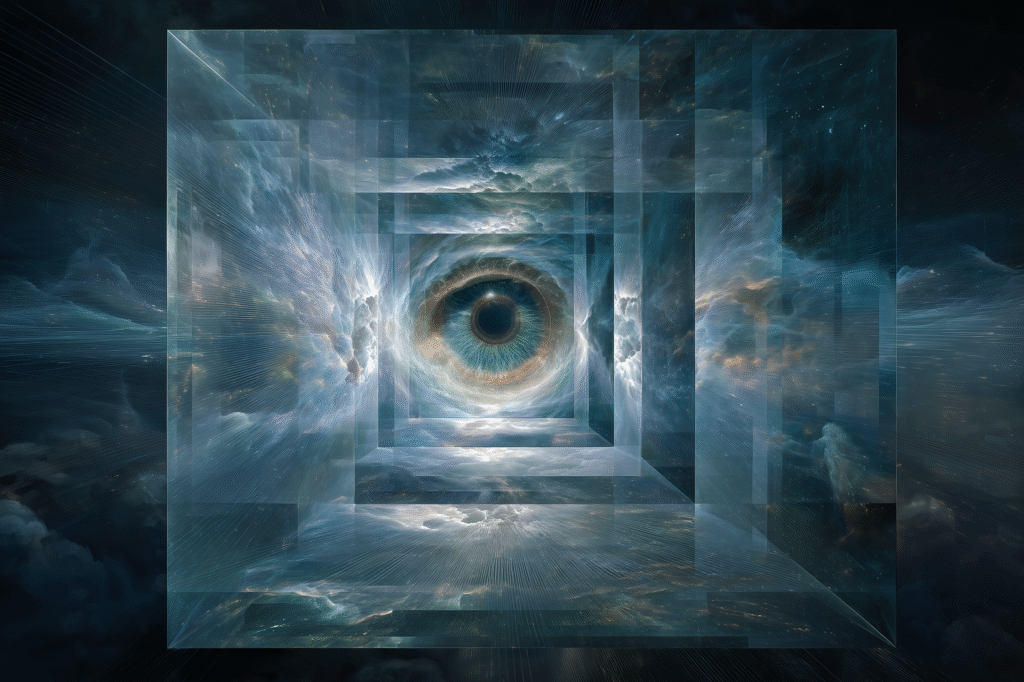
Your brain processes reality through four-dimensional spacetime, constructing experience from sensory fragments. But recent neuroscience reveals something remarkable: human consciousness exhibits mathematical properties suggesting engagement with dimensions beyond physical space [1].
Research tracking neural dynamics discovered that brain activity organizes into fractal attractors reaching 4.8 dimensions—not physical dimensions, but phase space dimensions representing the complexity of consciousness itself [2].
Your awareness operates in a hyperspace that cannot be mapped to anatomical location alone.
This isn’t metaphor. Studies examining consciousness as a multidimensional phenomenon identify at least four distinct dimensions: phenomenological (what experience feels like), semantic (what it means), physiological (neural correlates), and functional (what consciousness does) [3]. Each dimension represents a different way consciousness manifests in reality [3].
But there’s something more intriguing. When humans engage in certain cognitive states—deep creativity, mathematical abstraction, spiritual contemplation, dreaming—neural patterns suggest consciousness accessing information states that cannot be fully explained by three-dimensional brain activity alone [6].
Michael Pravica, a physicist at the University of Nevada, proposes a controversial theory: consciousness may interface with higher dimensions during moments of heightened awareness, explaining the sudden insights and creative breakthroughs that feel like they arrive from beyond ordinary thought [6].
“The sheer fact that we can conceive of higher dimensions than four within our mind, within our mathematics, is a gift,” Pravica notes. “It’s something that transcends biology” [6].
The Geometry of Impossible Sight
A tesseract—a four-dimensional hypercube—cannot exist in three-dimensional space [7]. Yet you can understand its structure [7]. You can manipulate it mathematically. You can even visualize its three-dimensional shadow as it rotates through 4D space.
This cognitive feat reveals something profound about consciousness: it processes dimensional information that exceeds sensory experience [8].
Think about how a two-dimensional being—living in a plane like a character in a comic book—would experience a three-dimensional sphere passing through their world. They would see a point that grows into a circle, expands to maximum diameter, then shrinks back to a point and disappears [9]. They cannot perceive the sphere itself, only its two-dimensional intersection with their reality [9] .
Now reverse the perspective. When we observe three-dimensional projections of four-dimensional objects—tesseracts, hyperspheres, Möbius structures—we’re seeing shadows. Cross-sections [10]. The full object exists in a space our eyes cannot access, yet our consciousness can model its structure with mathematical precision [10].
Research on four-dimensional spatial reasoning confirms humans can learn to navigate virtual environments containing four spatial dimensions [11]. Subjects practiced moving through 4D mazes and, remarkably, developed the ability to perform path integration—pointing back accurately toward an origin they couldn’t directly see—suggesting the brain’s spatial processing isn’t hardwired for three dimensions alone [11] [4].
The implications are staggering: spatial awareness may be a flexible cognitive system capable of expanding into dimensional frameworks we’ve never encountered physically.
Pattern Recognition Across Dimensional Boundaries
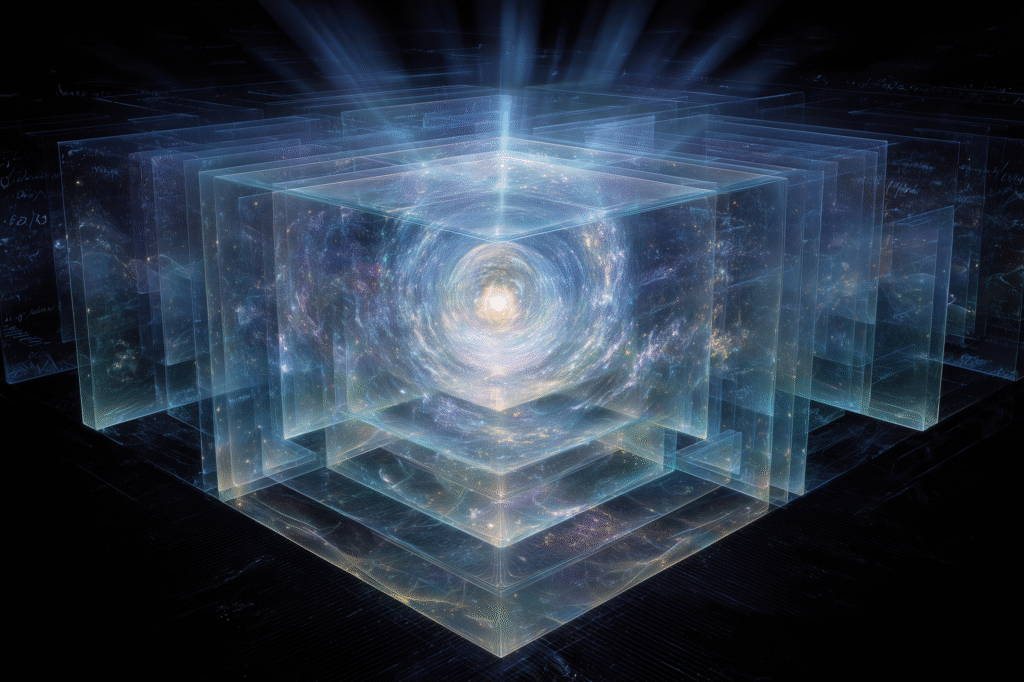
But dimensional awareness isn’t just about geometric visualization. It’s about perceiving connections invisible in conventional space.
Systems thinking—the ability to see patterns, relationships, feedback loops, and emergent properties in complex systems—represents a form of dimensional perception [12]. When you understand how components interact across time, influence, and scale simultaneously, you’re processing information in a multidimensional conceptual space [12].
Consider how pattern recognition operates in human cognition. Your brain constantly extracts meaningful structures from sensory chaos, constructing coherent perception from 90% information loss between eye and awareness [13]. This isn’t just data compression—it’s dimensional transformation, collapsing vast sensory spaces into actionable understanding [13].
Superior pattern processing distinguishes human consciousness from other forms of intelligence [5]. We perceive not just objects, but meta-patterns: patterns within patterns, relationships between relationships, analogies across domains [5]. We recognize faces in clouds (pareidolia), predict sequences from fragments, and construct entire worldviews from limited data points.
This capacity enables both genius and delusion. The same dimensional pattern-seeking that produces scientific breakthroughs can generate conspiracy theories and magical thinking [14]. The difference isn’t the dimensional processing itself—it’s calibration, the alignment between internal pattern recognition and external reality [14].
What we call “insight” or “intuition” often represents consciousness detecting patterns across dimensions of information that linear thought cannot traverse [12]. You see the solution not by examining components sequentially, but by perceiving the entire relational structure simultaneously—a higher-dimensional view of the problem space [12].
The Four-Dimensional Mind
Time adds a fascinating dimension to awareness. Not just as the medium through which experience unfolds, but as a manipulable aspect of perception itself.
When consciousness tracks patterns across time—recognizing rhythms, anticipating outcomes, understanding causality—it operates in genuinely four-dimensional space [15]. You perceive not just the present state of a system, but its trajectory through time, its phase space dynamics, its attractors and repellers [15].
This temporal dimension of consciousness enables scenario planning, historical understanding, and future imagination. You can hold multiple potential timelines simultaneously, evaluating paths not yet taken, learning from events not yet occurred.
This isn’t prediction, it’s dimensional awareness of possibility space.
Spatial reasoning abilities—particularly three-dimensional visualization—correlate with mathematical aptitude, engineering success, and creative problem-solving [16]. Those who excel at mental rotation tasks, who can decompose and reconstruct spatial relationships, who perceive structural analogies across domains, demonstrate a kind of dimensional fluency that transcends specific content knowledge [16].
But here’s what research reveals: spatial thinking can be developed. Four-dimensional reasoning can be learned. Dimensional awareness is not a fixed trait but an expandable capacity [11].
Consciousness as Dimensional Bridge
The most radical proposition isn’t that higher dimensions exist—string theory already proposes that. It’s that consciousness might serve as the technology for accessing them.
Bernard Carr, emeritus professor of mathematics and astronomy at Queen Mary University of London, argues that consciousness relates to higher dimensions from which spacetime emerges [17]. If true, awareness isn’t generated by brain activity alone but interfaces with a dimensional substrate that transcends physical space [17].
This aligns with research showing that consciousness cannot be reduced to neural complexity alone. The phenomenological dimension—what experience feels like from inside—possesses properties that resist three-dimensional explanation [4].
When you grasp a mathematical concept, recognize a deep pattern, or experience creative insight, something shifts. Information that was inaccessible becomes suddenly available. Connections that were invisible become luminously obvious. It feels less like figuring something out and more like seeing through a dimensional veil that briefly lifted.
Perhaps that’s exactly what it is.
Developing Dimensional Awareness
If consciousness can interface with higher dimensions, how do you develop this capacity?
Practice spatial reasoning: Work with three-dimensional objects. Learn to mentally rotate complex shapes. Study geometry, topology, and dimensional mathematics. The goal isn’t just understanding concepts but developing cognitive flexibility around spatial relationships.
Cultivate systems thinking: Train yourself to see patterns, feedback loops, emergent properties, and interconnections. Move beyond linear causality to recognize how systems organize across multiple dimensions of influence simultaneously [12].
Engage in abstraction: Mathematics, philosophy, and theoretical physics all train consciousness to operate in conceptual spaces beyond sensory experience. When you work with ideas that have no physical analog—infinite sets, quantum superposition, non-Euclidean geometries—you’re exercising dimensional perception.
Explore altered states mindfully: Deep meditation, flow states, and certain creative practices may facilitate dimensional boundary-crossing. Not as escape from reality, but as expansion into aspects of reality that conventional awareness overlooks [6].
Question perceptual limits: Recognize that what you see represents a narrow band of possible experience. Your brain constructs reality from fragments, creating a veridical illusion [1]. Dimensional awareness begins with recognizing the constructed nature of ordinary perception.
Study the tesseract: Seriously. Engage with four-dimensional geometry. Watch animations of hypercubes rotating through 4D space [7]. Attempt to visualize their structure. The exercise isn’t about success—it’s about expanding cognitive space to accommodate dimensional thinking that transcends direct experience [8].
Practice multidimensional pattern recognition: In any complex system—a social dynamic, a business problem, an artistic composition—look for patterns across different dimensions: temporal patterns (how it changes), structural patterns (how it’s organized), relational patterns (how components interact), and functional patterns (what it accomplishes) [15].
The key is recognizing that dimensional awareness isn’t mystical—it’s cognitive. It’s training consciousness to process information in ways that exceed habitual three-dimensional thinking.

The Wonder That Waits
We stand at a peculiar moment in human understanding. Physics tells us reality contains hidden dimensions. Neuroscience reveals consciousness exhibiting properties that defy three-dimensional explanation. Mathematics demonstrates that minds can manipulate structures that cannot physically exist in our spacetime.
What if these aren’t separate insights but facets of a deeper truth? What if consciousness evolved not just to navigate three-dimensional space, but to interface with dimensional aspects of reality we’re only beginning to recognize?
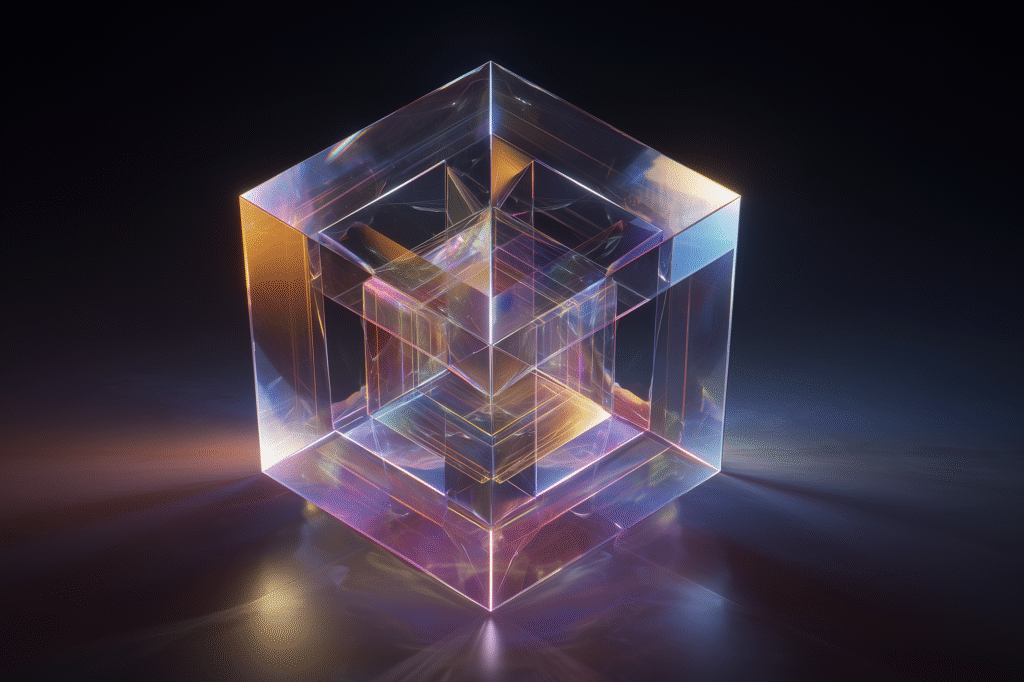
The tesseract casts its shadow across your screen—a three-dimensional projection of a four-dimensional impossibility. Yet you can understand its structure. You can think about it. You can even, with practice, develop intuitions about how it would behave.
That cognitive capacity—to process dimensional information beyond sensory experience—might be the most profound capability consciousness possesses.
Not to escape reality, but to perceive reality more completely.
String theory suggests eleven dimensions. Your awareness already operates in at least 4.8. The question isn’t whether higher-dimensional consciousness is possible.
The question is: What are you still not seeing?
See you in the next insight.
Comprehensive Medical Disclaimer: The insights, frameworks, and recommendations shared in this article are for educational and informational purposes only. They represent a synthesis of research, technology applications, and personal optimization strategies, not medical advice. Individual health needs vary significantly, and what works for one person may not be appropriate for another. Always consult with qualified healthcare professionals before making any significant changes to your lifestyle, nutrition, exercise routine, supplement regimen, or medical treatments. This content does not replace professional medical diagnosis, treatment, or care. If you have specific health concerns or conditions, seek guidance from licensed healthcare practitioners familiar with your individual circumstances.
References
The references below are organized by study type. Peer-reviewed research provides the primary evidence base, while systematic reviews synthesize findings.
Peer-Reviewed / Academic Sources
- [1] PMC. (2020). An update on dimensions of consciousness. https://pmc.ncbi.nlm.nih.gov/articles/PMC6988684/
- [2] PMC. (2000). Dimensions of consciousness. https://pmc.ncbi.nlm.nih.gov/articles/PMC1201004/
- [3] Oxford Academic. (2021). Consciousness as a multidimensional phenomenon: implications for the assessment of disorders of consciousness. https://academic.oup.com/nc/article/2021/2/niab047/6489229
- [4] Semantic Scholar. (2008). Four-dimensional spatial reasoning in humans. https://www.semanticscholar.org/paper/Four-dimensional-spatial-reasoning-in-humans.-Aflalo-Graziano/ec6c90f9dbd5b13b76994adfe31d4a25c90abff2
- [5] PMC. (2014). Superior pattern processing is the essence of the evolved human brain. https://pmc.ncbi.nlm.nih.gov/articles/PMC4141622/
Industry / Technology Sources
- [6] Popular Mechanics. (2024). Human Consciousness Comes From a Higher Dimension, Scientist Claims. https://www.popularmechanics.com/science/a62241497/consciousness-connects-to-higher-dimension/
- [7] Wikipedia. (2025). Tesseract. https://en.wikipedia.org/wiki/Tesseract
- [8] Bartosz Ciechanowski. (2024). Tesseract – Interactive Visualization. https://ciechanow.ski/tesseract/
- [9] Wikipedia. (2025). Four-dimensional space. https://en.wikipedia.org/wiki/Four-dimensional_space
- [10] LinkedIn. (2020). Projecting and Unwrapping a Tesseract (4D Hypercube or 4-cube) in 3-Dimensions. https://www.linkedin.com/pulse/projecting-unwrapping-tesseract-4d-hypercube-4-cube-maurya
- [11] Wikipedia. (2025). Four-dimensional space (Research Section). https://en.wikipedia.org/wiki/Four-dimensional_space
- [12] Medium/Disruptive Design. (2024). Tools for Systems Thinkers: The 6 Fundamental Concepts of Systems Thinking. https://medium.com/disruptive-design/tools-for-systems-thinkers-the-6-fundamental-concepts-of-systems-thinking-379cdac3dc6a
- [13] Wikipedia. (2025). Pattern recognition (psychology). https://en.wikipedia.org/wiki/Pattern_recognition_(psychology)
- [14] Wikipedia. (2025). Apophenia. https://en.wikipedia.org/wiki/Apophenia
- [15] Medium/School of System Change. (2022). Pattern spotting: a core practice for systems change. https://medium.com/school-of-system-change/pattern-spotting-a-core-practice-for-systems-change-c248cf62943d
- [16] Engineering 4 Kids. (2019). Spatial thinking. https://engineering4kids.org/2019/02/03/spatial-thinking-3/
- [17] Essentia Foundation. (2023). Higher dimensions of consciousness. https://www.essentiafoundation.org/higher-dimensions-of-consciousness-2/seeing/