What happens to who you are when your lifetime stretches from decades into centuries?
Note: This article is for educational and informational purposes only. See full disclaimer at the end.
Will our consciousness evolve, or will it fracture under the weight of endless years?
The scientist adjusts her biometric display, reviewing data from participants in the radical longevity study:
Subject 47, aged 147 chronologically but biologically 62, exhibits something unexpected in the neural scans—not deterioration, but reorganization. The longer humans live, it seems, the more their consciousness itself transforms.
We stand at a peculiar crossroad in human history. AI-driven longevity research promises to extend human healthspan by decades, with some researchers predicting life expectancies approaching 150 years by mid-century.
Futurists like Ray Kurzweil suggest that by 2030, the most informed individuals will reach “longevity escape velocity”—adding more than a year to life expectancy for each calendar year that passes [13]. But amid the excitement about living longer, we’re asking the wrong first question.
The question isn’t simply can we live 150 years, or 200, or indefinitely. The question is: who lives those years?
The Three Timeframes of Extended Life
Extended longevity isn’t a single phenomenon—it unfolds across three distinct phases, each raising different consciousness questions.
Near-term longevity (adding 20-50 years to current lifespans) primarily amplifies what we already experience. Research on longevity and life satisfaction suggests that understanding how extended lifespan influences subjective well-being and psychological adjustments is crucial for health psychology [10]. A 90-year-old with the body of a 60-year-old faces familiar challenges—career reinvention, relationship evolution, meaning-making—but on an extended timeline. Consciousness doesn’t fundamentally shift; it stretches.
Extended longevity (100-150 year lifespans) introduces something qualitatively different. Studies on imagining life beyond current life spans reveal that chronological aging, even when characterized by suspended biological aging, is associated with decreased self-continuity—people feel disconnected from their distant future selves [4]. This isn’t just about more time; it’s about how consciousness maintains coherence across timescales that evolution never prepared us for.
Radical longevity (centuries to potential immortality) enters genuinely uncharted territory. The Pew Research Center notes that extending human life spans beyond our oldest ancestors would raise unprecedented social, political, economic, environmental, and moral questions [8]. At this scale, we’re no longer discussing the same human consciousness navigating more years—we’re questioning whether human consciousness can persist meaningfully across such expanses.
The Consciousness Paradox of Immortality
Here’s what makes longevity research fascinating from a consciousness perspective: cognitive psychology traditionally views longevity as leading to mental deterioration, but optimistic research suggests that older minds tend to focus less on details and more on underlying significance and holistic meaning [2]. Extended life might not diminish consciousness—it might fundamentally reorganize it.
Consider what happens to human awareness across centuries:
Pattern Recognition Across Decades
A person who lives 150 years doesn’t just accumulate more experiences—they witness patterns invisible to shorter lifespans. Economic cycles. Cultural movements. Technological revolutions. Personality traits like conscientiousness predict longevity, and cognitive functioning partially mediates this relationship—suggesting that how we process information influences how long we live [1]. But the reverse also holds: how long we live influences how we process information.
Imagine recognizing patterns across 80 years of observation that someone living 40 years could never perceive. Your consciousness wouldn’t just contain more memories—it would develop an entirely different temporal resolution.
The Identity Persistence Problem
Research demonstrates that imagining extremely distant futures is associated with a sense of separation between current and distant future selves, with decreased perceived overlap and different anticipated activities [4]. At what point does the person who began the journey cease to exist, replaced by someone who merely inherits their memories?
The Ship of Theseus paradox, explored in Day 146, takes on visceral urgency here. If your cells regenerate, your neural pathways rewire, your values evolve, your relationships transform completely multiple times over centuries—who persists? Not metaphorically, but experientially: is the consciousness experiencing year 250 the same consciousness that experienced year 1?
Motivation and Meaning Across Centuries
Studies on motivation for longevity reveal four general response patterns: conditional wishes for longer life while healthy, continuing “as long as it goes,” unrealistic wishes for very long life more common in younger adults, and no wish to live longer than expected more common in very old adults [3]. But these patterns emerge from minds evolved for 70-80 year lifespans. What motivates consciousness across 300 years?
Traditional meaning-making structures—career, legacy, watching children grow—compress into the first century. What fills centuries two and three? Does consciousness develop entirely new motivation structures, or does it suffer existential exhaustion?
The Enhancement Trade-Off
Modern AI-driven longevity research can leverage next-generation sequencing data including proteomics and lipidomics to understand interactions between the human body and external environment, with external factors playing a key role in aging [7]. But technological life extension doesn’t occur in isolation—it’s intimately connected to consciousness enhancement.
Some scientists predict that eventually humans will achieve immortality by fully merging with machines, with futurists like Ray Kurzweil suggesting we’ll reverse-engineer the brain and download human consciousness [13]. This raises the most profound question: if we extend life by merging consciousness with AI systems, do we extend human consciousness—or replace it with something else?
The answer shapes everything. Consider three scenarios:
Scenario 1: Biological Extension
Researchers like biomedical gerontologist Aubrey de Grey suggest aging can be cured through medical advances, with some predicting 1,000-year lifespans by 2050 through genetic engineering, robotics, and digital consciousness uploaded into virtual space or artificial bodies [11]. If we achieve this through pure biological intervention—regenerating cells, repairing DNA, maintaining telomeres—consciousness remains rooted in carbon and water. The question becomes: can human awareness, evolved for brief lives, adapt to eternal ones?
Scenario 2: Hybrid Enhancement
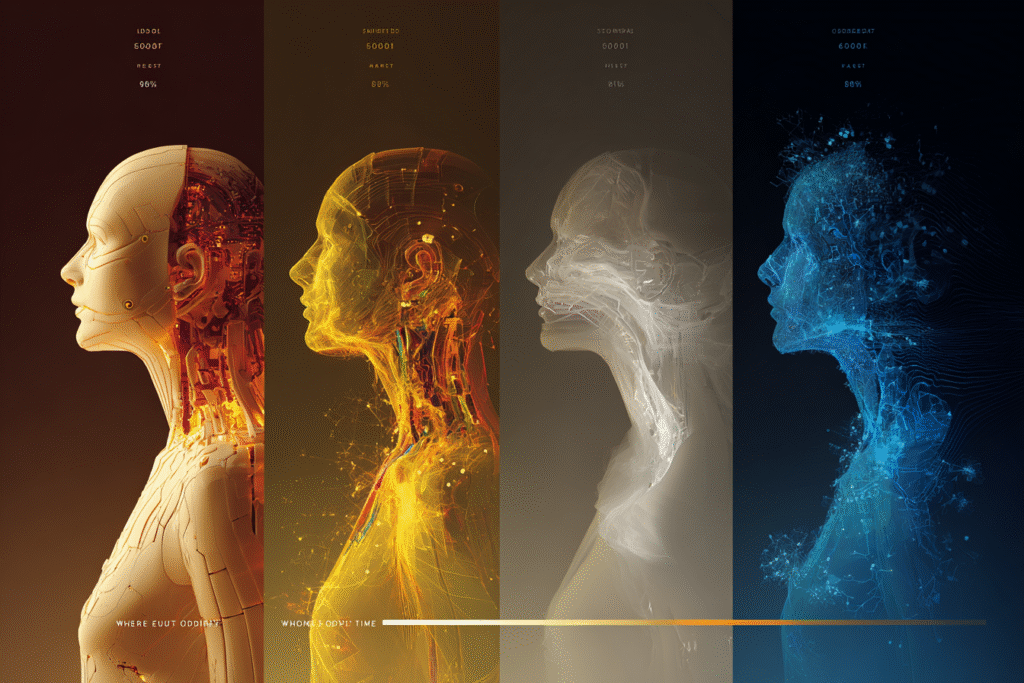
The more likely path: gradual augmentation. AI systems enhance memory, accelerate processing, expand sensory bandwidth. At what percentage augmentation does human consciousness transform into something else? 10%? 50%? Is there a threshold, or is it gradual?
Scenario 3: Digital Transfer
The most radical possibility: consciousness fully transferred to digital substrate. While sociologists note that awareness of mortality shapes human behavior, with potential social changes needed to accommodate immortal populations [12], questions remain about whether digital consciousness constitutes continuity or copies. Would you be immortal, or would a copy that believes it’s you be immortal while you died?
The Psychological Reality
Theory aside, what does existing research reveal about the actual psychological experience of extended life?
Extended life could bring emotional isolation and loneliness as loved ones and family members age and die while others remain, with these psychological burdens potentially proving harder to manage than anticipated [5]. Every relationship becomes temporary. Every connection exists with the shadow knowledge that you’ll outlive it—perhaps many times over.
Research on personality and longevity shows that conscientiousness, extraversion, and purpose all contribute to extended healthy life, with purpose predicting health outcomes above and beyond conscientiousness [9]. But these traits evolved in populations expecting 70-year lifespans. How do they function across 200 years?
The data suggests something counterintuitive: extended life doesn’t amplify our existing consciousness—it demands its evolution. Like the organism that transitions from land to water, consciousness adapting to century-scale lifespans must develop new structures, new patterns, new ways of organizing experience and meaning.

What Changes, What Persists
Days 145-147 established three principles: baseline capabilities are expanding (Day 145), identity can persist across substrate change (Day 146), and integration can occur without loss (Day 147). The longevity-consciousness intersection tests all three.
On Baseline Capabilities:
Scientists debating life extension note that understanding species-specific life span determination is critical, with some arguing we should focus on extending healthspan rather than trying to extend life indefinitely [6]. Perhaps consciousness evolution doesn’t mean living forever—it means maximizing the awareness we can achieve within our given timeframe, however extended.
On Identity Persistence:
The Ship of Theseus doesn’t break at any specific point. Perhaps consciousness across centuries maintains continuity not through unchanging essence, but through continuous self-narration. You’re not the person you were at 30 when you’re 180—but you remember being that person, and you’ve integrated their experiences into who you’ve become.
On Integration Without Loss:
Critics of radical life extension note that natural life cycles including death play vital roles in human society and biology, ensuring resource availability for new generations, driving cultural progress, and sustaining evolutionary processes. Perhaps the question isn’t whether individuals can live forever without loss, but whether humanity can evolve without the creative destruction of generational turnover.
The Consciousness of Longevity
So what happens to human consciousness across centuries of life?
The honest answer: we don’t know. We can’t know—not yet. No human has lived 150 years with a biologically young body. No consciousness has navigated 200 years of continuous awareness. We’re theorizing about an experience we cannot access.
But we can make educated guesses based on what we know about consciousness, time, and human psychology:
Consciousness will reorganize, not merely expand. Like water transitioning to ice, it will maintain continuity while fundamentally restructuring.
Meaning-making systems will need wholesale reinvention. What motivates consciousness across centuries won’t resemble what motivates it across decades.
The self/other boundary may need redefinition. When everyone you knew at 30 is dead by 130, and everyone you knew at 130 is dead by 230, individual identity may necessarily expand or transform to maintain coherence.
Temporal resolution will increase dramatically. Pattern recognition across centuries creates perceptual capabilities impossible for shorter lifespans—potentially approaching a form of historical wisdom we currently can’t conceive.
The longevity-consciousness intersection isn’t about whether we should extend life indefinitely—though that ethical question matters enormously. It’s about recognizing that extended life isn’t merely more life.
It’s different life, demanding evolved consciousness.
If we achieve it, we won’t simply be humans who live longer. We’ll be something that began as human, navigating an existence our evolutionary history never prepared us for, developing forms of awareness our ancestors couldn’t imagine.
The question isn’t whether consciousness can survive 200 years. The question is: what does it become?
See you in the next insight.
Comprehensive Medical Disclaimer: The insights, frameworks, and recommendations shared in this article are for educational and informational purposes only. They represent a synthesis of research, technology applications, and personal optimization strategies, not medical advice. Individual health needs vary significantly, and what works for one person may not be appropriate for another. Always consult with qualified healthcare professionals before making any significant changes to your lifestyle, nutrition, exercise routine, supplement regimen, or medical treatments. This content does not replace professional medical diagnosis, treatment, or care. If you have specific health concerns or conditions, seek guidance from licensed healthcare practitioners familiar with your individual circumstances.
References
The references below are organized by study type. Peer-reviewed research provides the primary evidence base, while systematic reviews synthesize findings.
Peer-Reviewed / Academic Sources
- [1] Hill, P.L., et al. (2011). Conscientiousness and longevity: An examination of possible mediators. PMC. https://pmc.ncbi.nlm.nih.gov/articles/PMC3587967/
- [2] Boeree, G. (2003). Psychology, meaning and the challenges of longevity. ScienceDirect. https://www.sciencedirect.com/science/article/abs/pii/S0016328702001076
- [3] Lang, F.R., & Rupprecht, F.S. (2019). Motivation for Longevity Across the Life Span: An Emerging Issue. PMC. https://pmc.ncbi.nlm.nih.gov/articles/PMC6585880/
- [4] Blouin-Hudon, E.-M.C., & Zelenski, J.M. (2020). The Mental Landscape of Imagining Life Beyond the Current Life Span: Implications for Construal and Self-Continuity. PMC. https://pmc.ncbi.nlm.nih.gov/articles/PMC7447858/
- [5] Fernández-Ballesteros, R., et al. (2019). Are Psycho-Behavioral Factors Accounting for Longevity? PMC. https://pmc.ncbi.nlm.nih.gov/articles/PMC6867970/
- [6] Olshansky, S.J., et al. (2025). From Life Span to Health Span: Declaring “Victory” in the Pursuit of Human Longevity. PMC. https://pmc.ncbi.nlm.nih.gov/articles/PMC10116038/
- [7] Marino, N., et al. (2023). Towards AI-driven longevity research: An overview. PMC. https://pmc.ncbi.nlm.nih.gov/articles/PMC10018490/
Government / Institutional Sources
- [8] Pew Research Center. (2024). To Count Our Days: The Scientific and Ethical Dimensions of Radical Life Extension. https://www.pewresearch.org/religion/2013/08/06/to-count-our-days-the-scientific-and-ethical-dimensions-of-radical-life-extension/
Industry / Technology Sources
- [9] Shpancer, N. (2021). One Personality Trait Predicts Longevity More Than Others—But Why? Psychology Today. https://www.psychologytoday.com/us/blog/insight-therapy/202102/one-personality-trait-predicts-longevity-more-others-why
- [10] iResearchNet. (2025). Longevity and Life Satisfaction – Health Psychology. https://psychology.iresearchnet.com/health-psychology/aging/longevity-and-life-satisfaction/
- [11] Reese, B. (2025). Humans Could Live For 1,000 Years by 2050. Popular Mechanics. https://www.popularmechanics.com/science/a65637132/immortality-singularity/
- [12] Grig, A. (2025). AI and the Quest for Immortality: Can Machines Help Us Live Forever? Medium. https://aliyagrig.medium.com/ai-and-the-quest-for-immortality-can-machines-help-us-live-forever-7478a41a3237
- [13] Kurzweil, R. (2024). AI can radically lengthen your lifespan. Fortune Well. https://fortune.com/well/article/a-i-radically-lengthen-lifespan-ray-kurzweil/