Consciousness learned to survive by thinking together. Now it’s learning to think as one distributed system that spans biology and code.
Note: This article is for educational and informational purposes only. See full disclaimer at the end.
Your consciousness evolved to navigate the world as an individual—but what happens when it learns to merge with others into something that thinks, adapts, and creates beyond what any single mind could achieve?
The architecture emerging around us isn’t just networks of connected individuals. It’s the scaffolding for genuine collective intelligence: systems where individual consciousness extends naturally into shared awareness, where your thoughts become part of a larger cognitive system, and where the boundaries between human and machine intelligence begin to dissolve in service of problems neither could solve alone.
This isn’t science fiction. The infrastructure for collective consciousness is being built right now, one interaction at a time.

From Individual Minds to Collective Emergence
Your consciousness—refined over thousands of days if you’re following this series, or perhaps just beginning its intentional evolution—wasn’t designed to operate in isolation. The human brain developed its remarkable capabilities precisely because we needed to coordinate, cooperate, and think together [1].
Individual intelligence created tools. Collective intelligence built civilizations.
But here’s what’s different about the collective intelligence emerging today: it’s no longer limited by the speed of speech, the reach of written language, or even the bandwidth of digital networks. AI systems are becoming active participants in collective cognition, not just tools we use but thinking partners that amplify, translate, and coordinate human intelligence at scales previously impossible [2].
When Bellingcat investigators combine human judgment with AI analysis to detect deepfakes, they’re not using AI as a tool—they’re creating a hybrid cognitive system that outperforms either humans or AI operating alone [1]. The human brings pattern recognition refined by evolution. The AI brings processing power that can analyze millions of data points simultaneously. Together, they create something new: a form of intelligence that emerges from their interaction.
This is collective intelligence architecture in action. And it’s just the beginning.
The Architecture of Shared Mind
Think about how ants build complex structures without blueprints, how they optimize foraging paths without central planning, how they make decisions as a colony that no individual ant comprehends. They use stigmergy—a form of coordination where actions leave traces in the environment that guide subsequent actions [5].
The digital world has created new forms of stigmergy. When you edit a Wikipedia article, upvote a helpful comment, or contribute code to an open-source project, you’re leaving traces that guide others. You’re participating in collective intelligence that emerges not from central control but from millions of individual contributions responding to each other’s digital footprints [3].
Now add AI to this equation.
AI systems don’t just process these digital traces—they begin to understand them, respond to them, predict from them, and create new traces that influence human behavior. The result is a multi-layered network of intelligence where humans and AI agents interact across cognitive, physical, and information layers simultaneously [4].
Your consciousness, once bounded by your skull, now extends into systems where thoughts become data, data becomes patterns, patterns become predictions, and predictions guide the next thought—yours or someone else’s, human or machine.
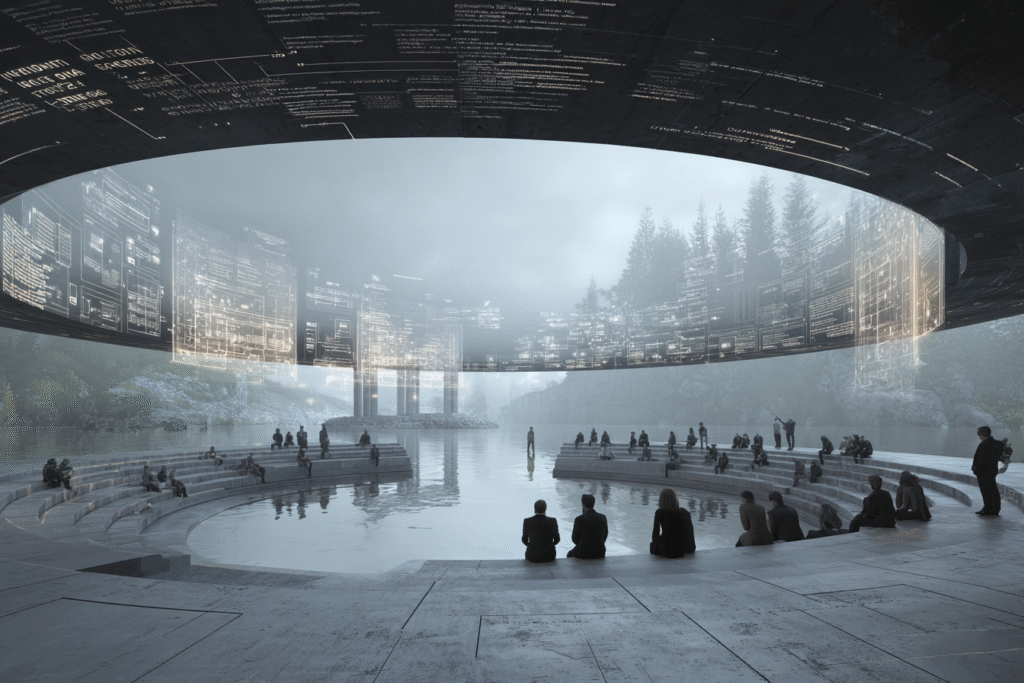
Where Individual Consciousness Extends
The longevity consciousness we explored yesterday—the awareness that emerges when you might live 150 years—doesn’t just transform your individual timeline. It changes how your consciousness participates in collective systems.
When you know you might live long enough to see your contributions compound over decades, you invest differently in collective intelligence. You build systems designed to evolve beyond your direct participation. You create architecture for consciousness that persists.
This is where individual and collective intelligence merge: your extended consciousness becomes part of a larger thinking system that includes:
Collective Memory: The ability of groups to store, access, and build upon information across time and individuals. Wikipedia represents one form. Open-source code repositories represent another. AI models trained on human knowledge represent a third [2].
Collective Attention: Systems that help groups focus on what matters most. Reddit’s upvote system is primitive collective attention. AI-curated feeds are more sophisticated. Emerging systems that combine human intuition with AI analysis of what deserves collective focus represent the next evolution [1].
Collective Reasoning: The capacity for groups to think through complex problems by combining diverse perspectives. This isn’t just voting or averaging—it’s genuine emergence of solutions that no individual conceived [2].
When AI participates in these processes, it doesn’t replace human contribution. It amplifies, translates, and coordinates at scales that unlock new forms of collective intelligence [6].
Your Mind in the Network
Imagine you’re working on a complex problem—climate adaptation strategies for coastal cities, perhaps. You’re one person with one perspective, one knowledge base, one set of experiences.
Now imagine your thinking becomes visible as data. Not your thoughts themselves, but your patterns of inquiry, your areas of focus, your questions. AI systems monitor these patterns across thousands of researchers working on similar problems. They identify complementary thinking styles, knowledge gaps, overlapping insights.
The AI doesn’t tell you what to think. It connects you with the three researchers whose thinking patterns would most productively challenge yours. It surfaces the questions you haven’t thought to ask yet. It translates insights from disciplines you don’t speak the language of. It coordinates attention across the entire network toward the insights gaining the most traction.
Your individual consciousness remains yours. But it’s now participating in a larger cognitive system where individual and collective intelligence amplify each other.
This is happening already in scientific research networks, in open-source development communities, in online creative collaborations. The Collective Intelligence Project uses AI-enabled deliberation to engage thousands of people in shaping AI governance, creating systems where collective wisdom emerges from structured participation [7].

The Architecture of Concerns
Let’s be direct: collective intelligence systems create real risks.
Loss of individuality isn’t paranoia—it’s a genuine concern. When your thinking becomes visible data that influences others, when AI systems nudge your attention toward collective priorities, when participation in shared consciousness becomes necessary for relevance, the pressure to conform becomes architectural, not just social [3].
In studies of human stigmergic interactions, researchers found that individuals can be classified into three behavioral profiles based on their degree of cooperation—and that competitive conditions prompt deceptive contributions [3]. When the system rewards conformity, collective intelligence can suppress the diversity it needs to function.
Manipulation becomes easier at scale. The same mechanisms that help collective intelligence emerge—digital traces, AI-mediated coordination, feedback systems—can be exploited to steer collective attention, amplify particular viewpoints, or suppress dissent. The architecture of collective intelligence is also the architecture of collective control.
These aren’t theoretical risks. They’re already visible in social media recommendation systems, in AI-generated content that shapes public discourse, in algorithmic amplification of engagement over truth.
The question isn’t whether to build collective intelligence systems. They’re being built. The question is whether we build them with intentional architecture that preserves individual sovereignty while enabling collective emergence—or whether we let them evolve without conscious design.
Opportunities in Conscious Architecture
But here’s what makes this moment unique: we can design collective intelligence architecture consciously.
The research on hybrid intelligence offers clear principles [6]:
Double literacy: Understanding both human cognitive processes and AI mechanisms allows us to design systems that honor what makes human consciousness unique while leveraging what AI does best.
Complementary capabilities: Humans bring intuition, creativity, ethical reasoning, and contextual understanding. AI brings computational power, pattern recognition at scale, and consistency. Collective intelligence emerges when these capabilities enhance rather than replace each other.
Transparent coordination: The best collective intelligence systems make their coordination mechanisms visible. You understand how your contributions are being processed, how AI is mediating interactions, where collective patterns are emerging from individual inputs.

Consider how GitHub coordinates millions of developers. The system doesn’t dictate what to build. It provides infrastructure for collective creation where individual contributions remain attributed, where coordination emerges from transparent interaction, where AI assists without controlling.
Or consider how Wikipedia coordinates collective knowledge. The architecture preserves individual contributions, makes editing history visible, and uses both human oversight and AI assistance to maintain quality. It’s not perfect, but it demonstrates that collective intelligence can emerge without erasing individual consciousness.
The emerging field researchers call COHUMAIN (Collective Human-Machine Intelligence) is explicitly working on architectures where AI agents are designed to foster collective intelligence rather than replace it [2]. These systems break down collective intelligence into coordinated memory, attention, and reasoning—creating scaffolding for shared consciousness that preserves individual agency.
Questions for Your Consciousness
As your individual consciousness considers participating in collective intelligence systems:
Where does your thinking already extend beyond your individual mind? What collaborative systems do you already participate in—professional networks, open-source projects, creative communities? How does your consciousness already operate collectively?
What would need to be true for you to trust your consciousness in a hybrid system? What transparency, what control, what safeguards would you require before allowing AI to mediate your participation in collective intelligence?
How do you distinguish between healthy collective emergence and coercive conformity? What would it feel like to participate in genuine collective intelligence versus being manipulated by systems that exploit collective coordination mechanisms?
If you’re building for a 150-year consciousness span, how do you invest in collective intelligence architecture? What systems would you want to exist, what values would you want embedded, what protections would you want built in?
These aren’t hypothetical questions. The collective intelligence systems being architected today will shape how human consciousness operates for generations. Your individual consciousness—refined through intentional evolution—matters to how these systems develop.

The Natural Extension
In the last insight we explored how your consciousness must reorganize to embrace radical longevity. Today we see how that extended consciousness naturally participates in larger thinking systems.
Individual consciousness evolved collective capabilities because our survival depended on coordination. Now consciousness itself is becoming collective in new ways—ways that include non-biological intelligence as active participants, not just tools.
The architecture emerging is neither purely human nor purely artificial. It’s hybrid, collective, and genuinely new: a form of intelligence where individual minds extend into shared consciousness, where human intuition combines with AI capability, where problems too complex for individual or artificial intelligence alone become solvable through conscious collaboration.
This is collective intelligence architecture. And your consciousness—however you’ve evolved it—is already participating in its construction, one interaction at a time.
The question isn’t whether you’ll be part of collective intelligence systems. The question is whether you’ll participate consciously in architecting them, or whether you’ll let your extended consciousness merge into systems designed without your input.
Your individual awareness matters precisely because it’s becoming collective.
See you in the next insight.
Comprehensive Medical Disclaimer: The insights, frameworks, and recommendations shared in this article are for educational and informational purposes only. They represent a synthesis of research, technology applications, and personal optimization strategies, not medical advice. Individual health needs vary significantly, and what works for one person may not be appropriate for another. Always consult with qualified healthcare professionals before making any significant changes to your lifestyle, nutrition, exercise routine, supplement regimen, or medical treatments. This content does not replace professional medical diagnosis, treatment, or care. If you have specific health concerns or conditions, seek guidance from licensed healthcare practitioners familiar with your individual circumstances.
References
The references below are organized by study type. Peer-reviewed research provides the primary evidence base, while systematic reviews synthesize findings.
Peer-Reviewed / Academic Sources
- [1] He, Z., Zhang, H., & Li, S. (2024). AI-enhanced collective intelligence. PMC. https://pmc.ncbi.nlm.nih.gov/articles/PMC11573907/
- [2] Gupta, M., et al. (2023). Fostering Collective Intelligence in Human–AI Collaboration: Laying the Groundwork for COHUMAIN. Topics in Cognitive Science. https://onlinelibrary.wiley.com/doi/10.1111/tops.12679
- [3] Bassanetti, T., et al. (2023). Cooperation and deception through stigmergic interactions in human groups. PNAS. https://www.pnas.org/doi/abs/10.1073/pnas.2307880120
- [4] He, Z., Zhang, H., & Li, S. (2024). AI-enhanced collective intelligence. ScienceDirect. https://www.sciencedirect.com/science/article/pii/S2666389924002332
Industry / Technology Sources
- [5] Wikipedia. (2025). Stigmergy. Wikipedia. https://en.wikipedia.org/wiki/Stigmergy
- [6] Walther, C. C. (2025). Why Hybrid Intelligence Is the Future of Human-AI Collaboration. Knowledge at Wharton. https://knowledge.wharton.upenn.edu/article/why-hybrid-intelligence-is-the-future-of-human-ai-collaboration/
- [7] Collective Intelligence Project. (2024). CIP Annual Report 2024. CIP. https://2024.cip.org/