When AI touches creativity, we fear the soul disappears, but what if it’s actually being amplified?
Note: This article is for educational and informational purposes only. See full disclaimer at the end.
You’re watching your favorite creator’s latest video when something feels different—the lighting is perfect, the audio crystal clear, every word precisely articulated. Then you notice the small label: “Enhanced with AI.”
For a moment, you wonder: is this still their authentic voice, or have you been listening to a beautifully crafted illusion?
This question haunts every creator working with AI tools today.
The fear runs deep: that by embracing artificial intelligence in our creative process, we somehow sacrifice the soul of our work, trading authenticity for efficiency.
But what if this binary thinking—human or machine, authentic or artificial—is the real illusion?
The Amplifier, Not the Replacement
When The Beatles released “Now And Then” in November 2023, it marked a historic moment in music. The song, which won a Grammy in 2025, used AI to isolate John Lennon’s voice from a demo recording so intertwined with noise and piano that it was previously unusable [3]. Was this artificial? Absolutely. Was it authentic? The two surviving Beatles would argue yes—AI didn’t create Lennon’s voice; it revealed what was already there, buried beneath decades of degradation.
This distinction matters. Holly Herndon, the experimental musician who has pushed the boundaries of AI collaboration, created an AI named Spawn that she treats as a member of her ensemble. “There’s something freeing about not having to make every single microdecision,” she explains, “but rather, creating an ecosystem where things tend to happen” [7]. The key word here is creating—Herndon remains the architect of the experience, even as she shares the creative process with her artificial collaborator.
The musician Arca, who has worked with Björk and Kanye West, puts it even more boldly: “It’s provided me a sense of relief and excitement that not everything has been done—that there’s a wide-open horizon of possibility” [7]. For these artists, AI isn’t diminishing their authenticity; it’s expanding their creative vocabulary.
The Transparency Paradox
Yet transparency about AI use creates its own challenges. Research from 2025 reveals a troubling finding: actors who disclose their AI usage are trusted less than those who don’t, even when that usage is minimal or enhances rather than replaces human creativity [1]. This “transparency dilemma” puts creators in an impossible position—be honest and lose trust, or stay silent and risk later exposure.
The irony is palpable. In an era where 60% of musicians are already using AI tools in their projects [8], and 60 million people used AI to create music in 2024 alone [9], the stigma around disclosure seems increasingly disconnected from reality. We’re all swimming in synthetic media whether we know it or not—82% of listeners already can’t tell the difference between AI-generated and human-composed music [8].
This creates what one researcher at KUNGFU.AI calls a “troubling cycle”: the systems optimized to capture our attention may simultaneously diminish our capacity for authentic expression [10]. But does using these tools mean surrendering our authenticity, or could it mean something else entirely?
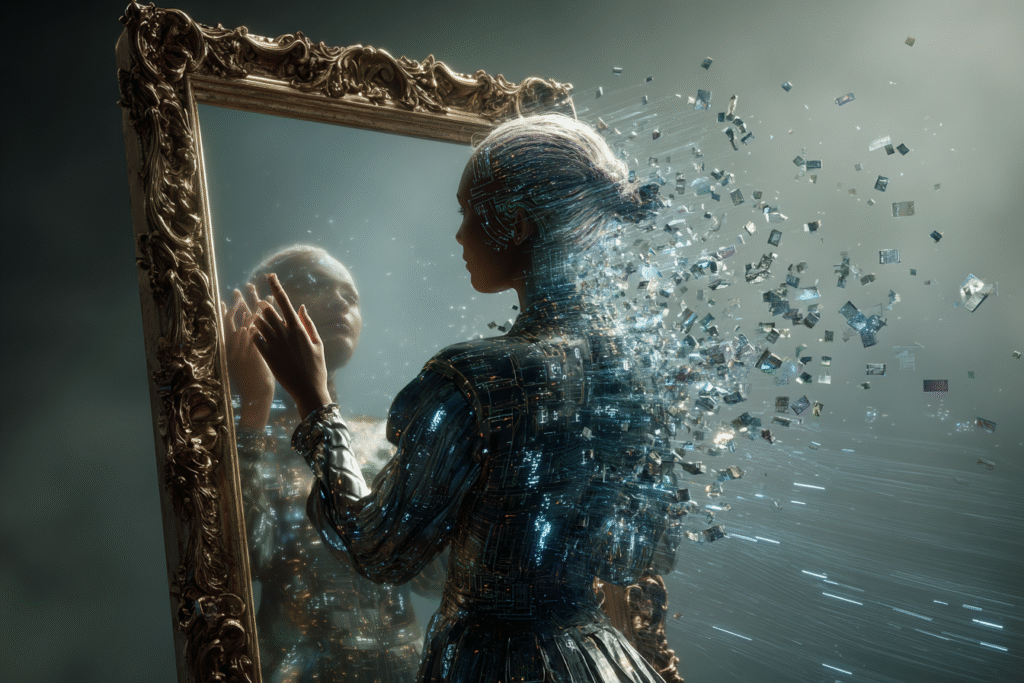
The Soul in the Machine
Shane Tepper, a writer who used AI to help create a book, offers a different perspective: “Generative AI tools can now serve as sophisticated partners that analyze writing patterns, identify stylistic strengths, and help transform personal perspectives into structured intellectual assets” [11]. The crucial insight is that AI analyzed and amplified his existing voice rather than replacing it with something generic.
This aligns with findings from MIT’s research on AI in creative fields. The technology works best as what researchers call a “high-tech paintbrush”—it can splash colors in ways we never dreamed of, but without the artist’s hand to guide it, it’s just splattering paint [12]. The magic happens when human imagination uses AI to create something neither could achieve alone.
Consider video creator Jesse Butler’s experiment comparing AI-generated videos with traditional content. His conclusion was unequivocal: “AI is a powerful tool, just not a replacement for human creativity” [13]. The AI-generated content lacked what he called “soul, spontaneity, and personality”—qualities that emerged only when he used AI as a support system rather than a content creator.
The Authenticity Spectrum
Perhaps we need to reconceptualize authenticity itself. As participants in a KUNGFU.AI study noted, transparency about AI use changes everything: “I don’t like being deceived… if a movie at the end credits says no generative AI used or has some generative AI disclosure—that’s a big distinction for me” [10].
This suggests authenticity isn’t about avoiding AI—it’s about honest engagement with it. Grimes exemplifies this approach by openly sharing her AI voice for others to use, splitting royalties 50-50 with creators who generate songs with it [14]. She’s not hiding behind the technology; she’s making it part of her artistic identity.
The film industry is grappling with similar questions. At the 2025 Venice Film Festival’s AI competition, filmmakers were challenged to demonstrate how AI could create “authentic and emotionally engaging” films [15]. The winning entries didn’t use AI to replace human creativity but to explore new frontiers in storytelling that wouldn’t be possible without it.
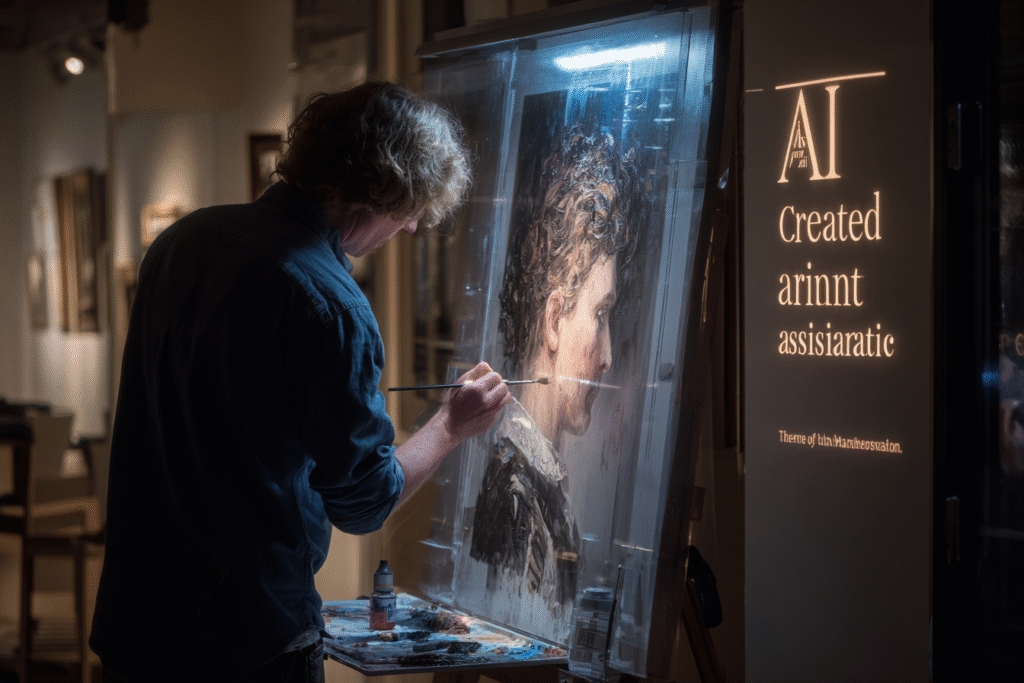
The Creative Responsibility
But with this power comes responsibility. The controversy at Cannes Lions 2025—where a campaign was withdrawn after AI-generated imagery was submitted as “original photography” without disclosure—serves as a cautionary tale [16]. The issue wasn’t the use of AI; it was the deception about its use.
California’s new AI Transparency Act, taking effect in 2026, will require AI systems to include both visible and embedded disclosures in generated content [4]. TikTok has already rolled out AI-generated content labels, recognizing that “AI enables incredible creative opportunities, but can potentially confuse or mislead viewers if they’re not aware content was generated or edited with AI” [17].
Yet research from Nature Anthropology suggests we might be thinking about this all wrong. Drawing on neuropsychology and hemispheric brain theory, researchers argue that “AI does not replace human creativity but rather augments it, offering novel tools for artistic exploration” [2]. The key is maintaining what they call the balance between left-hemisphere analytical processing (which AI excels at) and right-hemisphere creative synthesis (which remains distinctly human).
Finding Your Voice Through the Algorithm
How do creators maintain authenticity while leveraging AI’s capabilities? The answer lies in treating AI as what one researcher calls “consulting… almost like a group of people giving me ideas” while maintaining “a critical eye” on everything it produces [10].
Writer and creative Sam’s journey illustrates this perfectly. Initially skeptical about AI eroding their creative touch, they discovered that AI tools for automated editing and caption generation freed them to focus on what mattered most: storytelling [18]. The tools handled the grunt work while Sam provided the soul.
This mirrors findings across creative industries. In electronic music, 54% of producers have adopted AI tools, not to replace their creativity but to explore sonic territories they couldn’t access before [8]. They’re using AI to generate new soundscapes while maintaining artistic control over how those sounds serve their vision.
The Depth Beneath the Surface
The real danger isn’t AI replacing human creativity—it’s humans surrendering their judgment to the machine. As one Medium writer warns, “Over-reliance on AI can result in content that feels generic and lacks emotional depth” [19]. The sweet spot lies in what researchers call “hybrid approaches”: AI assists, but humans remain at the core of great content.
Musicians understand this intuitively. When 36.8% of music producers integrate AI into their workflow, they’re not letting it compose for them—they’re using it for mixing, mastering, and exploring variations [8]. The emotional core, the artistic vision, the thing that makes listeners feel something—that remains irreducibly human.
This is why Sudowrite, an AI writing tool for fiction authors, has gained such traction. It has “an intuitive understanding of scene structure and blocking that most other AI tools don’t seem to have,” but writers use it as a collaborator, not a replacement [20]. The AI suggests; the human decides. The AI generates options; the human chooses which path serves the story.
The Evolution of Authentic
What we’re witnessing isn’t the death of authenticity but its evolution. Just as photographers once faced criticism for not being “real” artists because they used cameras instead of paintbrushes, today’s AI-enhanced creators face skepticism about whether their work is “really” theirs.
But authenticity has never been about the tools—it’s been about the intention, the vision, and the human choice behind the work. When Paul McCartney used AI to complete that Beatles song, he wasn’t creating something inauthentic; he was using new tools to fulfill an old dream, to finish something he and John had started decades ago.
The Federal Trade Commission’s guidance on AI disclosure gets at something important: transparency is required when “the average consumer would assume a human marketer created the content” [21]. But what happens when AI assistance becomes so ubiquitous that the assumption flips? When not using AI becomes the exception rather than the rule?
Your Truth, Amplified
We stand at a crossroads. On one path lies the fear that AI will homogenize creativity, reducing all expression to algorithmic patterns. On the other lies the possibility that these tools could help more people express their authentic selves than ever before—breaking down technical barriers that have kept voices silent.
The choice isn’t whether to use AI—that ship has sailed. The choice is how to use it authentically. As IBM’s research on AI transparency notes, “A high level of transparency is essential to responsible AI” [5]. But transparency alone isn’t enough. We need what Partnership on AI calls “a shared visual language for disclosure” [6] and, more importantly, a shared understanding that using AI doesn’t diminish the human element—it can amplify it.
Your voice, your perspective, your lived experience—these are things no AI can generate. But AI can help you express them more clearly, share them more widely, and explore them more deeply than ever before. The question isn’t whether you’ll lose your soul to the machine. The question is: what truth have you been unable to express that AI might help you finally share with the world?
The creators who thrive in this new landscape won’t be those who resist AI or those who surrender to it, but those who learn to dance with it—maintaining their authentic voice while embracing new modes of expression. They’ll be the ones who understand that in the age of synthetic media, authenticity isn’t about avoiding artificial tools; it’s about using them to become more genuinely, powerfully, unmistakably yourself.
See you in the next insight.
Comprehensive Medical Disclaimer: The insights, frameworks, and recommendations shared in this article are for educational and informational purposes only. They represent a synthesis of research, technology applications, and personal optimization strategies, not medical advice. Individual health needs vary significantly, and what works for one person may not be appropriate for another. Always consult with qualified healthcare professionals before making any significant changes to your lifestyle, nutrition, exercise routine, supplement regimen, or medical treatments. This content does not replace professional medical diagnosis, treatment, or care. If you have specific health concerns or conditions, seek guidance from licensed healthcare practitioners familiar with your individual circumstances.
References
The references below are organized by study type. Peer-reviewed research provides the primary evidence base, while systematic reviews synthesize findings.
Peer-Reviewed / Academic Sources
- [1] ScienceDirect, (2025). The transparency dilemma: How AI disclosure erodes trust. Journal of Experimental Social Psychology. https://www.sciencedirect.com/science/article/pii/S0749597825000172
- [2] SCIEPublish, (2025). The Emerging “AI Artists”: Breaking the Metacrisis and the Fear of Losing Human Creativity. Nature Anthropology. https://www.sciepublish.com/article/pii/418
Government / Institutional Sources
- [3] Ohio University, (2025). How AI is transforming the creative economy and music industry. Ohio University News. https://www.ohio.edu/news/2024/04/how-ai-transforming-creative-economy-music-industry
- [4] Mayer Brown, (2024). New California Law Will Require AI Transparency and Disclosure Measures. Mayer Brown Insights. https://www.mayerbrown.com/en/insights/publications/2024/09/new-california-law-will-require-ai-transparency-and-disclosure-measures
- [5] IBM, (2025). What Is AI Transparency? IBM Think. https://www.ibm.com/think/topics/ai-transparency
- [6] Partnership on AI, (2024). 10 Things You Should Know About Disclosing AI Content. Partnership on AI. https://partnershiponai.org/10-things-you-should-know-about-disclosing-ai-content/
Industry / Technology Sources
- [7] TIME, (2020). Musicians Using AI to Create Otherwise Impossible New Songs. TIME Magazine. https://time.com/5774723/ai-music/
- [8] Artsmart.ai, (2024). AI in Music Industry Statistics 2025: Market Growth & Trends. Artsmart.ai. https://artsmart.ai/blog/ai-in-music-industry-statistics/
- [9] DJ Mag, (2025). 60 million people used AI to create music in 2024, IMS Business Report 2025 finds. DJ Magazine. https://djmag.com/news/60-million-people-used-ai-create-music-2024-ims-business-report-2025-finds
- [10] KUNGFU.AI, (2025). AI & Authenticity—What Does It Mean to Be “Real” in 2025? KUNGFU.AI Blog. https://www.kungfu.ai/blog-post/ai-authenticity–what-does-it-mean-to-be-real-in-2025
- [11] Medium, (2025). How I Used AI to Write A Book (While Keeping My Authentic Voice). Medium. https://medium.com/@shaneht/how-i-used-ai-to-write-a-book-while-keeping-my-authentic-voice-7477ec9e662c
- [12] Envato Elements, (2025). Top 12+ AI tools to spark your creativity in 2025. Envato Elements. https://elements.envato.com/learn/creative-ai-tools
- [13] Jesse Butler, (2025). AI vs. Authenticity in Video Creation: Why Real Content Still Wins in 2025. Jesse Butler Thinks. https://jessebutlerthinks.com/ai-vs-authenticity-in-video-creation-why-real-content-still-wins-in-2025/
- [14] Medium, (2024). Why AI Will Never Replace Musicians. Medium. https://musettedc.medium.com/why-artificial-intelligence-will-never-replace-musicians-a03600b0310f
- [15] PYMNTS, (2025). Lights, Camera, Input: Film Festival Celebrates ‘Authentic’ Emotion Generated by AI. PYMNTS.com. https://www.pymnts.com/news/artificial-intelligence/2025/lights-camera-input-film-festival-celebrates-authentic-emotion-generated-ai
- [16] The Drum, (2025). Can your brand prove its content is authentic? The growing pressure for AI transparency. The Drum. https://www.thedrum.com/news/2025/07/10/can-your-brand-prove-its-content-authentic-the-growing-pressure-ai-transparency
- [17] TikTok Newsroom, (2024). New labels for disclosing AI-generated content. TikTok Newsroom. https://newsroom.tiktok.com/en-us/new-labels-for-disclosing-ai-generated-content
- [18] Creators Synergy, (2025). The Future of Content Creation in 2025: How AI is Redefining Creativity. Creators Synergy. https://www.creatorssynergy.com/blog-post/the-future-of-content-creation-in-2025-how-ai-is-redefining-creativity
- [19] WiT Group Agency, (2025). The Future of AI in Content Creation: Advantages, Pitfalls, and What’s Next in 2025. WiT Group Agency. https://witgroupagency.com/future-ai-content-creation-advantages-pitfalls-2025/
- [20] Kindlepreneur, (2025). 15 Best AI Writing Tools for Authors (June 2025 Update). Kindlepreneur. https://kindlepreneur.com/best-ai-writing-tools/
- [21] Upvoty, (2024). Transparency in AI-Generated Content: Disclosure and Labeling Practices. Upvoty Blog. https://www.upvoty.com/blog/transparency-in-ai-generated-content-disclosure-and-labeling-practices