We conquered scarcity, defeated diseases, and connected the globe, yet meaning has never felt more elusive.
Note: This article is for educational and informational purposes only. See full disclaimer at the end.
We have everything and feel nothing. The most prosperous generation in human history reports the highest rates of anxiety and depression ever recorded. We’ve conquered scarcity, defeated countless diseases, and built technologies that would seem miraculous to our ancestors—yet meaning feels more elusive than ever.
This is the paradox defining our age: material abundance has not translated to existential satisfaction. In wealthy nations across the globe, depression rates continue climbing even as GDP soars [10]. Young people in particular face what Jonathan Haidt calls an “epidemic of mental illness,” with rates of anxiety and depression more than doubling since 2010 [19]. We’ve solved the problems our species spent millennia fighting, only to discover that comfort doesn’t create meaning.
The crisis runs deeper than individual psychology. The World Economic Forum’s 2025 Global Risks Report identifies societal polarization and inequality as top interconnected risks, noting how “profound societal fractures” threaten not just personal wellbeing but collective stability [7]. We’re witnessing what Viktor Frankl warned about decades ago: when survival is secured, the question of why we survive becomes unbearable [13].
Yet within this crisis lies opportunity. The same consciousness that creates our existential angst holds the key to transcending it.

The Anatomy of Emptiness
The modern meaning crisis isn’t simply about lacking purpose—it’s about the structures that once provided meaning collapsing faster than we can build replacements. Traditional communities fragmented into digital networks. Sacred rituals replaced by scrolling. The embodied childhood of previous generations gave way to what Haidt terms the “phone-based childhood,” where virtual validation substitutes for real connection [20].
Consider how profoundly our relationship with suffering has changed. Frankl observed in the concentration camps that those who found meaning in their suffering were more likely to survive [2]. “Everything can be taken from a man but one thing,” he wrote, “the last of the human freedoms—to choose one’s attitude in any given set of circumstances” [12]. But what happens when comfort removes suffering from the equation? When there’s nothing to overcome, no clear enemy to fight, no obvious purpose to fulfill?
The result is what Frankl called the “existential vacuum”—a state of emptiness arising when individuals lack purpose [17]. This void manifests in what we see everywhere today: endless consumption that never satisfies, achievement that feels hollow, connection through screens that leaves us lonelier than ever.
Recent data underscores this emptiness. Despite unprecedented material wealth, young people report feeling increasingly disconnected. The number of teenagers spending time with friends in person has plummeted since 2010, while those reporting loneliness has surged [23]. We’ve never been more connected digitally, yet meaningful human connection—the kind that creates genuine meaning—continues declining.
The Consciousness Revolution
The solution emerging across disciplines points to a fundamental shift: from external acquisition to internal cultivation, from having to being, from achievement to awareness. This isn’t about rejecting material progress but recognizing that meaning arises from consciousness itself, not from what consciousness acquires.
Modern neuroscience confirms what contemplatives have long known. Mindfulness meditation physically remodels the brain, strengthening neural pathways associated with awareness, emotional regulation, and wellbeing [27]. A 2018 analysis of over 12,000 participants found mindfulness-based approaches as effective as established treatments for anxiety and depression [9].
But the consciousness solution goes beyond individual practice. It involves recognizing that meaning emerges through three interconnected dimensions that mirror Frankl’s original insights about purpose: creative expression (purposeful work), genuine connection (love), and transformative response to challenge (courage in facing difficulty) [15].
What’s revolutionary is how these ancient pathways to meaning are being validated and amplified by modern understanding. When we engage in mindfulness practice, we’re not just reducing stress—we’re literally rewiring our capacity for presence, connection, and meaning-making [6]. When communities practice together, something even more profound occurs: a collective field of awareness that transcends individual consciousness [4].

Individual Awakening, Collective Transformation
The path through the meaning crisis begins with individual consciousness but doesn’t end there. Each person who develops genuine presence and awareness becomes a node in an emerging network of meaning—not through digital connection but through embodied presence.
During the COVID-19 pandemic, researchers studied online mindfulness communities and discovered something remarkable. Even through screens, groups practicing together reported experiencing “something happening on a subconscious cellular level” when meditating collectively [4]. Participants described feeling more connected not just to each other but to life itself, finding meaning through shared practice even in isolation.
This points to a crucial insight: meaning isn’t something we find or create alone—it emerges through the interplay of individual consciousness and collective field. When one person awakens to deeper presence, they create ripples that affect everyone around them. When communities practice together, they generate fields of coherence that make meaning more accessible to all.
Viktor Frankl understood this deeply. He argued that meaning comes not from focusing on ourselves but from self-transcendence—giving ourselves to causes greater than ourselves or to people we love [18]. “The more one forgets himself,” he wrote, “the more human he is and the more he actualizes himself.”
The Technology Paradox
Ironically, the same technology that contributed to the meaning crisis may help solve it—but only if we fundamentally change our relationship with it. The issue isn’t technology itself but how it’s hijacked our consciousness, fragmenting attention and replacing embodied experience with digital simulation.
Haidt’s research reveals how social media specifically damages meaning-making capacity, especially in young people. The constant comparison, validation-seeking, and attention fragmentation create what he calls “spiritual degradation”—the opposite of the transcendence and connection that generate meaning [19].
Yet technology can also amplify consciousness practices when used skillfully. Apps teaching meditation reach millions who might never find a teacher. Online communities create spaces for shared practice across distances. The key is using technology to enhance rather than replace embodied experience, to connect rather than distract, to deepen rather than fragment consciousness.
The Anxious Generation movement, sparked by Haidt’s work, demonstrates this potential. Thousands of parents, educators, and young people are using digital tools to coordinate returning to “play-based childhoods,” creating phone-free schools, and rebuilding real-world connection [21]. Technology becomes the means to transcend technology’s limitations.

Practical Pathways Forward
The consciousness solution to the meaning crisis isn’t abstract philosophy—it involves concrete practices accessible to anyone. Research consistently shows that even simple mindfulness exercises create measurable improvements in wellbeing, meaning, and life satisfaction [25].
Start with presence. The capacity to fully inhabit the current moment, rather than being pulled into past rumination or future anxiety, forms the foundation of meaning. This doesn’t require hours of meditation—even brief moments of conscious breathing or sensory awareness throughout the day accumulate into transformed consciousness [26].
Cultivate genuine connection. In an age of digital relationships, prioritizing embodied presence with others becomes revolutionary. Eye contact, physical proximity, shared silence—these simple acts of presence generate meaning in ways screens cannot replicate. Research shows that in-person social connection remains irreplaceable for psychological wellbeing, despite technology’s promise of digital substitutes [24].
Embrace chosen challenge. Without the survival challenges that historically provided meaning, we must consciously choose difficulties that stretch us. This might mean creative projects that risk failure, physical endeavors that test limits, or service that demands sacrifice. Frankl discovered that meaning often emerges not despite suffering but through our response to it [11].
Find your why. Frankl emphasized that we cannot create meaning through direct pursuit—happiness ensues from living meaningfully rather than being pursued directly [16]. Instead of asking what life owes us, we must ask what life asks of us. What unique contribution can only you make? What suffering can you help alleviate? What beauty can you bring into being?
Communities of Meaning
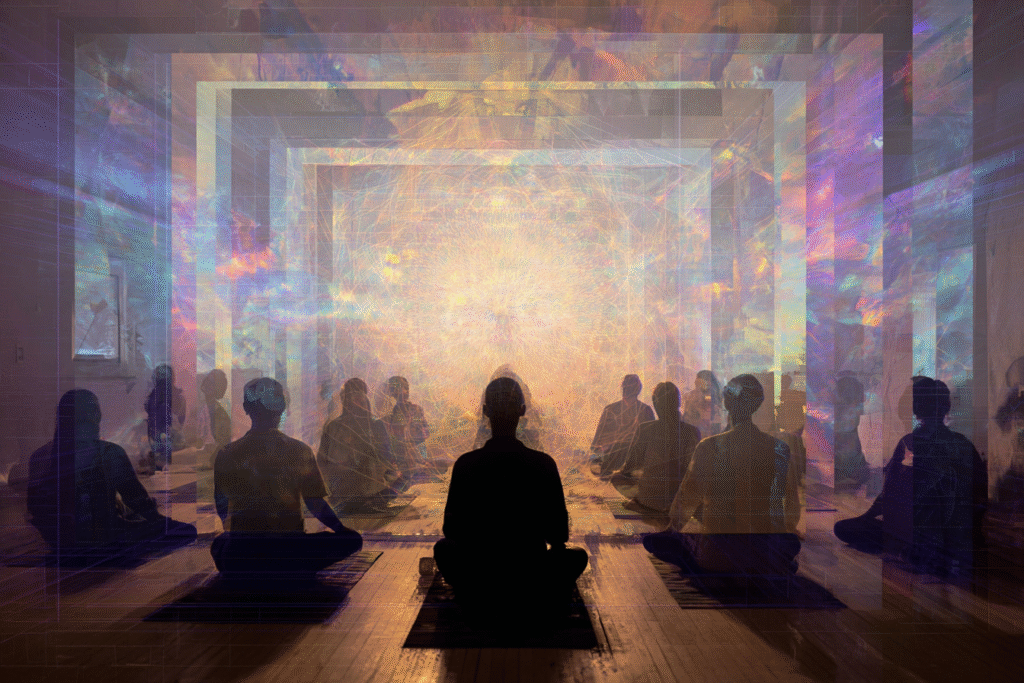
Individual practice alone cannot solve a collective crisis. The meaning emergency requires communities of practice—groups committed to embodied presence, genuine connection, and shared purpose. These aren’t online networks but actual gatherings where people practice together, support each other’s growth, and create fields of meaning through collective consciousness.
Mindfulness communities demonstrate this potential. Participants report that practicing with others, even strangers, generates an energy that amplifies individual practice. “There’s something happening on a subconscious cellular level when people meditate together,” one practitioner observed, describing how collective practice creates meaning unavailable in isolation [4].
This extends beyond formal meditation. Any community organized around shared practice and mutual support becomes a meaning-generating field. Whether it’s artistic creation, environmental restoration, or neighborhood mutual aid, groups that combine individual development with collective purpose offer antidotes to existential vacuum.
The key is balancing individual autonomy with collective coherence. Unlike traditional communities that often demanded conformity, conscious communities celebrate individual uniqueness while recognizing interconnection. Each person’s consciousness development strengthens the whole, while the collective field supports individual growth.
The Evolutionary Moment
We stand at a threshold. The old sources of meaning—survival, tradition, external achievement—no longer sustain us. The new sources—conscious presence, creative expression, genuine connection—await our cultivation. This transition from external to internal, from having to being, from acquisition to awareness, represents not crisis but evolution.
Young people, despite bearing the brunt of the meaning crisis, may be best positioned to lead this transformation. Having grown up with technology’s limitations visible, they’re increasingly choosing real connection over digital validation. The massive response to Haidt’s work, particularly among young adults, suggests readiness for change [22].
What if the meaning crisis isn’t a problem to solve but an invitation to evolve? What if material abundance freed us from survival fears precisely so we could discover deeper purposes? What if the emptiness we feel is not pathology but the void before creation, the silence before the symphony?
Frankl witnessed humanity at its worst yet emerged convinced of our capacity for meaning-making. “Between stimulus and response there is a space,” he observed. “In that space is our power to choose our response. In our response lies our growth and our freedom” [14].
Your Consciousness, Our Future
The meaning crisis is real, urgent, and solvable—but not through external fixes. No amount of achievement, acquisition, or digital connection will fill the existential vacuum. Only consciousness itself, developed individually and expressed collectively, can transform emptiness into meaning.
This doesn’t require perfection or even expertise. It requires only willingness to be present, to connect genuinely, to choose growth over comfort, to serve something beyond yourself. Every moment of conscious presence, every genuine connection, every chosen challenge becomes a thread in the web of meaning we’re weaving together.

The question isn’t whether meaning exists in an age of abundance—it’s whether we’ll do the inner work to access it. Will we continue seeking meaning in all the wrong places, or will we turn toward consciousness itself as the source? Will we remain isolated in our individual struggles, or will we gather in communities of practice that amplify meaning through collective presence?
The choice, as Frankl knew, is always ours. Even in the concentration camps, even in the depths of suffering, the human capacity to choose our response remained intact. How much more so now, with comfort secured and resources abundant, can we choose meaning over emptiness, presence over distraction, connection over isolation?
The consciousness solution isn’t just personal development—it’s collective evolution. Each person who awakens to deeper meaning creates possibilities for others. Each community that practices together generates fields that make transformation easier for all. Each choice for presence over absence, connection over isolation, meaning over emptiness, contributes to solving not just individual crisis but collective challenge.
The tools exist. The practices are proven. The communities are forming. All that remains is choice—your choice—to stop seeking meaning in what you have and start cultivating it in who you are, how you connect, and what you serve.
The meaning crisis ends not when we find the answer but when we become it.
See you in the next insight.
Comprehensive Medical Disclaimer: The insights, frameworks, and recommendations shared in this article are for educational and informational purposes only. They represent a synthesis of research, technology applications, and personal optimization strategies, not medical advice. Individual health needs vary significantly, and what works for one person may not be appropriate for another. Always consult with qualified healthcare professionals before making any significant changes to your lifestyle, nutrition, exercise routine, supplement regimen, or medical treatments. This content does not replace professional medical diagnosis, treatment, or care. If you have specific health concerns or conditions, seek guidance from licensed healthcare practitioners familiar with your individual circumstances.
References
The references below are organized by study type. Peer-reviewed research provides the primary evidence base, while systematic reviews synthesize findings.
Peer-Reviewed / Academic Sources
- [1] National Center for Biotechnology Information. (2022). Wealth and depression: A scoping review. PMC. https://pmc.ncbi.nlm.nih.gov/articles/PMC8933775/
- [2] Bushkin, H., et al. (2022). Searching for Meaning in Chaos: Viktor Frankl’s Story. PMC. https://pmc.ncbi.nlm.nih.gov/articles/PMC8763215/
- [3] Multiple authors. (2025). Beyond mindfulness: how Buddhist meditation transforms consciousness through distinct psychological pathways. Frontiers in Psychology. https://www.frontiersin.org/journals/psychology/articles/10.3389/fpsyg.2025.1649564/full
- [4] Tobias Mortlock, J., Alapati, S., & Edginton, T. (2025). How to create a mindful community of practice: exploring the social functions of group-based mindfulness practices facilitated via Zoom during COVID-19. PMC. https://pmc.ncbi.nlm.nih.gov/articles/PMC11814460/
- [5] Multiple authors. (2022). Reducing and deducing the structures of consciousness through meditation. Frontiers in Psychology. https://www.frontiersin.org/journals/psychology/articles/10.3389/fpsyg.2022.884512/full
- [6] Keng, S. L., Smoski, M. J., & Robins, C. J. (2011). Effects of Mindfulness on Psychological Health: A Review of Empirical Studies. PMC. https://pmc.ncbi.nlm.nih.gov/articles/PMC3679190/
Government / Institutional Sources
- [7] World Economic Forum. (2025). Global Risks Report 2025. https://www.weforum.org/publications/global-risks-report-2025/digest/
- [8] Mayo Clinic. (2022). Mindfulness exercises. https://www.mayoclinic.org/healthy-lifestyle/consumer-health/in-depth/mindfulness-exercises/art-20046356
- [9] National Center for Complementary and Integrative Health. (2025). Meditation and Mindfulness: Effectiveness and Safety. https://www.nccih.nih.gov/health/meditation-and-mindfulness-effectiveness-and-safety
Industry / Technology Sources
- [10] DataPandas. (2025). Depression Rates By Country 2025. https://www.datapandas.org/ranking/depression-rates-by-country
- [11] Pursuit of Happiness. (2023). Viktor Frankl | Happiness and Meaning. https://www.pursuit-of-happiness.org/history-of-happiness/viktor-frankl/
- [12] Wikipedia. (2025). Man’s Search for Meaning. https://en.wikipedia.org/wiki/Man’s_Search_for_Meaning
- [13] PositivePsychology.com. (2025). Logotherapy: Viktor Frankl’s Theory of Meaning. https://positivepsychology.com/viktor-frankl-logotherapy/
- [14] The Meaning Movement. (2025). Viktor Frankl Quotes: 25 Life-Changing Insights on Purpose & Suffering. https://themeaningmovement.com/viktor-frankl-quotes/
- [15] The Marginalian. (2017). Viktor Frankl on the Human Search for Meaning. https://www.themarginalian.org/2013/03/26/viktor-frankl-mans-search-for-meaning/
- [16] Sandstone Psychology. (2024). Viktor Frankl: A Journey from Despair to Meaning. https://www.sandstonepsychology.org/viktor-frankl-a-journey-from-despair-to-meaning/
- [17] Achology. (2024). Finding life’s purpose with Viktor Frankl’s Man’s Search for Meaning. https://achology.com/psychology/finding-lifes-purpose-with-viktor-frankls-mans-search-for-meaning/
- [18] HowStuffWorks. (2024). Viktor Frankl’s ‘Search for Meaning’ in 5 Enduring Quotes. https://history.howstuffworks.com/historical-figures/viktor-frankl.htm
- [19] Wikipedia. (2025). The Anxious Generation. https://en.wikipedia.org/wiki/The_Anxious_Generation
- [20] Jonathan Haidt. (2024). The Anxious Generation. https://jonathanhaidt.com/anxious-generation/
- [21] The Anxious Generation Movement. (2025). The Anxious Generation — from a book to a movement. https://www.anxiousgeneration.com/
- [22] Goodreads. (2025). The Anxious Generation by Jonathan Haidt. https://www.goodreads.com/book/show/171681821-the-anxious-generation
- [23] Audible. (2025). The Anxious Generation by Jonathan Haidt. https://www.audible.com/blog/summary-the-anxious-generation-by-jonathan-haidt
- [24] Persuasion. (2024). Jonathan Haidt on The Anxious Generation. https://www.persuasion.community/p/haidt
- [25] Psychology Today. (2025). Mindfulness. https://www.psychologytoday.com/us/basics/mindfulness
- [26] Mindworks. (2024). The Meaning of Mindfulness and Awareness. https://mindworks.org/blog/the-meaning-of-mindfulness-and-awareness/
- [27] Mindful. (2025). Getting Started with Mindfulness. https://www.mindful.org/meditation/mindfulness-getting-started/