We treat consciousness as though it appears at birth and vanishes at death, defying the fundamental rules governing every other phenomenon in the universe.
Note: This article is for educational and informational purposes only. See full disclaimer at the end.
In physics, conservation laws are not suggestions—they’re constraints on what reality can do. Energy transforms but never vanishes. Momentum shifts but never disappears. Angular momentum redistributes but never ceases [1]. These aren’t observations about what usually happens; they’re statements about what cannot happen, boundaries on the possible carved into the structure of existence itself.
The universe doesn’t waste anything. It rearranges, redistributes, transforms—but it doesn’t make things from nothing and it doesn’t send things into nonexistence. This principle runs so deep that physicist Emmy Noether proved in 1918 that every conservation law corresponds to a fundamental symmetry in nature’s laws [2]. Time works the same way tomorrow as today? Energy is conserved. Space works the same way here as there? Momentum is conserved. The universe’s consistency with itself demands that certain quantities persist.
But here’s where things get strange: we exempt consciousness from this reasoning. We act as though awareness appears spontaneously when neurons reach sufficient complexity, then vanishes completely when those neurons cease functioning. We treat consciousness as the one phenomenon in the universe that violates the conservation principle—the only thing that can be truly created from nothing and truly destroyed into nothing.
What if that’s wrong?

What Conservation Actually Means
Before we can ask what’s conserved in consciousness, we need clarity about what conservation means in physics. It’s not about things staying the same—it’s about something deeper [3].
When physicists say energy is conserved, they don’t mean your cup of coffee stays hot. They mean the total energy in an isolated system remains constant even as it changes form—from chemical energy to thermal energy to kinetic energy and back. The forms transform, but the fundamental quantity persists [3].
Conservation is about transformation, not stasis. It’s the universe’s accounting system, ensuring that whatever exists now must have existed before in some form, and whatever exists later must exist now in some form. Nothing appears. Nothing disappears. Everything transforms.
This is not faith—it’s testable. When physicist Enrico Fermi studied neutron decay in 1934, his calculations showed the resulting particles had less energy than the original neutron. Rather than abandon conservation, he predicted a third particle no one had detected yet: the neutrino. His faith in conservation led him to predict something invisible. Experiments later confirmed he was right [3].
Conservation laws work because they’re consequences of deeper symmetries. If physical laws don’t change over time, energy must be conserved. If they don’t change across space, momentum must be conserved [2]. Conservation emerges from consistency—from the universe having rules that apply everywhere and always.
So when we ask whether consciousness is conserved, we’re asking: Is awareness subject to the same fundamental consistency that governs everything else? Or is it genuinely exempt from the rules?
The Consciousness Exception
Standard neuroscience treats consciousness as an emergent property of complex systems—something that arises when neurons organize in particular ways [4]. In this view, consciousness appears when sufficient complexity emerges and disappears when that complexity collapses. It’s genuinely created and genuinely destroyed, violating the conservation principle that applies to energy, momentum, and every other physical quantity.
This seems reasonable until you notice what it implies.
If consciousness emerges from neural complexity, then at some point in evolutionary history, the universe went from containing zero consciousness to containing some consciousness. Something genuinely new appeared—a violation of conservation [5]. And when any conscious being dies, something genuinely disappears—another violation.
We don’t see this as problematic because consciousness seems so different from physical quantities. But physicist Sean Carroll points out that if consciousness causally affects the physical world—if your thoughts actually influence your actions—then this interaction should leave physical traces [6]. If awareness can move your hand, it must interface with the same physical laws that govern everything else.
The “consciousness exception” creates what philosophers call the interaction problem: How does something supposedly outside physical law (consciousness) interact with something inside physical law (neurons, muscles, behavior)? Conservation laws are local—they apply everywhere separately, not just to the universe as a whole [1]. If consciousness interacts with matter at specific times and places, it should affect local conservation there and then.
Unless consciousness isn’t an exception at all.
Consciousness as Fundamental
A growing number of physicists and philosophers are exploring a radical alternative: consciousness might be a fundamental aspect of reality, like mass or charge, rather than something that emerges from complexity [5].
This isn’t mysticism—it’s pragmatism. If consciousness is real (and you can’t seriously doubt your own awareness without using that awareness to doubt), and if everything real follows conservation principles, then perhaps consciousness must be conserved too [7].
Panpsychism—the view that consciousness is a fundamental property of matter—proposes that even elementary particles possess incredibly simple forms of experience, and the complex experience of human brains emerges from these fundamental constituents [8] [9]. In this view, consciousness doesn’t appear with evolution—it’s always present, just organized differently in different systems.
Physicist Max Tegmark approaches this differently, suggesting consciousness might be understood as a state of matter, like solid or liquid [10]. Systems demonstrating consciousness have two traits: they store and process large amounts of information, and this information must be integrated into a unified whole. Consciousness, in this view, is a property that certain configurations of matter exhibit—not something created by those configurations.
What these approaches share is treating consciousness as fundamental rather than emergent—subject to conservation rather than exempt from it.
What Cannot Be Created or Destroyed
If consciousness is conserved, what exactly persists?
Not the contents of consciousness—your specific thoughts, memories, and experiences clearly change and decay. Not even the pattern of consciousness—your particular way of being aware evolves throughout life. What might be conserved is something more fundamental: the capacity for awareness itself [11].
Think of it like energy. The specific forms energy takes are constantly changing—electrical energy becomes thermal energy becomes kinetic energy—but the underlying quantity that transforms remains constant. Similarly, the specific contents and patterns of consciousness transform continuously, but perhaps the fundamental capacity for experience persists.
Some researchers propose consciousness is essentially information that maintains coherence [11]. Consciousness arises not when systems run smoothly but when they face unpredictability—when buffering capacity approaches limits and recalibration becomes necessary.
Awareness, in this view, is active recalibration under collapse threat, a self-restoring property that maintains coherence against entropy.
This connects to physicist Leonard Susskind’s “minus-first law”—that information is never lost, not even in black holes [12]. As philosopher John Horgan points out, information requires something to be informed—a mind. If information is conserved, and information presupposes consciousness, then consciousness must in some sense be conserved too [12].
Whether you accept this reasoning or not, it points to something crucial: the deep structure that allows experience to occur might be as fundamental and indestructible as the deep structures that allow energy and momentum to exist.
What Transforms Rather Than Persists
Conservation doesn’t mean permanence of form. When energy transforms from one type to another, the original form genuinely ceases—chemical bonds break, heat dissipates, light scatters. What persists is the underlying quantity, not the particular manifestation.
If consciousness is conserved, your specific configuration of awareness—the particular pattern that makes you you—isn’t guaranteed to persist any more than a particular arrangement of chemical energy is guaranteed to persist. What might persist is the fundamental capacity for experience that your particular awareness expresses [13].
This has profound implications. It means your awareness right now is a transformation of something that existed before, not something genuinely new. And it means your awareness tomorrow will be a transformation of what exists now, not something genuinely destroyed.
It also means consciousness might be reorganized, redistributed, transformed—but not eliminated. Just as energy leaving your body doesn’t vanish but disperses as heat and light, the fundamental awareness expressing itself through your neurons might not vanish at death but transform into other configurations.
This isn’t an argument for any particular afterlife or reincarnation scheme—it’s simply following conservation logic to its conclusion. If awareness is conserved like energy, then it transforms like energy: continuously, inevitably, without creation or destruction.
The Physics of Permanence
What makes something conserved isn’t magic—it’s mathematical necessity arising from symmetry. Noether’s theorem proves that every conservation law corresponds to a symmetry in nature’s laws [14]. Energy is conserved because physical laws don’t change over time. Momentum is conserved because they don’t change across space.
If consciousness is conserved, there should be a corresponding symmetry. What symmetry could that be?
Perhaps it’s the consistency of subjective experience itself—the fact that awareness, wherever and whenever it occurs, has certain fundamental properties. Or perhaps it’s related to information symmetries in quantum mechanics, where the total information content of the universe remains constant even as it reorganizes [12].
Some researchers propose that consciousness maintains coherence through recursive self-regulation, creating a localized zone where mutual information is buffered against collapse [11]. Consciousness, in this view, is where the universe becomes aware of its own balance—a self-restoring mirror of the very field that holds reality together.
This suggests consciousness might be conserved not because it’s a substance but because it’s a necessary feature of any universe that maintains information coherence. Just as energy conservation emerges from temporal consistency, consciousness conservation might emerge from informational consistency.
Living With Uncertainty
We don’t know whether consciousness is conserved. We don’t even know if the question makes sense in its current form. But considering it reveals how radically we’ve exempted awareness from the rules governing everything else.
Either consciousness genuinely violates conservation—appearing from nothing, disappearing into nothing—or it follows the same fundamental principles as every other real phenomenon. If it violates conservation, we need to explain how and why this unique exception exists. If it follows conservation, we need to rethink what consciousness fundamentally is.
The conservation question forces clarity. It makes explicit what we usually leave implicit: our assumptions about whether consciousness is genuinely created by brains or merely organized by them, whether it’s an emergent accident or a fundamental feature, whether it can truly cease or only transform.
Physics teaches us that what cannot be created or destroyed shapes what can happen. Conservation laws aren’t constraints that limit reality—they’re expressions of reality’s deeper consistency. They tell us what the universe is committed to preserving because it must, not because it chooses to.
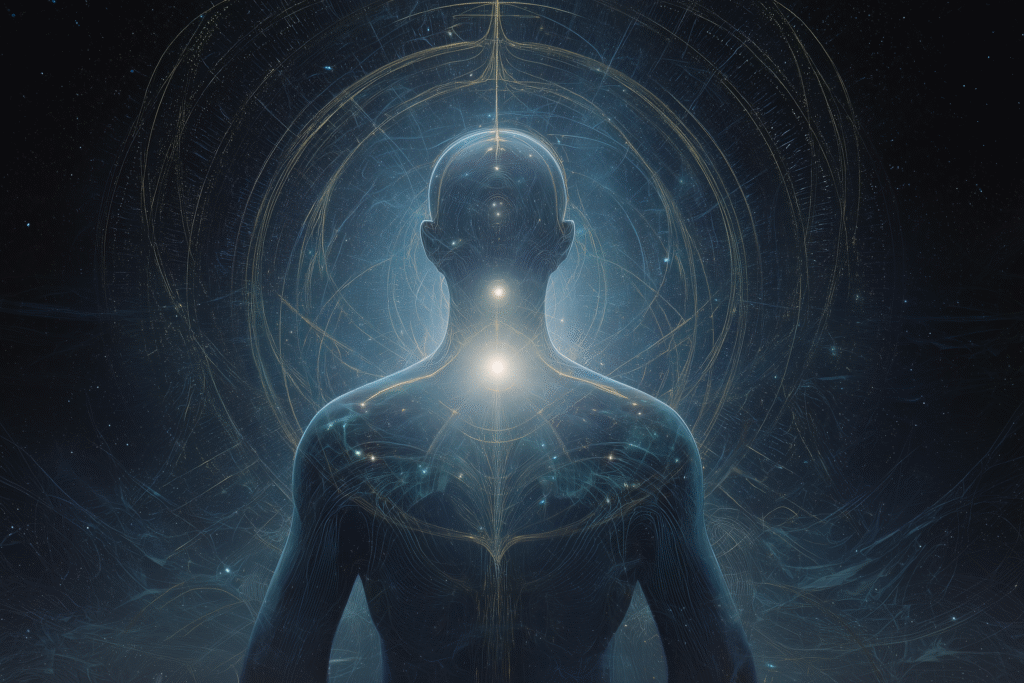
If consciousness is conserved, then every moment of awareness is a transformation of something eternal—not eternal in the sense of unchanging, but eternal in the sense of continuous transformation without beginning or end.
Your awareness right now would be part of an unbroken chain of experience stretching back to the universe’s origin and forward to its ultimate fate.
That’s either trivially true or impossibly false. We’re not sure which yet.
But the question itself reveals something important: we’ve been treating consciousness as an exception to the rules when perhaps it’s been following them all along. What cannot be created or destroyed in awareness might be precisely what makes awareness possible—the fundamental capacity for experience that no universe can conjure from nothing or banish into nonexistence.
The physics of consciousness might simply be the physics of everything else, applied honestly.
See you in the next insight.
Comprehensive Medical Disclaimer: The insights, frameworks, and recommendations shared in this article are for educational and informational purposes only. They represent a synthesis of research, technology applications, and personal optimization strategies, not medical advice. Individual health needs vary significantly, and what works for one person may not be appropriate for another. Always consult with qualified healthcare professionals before making any significant changes to your lifestyle, nutrition, exercise routine, supplement regimen, or medical treatments. This content does not replace professional medical diagnosis, treatment, or care. If you have specific health concerns or conditions, seek guidance from licensed healthcare practitioners familiar with your individual circumstances.
References
The references below are organized by study type. Peer-reviewed research provides the primary evidence base, while systematic reviews synthesize findings.
Peer-Reviewed / Academic Sources
- [1] Pitts, J. B. (2020). Conservation Laws and the Philosophy of Mind: Opening the Black Box, Finding a Mirror. Philosophia. https://link.springer.com/article/10.1007/s11406-019-00102-7
Government / Institutional Sources
- [2] Siegel, E. (2024). Ask Ethan: How do symmetries lead to conservation laws? Big Think. https://bigthink.com/starts-with-a-bang/symmetries-conservation-laws/
- [3] Quantum Physics Lady. (2017). Conservation laws. https://quantumphysicslady.org/glossary/conservation-laws/
- [4] Journal of Young Physicists. (2023). Emergence And Consciousness. https://www.journalofyoungphysicists.org/post/emergence-and-consciousness
- [5] Goff, P. (2023). Is Consciousness Part of the Fabric of the Universe? Scientific American. https://www.scientificamerican.com/article/is-consciousness-part-of-the-fabric-of-the-universe1/
- [6] Carroll, S. M. (2021). Consciousness and the Laws of Physics. PhilSci Archive. https://philsci-archive.pitt.edu/19311/1/Consciousness%20and%20Laws%20of%20Physics-full.pdf
Industry / Technology Sources
- [7] Maverick Philosopher. (2009). Consciousness and the Conservation of Energy. https://maverickphilosopher.typepad.com/maverick_philosopher/2009/07/consciousness-and-the-conservation-of-energy.html
- [8] Goff, P. (2024). Does Consciousness Pervade the Universe? Scientific American. https://www.scientificamerican.com/article/does-consciousness-pervade-the-universe/
- [9] Pang, A. (2024). Is the Universe Conscious? Psychology Today. https://www.psychologytoday.com/us/blog/consciousness-and-beyond/202409/is-the-universe-conscious
- [10] Tegmark, M. (2018). Why Physicists Are Saying Consciousness Is A State Of Matter, Like a Solid, A Liquid Or A Gas. Medium. https://medium.com/the-physics-arxiv-blog/why-physicists-are-saying-consciousness-is-a-state-of-matter-like-a-solid-a-liquid-or-a-gas-5e7ed624986d
- [11] Giannakopoulos, B. (2025). Why Consciousness Is Not External to Physics. Medium. https://medium.com/@bill.giannakopoulos/why-consciousness-is-not-external-to-physics-69d55ca51d96
- [12] Horgan, J. (2024). Will the Universe Remember Us after We’re Gone? Scientific American. https://www.scientificamerican.com/article/will-the-universe-remember-us-after-were-gone/
- [13] Philosophy Stack Exchange. (2023). Is consciousness fundamental to the universe? https://philosophy.stackexchange.com/questions/105505/is-consciousness-fundamental-to-the-universe
- [14] Wikipedia. (2024). Noether’s theorem. https://en.wikipedia.org/wiki/Noether’s_theorem