The choice isn’t whether to merge with machines anymore; it’s how much of yourself you’re willing to lose in the process.
Note: This article is for educational and informational purposes only. See full disclaimer at the end.
We stand at a peculiar threshold in human history. For the first time, we’re not just observing our consciousness—we’re beginning to merge it with digital systems.
Brain-computer interfaces now allow paralyzed individuals to type with their thoughts [8]. Researchers decode neural patterns to detect consciousness in patients who appear unresponsive [1]. And theorists propose methods for “seamless mind uploading” that preserve continuous consciousness across biological and digital substrates [9].
But here’s the question that keeps consciousness researchers awake at night: when we integrate with technology, what gets preserved and what gets lost?
The Integration Paradox
The promise sounds almost miraculous. Connect your brain directly to computing power. Enhance memory, accelerate processing, access information instantaneously. Overcome the limitations of biological cognition while retaining everything that makes you you.
Except that’s where the paradox lives.
Every integration carries a cost. Not necessarily in the dramatic “loss of humanity” sense that dominates science fiction, but in subtler, more insidious ways. When you externalize memory to a device, does your biological memory system atrophy? When you offload pattern recognition to an algorithm, does your intuition diminish? When you replace neurons with silicon, what happens to the emergent properties that arise specifically from biological neural networks?
Brain-computer interfaces already demonstrate this tension. They can restore communication and movement to individuals with severe disabilities—a profound medical breakthrough [2]. Yet as BCIs move from therapeutic to enhancement applications, they raise fundamental questions about identity, autonomy, and what constitutes authentic human experience [3].
The U.S. Government Accountability Office notes that BCIs could give users “unfair advantages by enhancing physical and cognitive abilities” and that “hackers could steal data related to a person’s brain signals” [7]. These aren’t theoretical concerns. They’re present-tense realities emerging as the technology scales from medical intervention to cognitive enhancement.
What Actually Gets Lost
Let’s be specific about what bio-digital integration threatens to compromise.
Biological consciousness substrate: Human consciousness emerges from wetware—biological neural networks with specific chemical, electrical, and structural properties. Neurons communicate through synaptic transmission involving neurotransmitters, ion channels, and complex molecular cascades. This isn’t just information processing. It’s embodied information processing where the medium shapes the message.
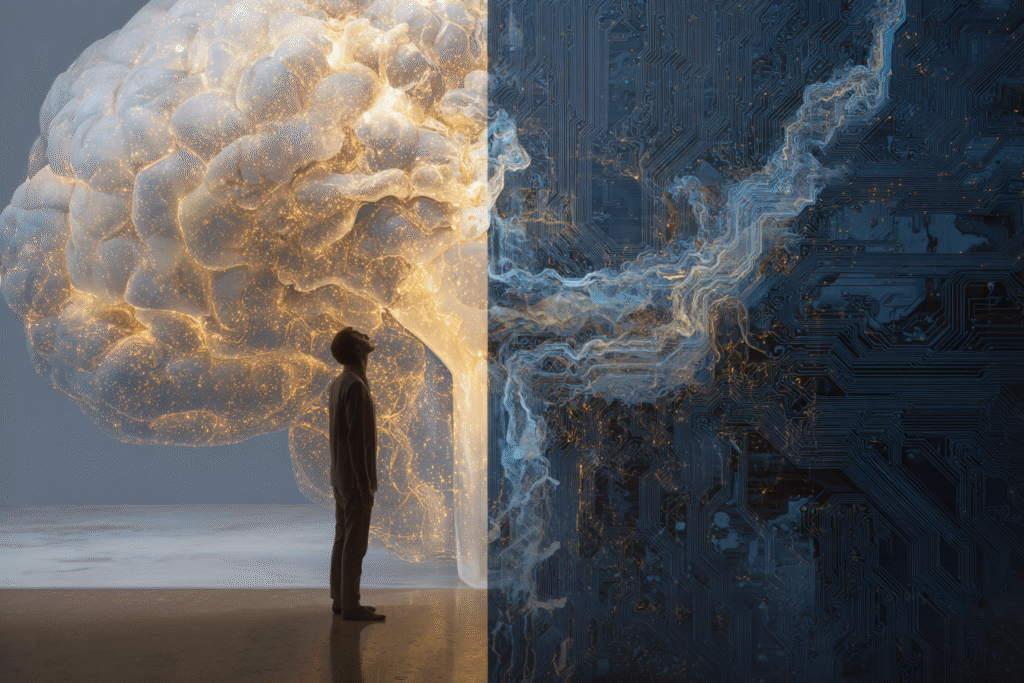
When you replace biological neurons with digital equivalents, you’re not just changing the hardware. You’re changing the fundamental substrate from which consciousness emerges. Digital systems process information through binary logic and electromagnetic signals. The question isn’t whether they can replicate function—they increasingly can. The question is whether they replicate experience.
Experiential continuity: Philosopher Susan Schneider argues that mind uploading would create a copy, not a continuation—”at best, uploading would create a copy of the original mind” while “it is implausible to think that one’s consciousness could leave one’s brain for another location” [10]. This mirrors the Ship of Theseus dilemma we explored previously. If integration happens gradually, piece by piece, when does the original consciousness end and the copy begin?
Autonomy and agency: Digital twins and personal AI systems raise concerns about “externalization” of decision-making [4]. When your digital twin predicts what you’d want before you consciously decide, who’s really choosing? When algorithms shape your desires through patterns you don’t consciously perceive, where does authentic preference end and programmed behavior begin?
Privacy of consciousness: Once brain data becomes digital, it becomes vulnerable. Digital twins in healthcare already struggle with issues of data ownership, privacy, and the potential for “segmentation and discrimination” based on neural patterns [5]. Your thoughts, memories, and cognitive patterns—previously locked safely inside your skull—become extractable, analyzable, potentially manipulable data [6].
The Consciousness Preservation Principle
So how do we integrate without loss? How do we merge with digital systems while preserving what makes consciousness distinctly ours?
Here’s what the research and philosophy suggest:
Primacy of biological substrate: Integration should augment, not replace, biological consciousness. Brain-computer interfaces work best when they serve as tools for biological systems rather than replacements. A prosthetic limb controlled by brain signals is fundamentally different from replacing brain tissue with silicon. One extends biological capability; the other substitutes for it.
Neuroscientist Masataka Watanabe proposes a “seamless” integration method that maintains continuous consciousness by creating a “transition state” where biological and artificial hemispheres operate together before any biological tissue is removed [9]. The emphasis on continuity—never severing the biological stream—suggests that preservation requires biological grounding, even in highly integrated systems.
Opt-in, reversible integration: Every step toward bio-digital merger should be voluntary and, where possible, reversible. This isn’t just about informed consent. It’s about maintaining the optionality that defines human agency. You should be able to disconnect, to experience unenhanced consciousness, to know what it feels like to be just biological.
Current therapeutic BCIs demonstrate this principle. They can be turned off. The person returns to their unaugmented baseline. This reversibility provides a crucial safety valve—both psychologically and practically.
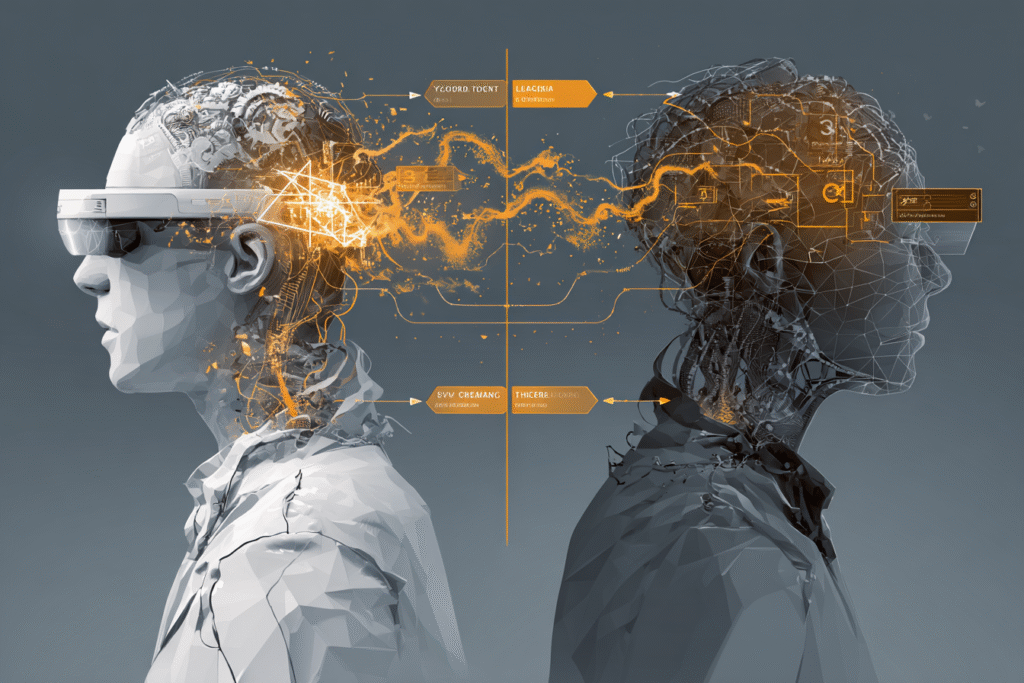
Preservation of experiential substrate: Integration methods that maintain the biological mechanisms of consciousness—synaptic plasticity, neurochemical modulation, embodied sensation—preserve more of “you” than methods that merely replicate function. The difference between mind uploading (replacing biological consciousness) and mind extending (augmenting it with digital tools) isn’t semantic. It’s existential.
This is why proposals for gradual neuron replacement face such profound skepticism. Even if you replace one neuron at a time with a perfect functional equivalent, you’re still gradually shifting from biological to digital substrate. At some point, the emergent properties change. What made you you doesn’t fully transfer.
Transparency and interpretability: You should understand what the integrated system is doing. Black-box algorithms operating on your neural data without your comprehension erode agency and autonomy. The integration should be interpretable: you should know when the digital component is influencing your thoughts, perceptions, or decisions.
This matters enormously for digital twins. If your digital twin makes predictions about your preferences that influence what you see, what you’re offered, what paths become available to you, you need to know that’s happening [4]. Unconscious manipulation—even well-intentioned—compromises the authenticity of your choices.
The Enhancement Versus Replacement Distinction
There’s a bright line between enhancement and replacement, even if technology increasingly blurs it.
Enhancement preserves the biological substrate while extending its capabilities. A memory prosthetic that helps you recall information doesn’t replace your hippocampus—it supplements it. An interface that lets you control a computer with thought doesn’t replace your motor cortex—it adds a new output channel.
Replacement substitutes digital for biological. Uploading your connectome to a computer and discarding the biological brain. Replacing damaged tissue with artificial equivalents that have fundamentally different operating principles. Creating a digital twin that functions independently of your biological consciousness.
The enhancement path preserves continuity. The replacement path creates a copy—and as Schneider argues, even a perfect copy isn’t you [10].
This matters for how we approach integration. Therapeutic BCIs that restore lost function clearly fall on the enhancement side. But what about BCIs that boost healthy cognition? What about memory augmentation for people with normal memory? What about neural interfaces that provide capabilities humans have never had?
The answer isn’t absolute prohibition. It’s conscious choice with full awareness of what’s being preserved and what’s being risked. Enhancement that maintains biological primacy and reversibility differs fundamentally from replacement that substitutes silicon for neurons.
The Embodiment Problem
Here’s what often gets overlooked in discussions of bio-digital integration: consciousness isn’t just in your brain. It’s embodied. Your cognitive processes arise from the interaction between brain, body, and environment. Emotions aren’t just brain states—they’re interoceptive signals from your body interpreted by your brain. Memory isn’t purely neural—it’s encoded in muscle patterns, gut feelings, the somatic markers that guide decision-making.
When we talk about preserving consciousness through integration, we’re talking about preserving this entire embodied system. A digital twin that models only your brain patterns misses the bodily dimension of who you are. An uploaded consciousness that lacks visceral sensation loses something fundamental about human experience.
Some integration proposals acknowledge this. Watanabe suggests that artificial consciousness might need “a body that interacts with its environment” and proposes virtual embodiment as a solution [9]. But a virtual body in a virtual environment isn’t the same as a biological body in physical reality. The sensory richness, the evolutionary optimization, the deep integration between perception and action—these arose from millions of years of embodied existence.
Can they be replicated digitally? Perhaps partially. But “partially” means loss. And we should acknowledge what we’re losing.
Living at the Threshold
We’re living through the early stages of a transformation that could fundamentally alter what it means to be human. Brain-computer interfaces move from laboratory to clinic. Digital twins become increasingly sophisticated. Proposals for consciousness uploading shift from science fiction to serious academic discussion.
This is happening whether we’re ready or not.
The question isn’t whether to integrate. Medical necessity alone ensures some integration will occur. The question is how to integrate consciously—with full awareness of what we’re preserving and what we risk losing.
The consciousness preservation principle offers guidance: prioritize biological substrate, maintain reversibility, preserve embodiment, ensure transparency, and always distinguish enhancement from replacement. These aren’t rules. They’re navigational aids for territory we’ve never crossed before.
Because here’s what we know: once you replace biological consciousness with digital simulation, there’s no going back. The original is gone. Maybe the simulation is perfect. Maybe it contains all your memories, mimics all your behaviors, passes every test of personhood. But it’s not continuous with your current stream of consciousness. It’s a copy that begins when you end.
Integration without replacement preserves that continuity. It extends your biological consciousness with digital capabilities without severing the thread of experience that connects your past self to your future self. It acknowledges that you aren’t just information to be copied—you’re an ongoing process to be preserved.
The Boundaries You Draw
So where do you draw your boundaries?
What kinds of integration feel like enhancement versus replacement? What level of digital dependence crosses the line from tool use to identity loss? How much neural data are you willing to externalize, knowing it becomes potentially accessible, analyzable, exploitable?
These aren’t rhetorical questions. They’re the most important questions you’ll face as bio-digital integration becomes not just possible but commonplace. The technology companies and research institutions pushing integration forward have incentives that don’t necessarily align with consciousness preservation. They optimize for capability, efficiency, market potential—not for maintaining the subtle, embodied, irreducibly biological aspects of human consciousness.
You’re the only one who can decide what parts of your consciousness are non-negotiable.
What aspects of being human you refuse to compromise, regardless of promised enhancements. Where you draw the line between augmentation that preserves your essence and transformation that replaces it.
Because once that line is crossed—once the biological substrate is gone—there’s no retrieving what was lost.
The integration is coming. The only question is whether you’ll navigate it consciously or wake up one day to discover you’re already more digital than biological, without ever deciding where to draw the boundaries.
Your consciousness is continuous. Keep it that way.
See you in the next insight.
Comprehensive Medical Disclaimer: The insights, frameworks, and recommendations shared in this article are for educational and informational purposes only. They represent a synthesis of research, technology applications, and personal optimization strategies, not medical advice. Individual health needs vary significantly, and what works for one person may not be appropriate for another. Always consult with qualified healthcare professionals before making any significant changes to your lifestyle, nutrition, exercise routine, supplement regimen, or medical treatments. This content does not replace professional medical diagnosis, treatment, or care. If you have specific health concerns or conditions, seek guidance from licensed healthcare practitioners familiar with your individual circumstances.
References
The references below are organized by study type. Peer-reviewed research provides the primary evidence base, while systematic reviews synthesize findings.
Peer-Reviewed / Academic Sources
- [1] Frontiers. (2022). EEG-based Brain-Computer Interfaces for people with Disorders of Consciousness: Features and applications. https://www.frontiersin.org/journals/human-neuroscience/articles/10.3389/fnhum.2022.1040816/full
- [2] National Center for Biotechnology Information. (2024). Brain–computer interfaces: the innovative key to unlocking neurological conditions. https://pmc.ncbi.nlm.nih.gov/articles/PMC11392146/
- [3] National Center for Biotechnology Information. (2024). Ethical considerations for the use of brain–computer interfaces for cognitive enhancement. https://pmc.ncbi.nlm.nih.gov/articles/PMC11542783/
- [4] Royal Society Publishing. (2021). The personal digital twin, ethical considerations. https://royalsocietypublishing.org/doi/10.1098/rsta.2020.0367
- [5] Frontiers. (2018). Digital Twins in Health Care: Ethical Implications of an Emerging Engineering Paradigm. https://www.frontiersin.org/journals/genetics/articles/10.3389/fgene.2018.00031/full
- [6] National Center for Biotechnology Information. (2022). Ethical Issues of Digital Twins for Personalized Health Care Service: Preliminary Mapping Study. https://pmc.ncbi.nlm.nih.gov/articles/PMC8844982/
Government / Institutional Sources
- [7] U.S. Government Accountability Office. (2022). Science & Tech Spotlight: Brain-Computer Interfaces. https://www.gao.gov/products/gao-22-106118
Industry / Technology Sources
- [8] Wikipedia. (2024). Brain–computer interface. https://en.wikipedia.org/wiki/Brain–computer_interface
- [9] Research Features. (2023). Rethinking our consciousness. https://researchfeatures.com/rethinking-consciousness/
- [10] Wikipedia. (2025). Mind uploading. https://en.wikipedia.org/wiki/Mind_uploading