In an age where machines can replicate almost anything, the value of being irreplaceably human has never been higher.
Note: This article is for educational and informational purposes only. See full disclaimer at the end.
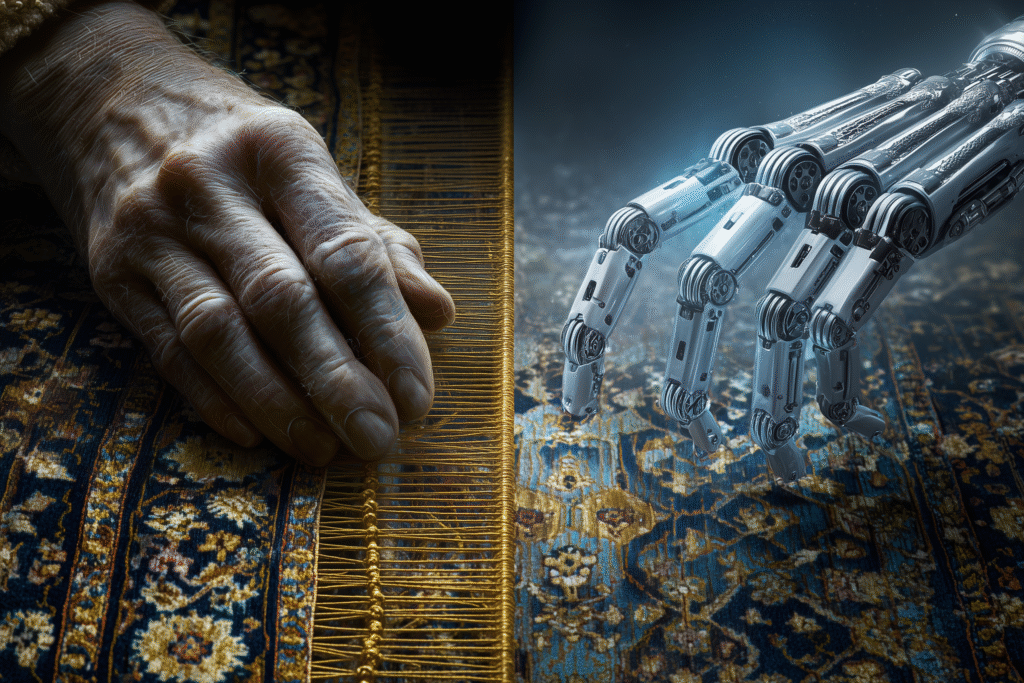
The Persian rug catches your eye immediately. Its intricate patterns flow across centuries-old designs, each knot tied by hand. The price tag reads $27,000. Right beside it sits another rug—same size, same pattern, produced by machine in perfect precision. Price: $970. The difference isn’t in the wool or the design. It’s in the human story woven into every thread.
This 2,777% price premium for human touch isn’t an anomaly—it’s a principle that’s becoming more pronounced as AI floods our markets with perfect efficiency.
You’re witnessing the emergence of what I call the Human Premium Principle: the exponential increase in value assigned to human-created work precisely because machines can now replicate almost everything we do. It’s economics meeting consciousness, scarcity meeting abundance, and humanity asserting its worth in unexpected ways.
The Value Paradox of Perfect Replication
Consider what happened when Columbia Business School researchers showed people identical artworks. When labeled “human-made,” participants valued them 62% higher than when labeled “AI-generated” [6]. The artwork hadn’t changed. Only the story of its creation had.
This isn’t irrational bias—it’s rational recognition. In a world where AI can generate thousands of images in minutes, the time a human spends creating becomes precious. When chef’s knives from the same company sell for 2,000% more when handmade versus machine-made [7], buyers aren’t just purchasing steel shaped into tools. They’re investing in human mastery, patience, and the irreplaceable element of conscious craft.
The behavioral economics behind this are fascinating. A comprehensive study in the Review of Industrial Organization found that consumers willingly pay premium prices for handmade products even when machine alternatives offer superior technical specifications [1]. The researchers termed this the “handmade effect”—our deep psychological preference for objects touched by human consciousness.
The Authenticity Economy Emerges
We’re not just buying products anymore. We’re buying proof of human involvement.
This shift represents what behavioral economists call the “authenticity intuition.” When researchers tested whether people would plug into a hypothetical “experience machine” that could create a perfectly optimal life, 70% refused [8]. We value authentic experience over optimized outcomes—and we’re willing to pay for it.
The numbers tell the story. A global survey found that 93% of consumers prefer handmade products specifically for their uniqueness and authenticity [9]. This isn’t nostalgia. It’s recognition that in an age of infinite replication, the unreplicable becomes invaluable.
Luxury brands have understood this for decades. When Rolex or Louis Vuitton price their products at astronomical levels, they’re not just selling watches or handbags. They’re selling human craftsmanship as a signal—what behavioral economist Thorstein Veblen identified over a century ago as conspicuous consumption, now evolved into conscious consumption [10].
The Creative Premium Multiplier
The art world provides our clearest window into this transformation. When an AI-generated portrait sold for $1.08 million at auction, it made headlines. But here’s what’s more interesting: human artists who explicitly marketed their work as “made without AI” saw their prices increase [6].
Nature published research showing people consistently devalue AI-labeled art—not because they can tell the difference (studies show they often can’t), but because the human creative process itself carries value [2]. Participants rated human-made art higher on beauty, profundity, emotional intensity, and worth—even when viewing the exact same image.
This isn’t just about art. It’s about what art represents: the ultimate expression of human consciousness made tangible. When you purchase human-made art, you’re not buying pixels or paint. You’re buying a piece of someone’s lived experience, their unique perception, their consciousness signature that no algorithm can replicate.
The Consciousness Signature
Every human creation carries what I call a consciousness signature—the irreducible mark of individual experience and perception. It’s why a child’s handmade Mother’s Day card means more than a store-bought one. Why we treasure handwritten letters in an age of perfect typography. Why a grandmother’s imperfect cookies taste better than factory-produced perfection.
Harvard creatives studying this phenomenon identified three elements that AI cannot replicate: unique ways of viewing the world shaped by personality, linguistic originality born from lived experience, and inimitable details that emerge from personal history [3]. These aren’t inefficiencies—they’re the essence of human value.
The consciousness signature extends beyond creative work. When you interact with a human professional—a therapist, teacher, or consultant—you’re not just receiving information transfer. You’re engaging with someone who understands mortality, who has felt joy and loss, who brings the full weight of human experience to the encounter. This creates what psychologists studying pricing call “emotional utility”—value that transcends functional outcomes [10].
Cultivating Your Premium
So how do you develop and monetize your human premium? The answer isn’t to compete with AI on its terms—efficiency, consistency, scale. It’s to amplify what makes you irreducibly human.
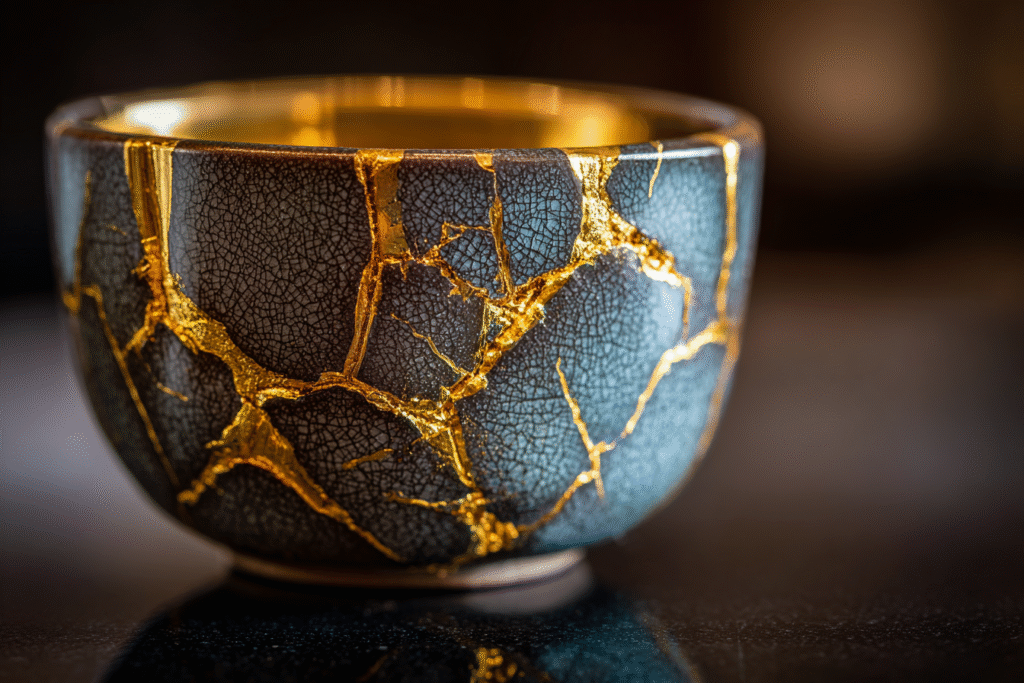
First, embrace your inefficiencies. The Japanese concept of wabi-sabi finds beauty in imperfection, and markets are beginning to price this accordingly. The slight irregularities in handmade pottery, the brushstrokes visible in a painting, the pauses in live performance—these aren’t flaws to eliminate but premiums to cultivate.
Second, make your process visible. Studies show that when consumers understand the human effort involved in creation, they’re willing to pay significantly more [11]. Document your journey. Share your struggles. Let people see the consciousness behind the creation.
Third, focus on what AI amplifies rather than replaces. Use AI as a tool to handle repetitive tasks, freeing you to invest more deeply in the uniquely human aspects of your work. The architects who thrive won’t be those who reject AI but those who use it to spend more time on the creative vision that only human consciousness can provide.
Fourth, build direct relationships. The human premium isn’t just about the product—it’s about the connection. When someone buys from you, they’re buying into your story, your values, your unique perspective. This relationship itself becomes part of the value proposition.
The Market Reorganization
We’re witnessing a fundamental reorganization of value in real-time. Markets are splitting into two tiers: the efficient, AI-optimized tier where price and convenience reign, and the human premium tier where consciousness, authenticity, and connection command exponentially higher prices.
This isn’t just economic theory. Etsy’s handmade marketplace has grown to over 90 million active buyers, with average transaction values increasing even as AI alternatives proliferate. Farmers’ markets thrive despite supermarket convenience. Artisanal everything—from coffee to clothing—commands premiums that would have seemed irrational just decades ago.
The behavioral science is clear: as AI handles more of our functional needs, we’ll pay increasingly higher premiums for proof of human involvement. Not because we’re romantic or irrational, but because human consciousness—with all its beautiful inefficiency—becomes scarcer and therefore more valuable.

Your Premium Awaits
The Human Premium Principle isn’t about rejecting technology or romanticizing the past. It’s about recognizing that as machines become better at being machines, the value of being human increases exponentially.
Every day, you make choices about where to invest your consciousness. Every creation you produce, every service you provide, every interaction you have carries your unique consciousness signature. The question isn’t whether you have value in an AI age—it’s whether you’re positioning yourself to capture the premium that consciousness commands.
The Persian rug weavers understood something profound: their value wasn’t in competing with machines on efficiency. It was in offering what machines never could—the accumulated wisdom of generations, the meditation of repetitive hand motion, the tiny imperfections that whisper “a human was here.”
Your consciousness is your competitive advantage. Your lived experience is your moat. Your humanity is your premium.
The market is reorganizing around this truth. The only question is: are you ready to claim your premium?
See you in the next insight.
Comprehensive Medical Disclaimer: The insights, frameworks, and recommendations shared in this article are for educational and informational purposes only. They represent a synthesis of research, technology applications, and personal optimization strategies, not medical advice. Individual health needs vary significantly, and what works for one person may not be appropriate for another. Always consult with qualified healthcare professionals before making any significant changes to your lifestyle, nutrition, exercise routine, supplement regimen, or medical treatments. This content does not replace professional medical diagnosis, treatment, or care. If you have specific health concerns or conditions, seek guidance from licensed healthcare practitioners familiar with your individual circumstances.
References
The references below are organized by study type. Peer-reviewed research provides the primary evidence base, while systematic reviews synthesize findings.
Peer-Reviewed / Academic Sources
- [1] Fuchs, C. (2021). The Handmade Effect: A Model of Conscious Shopping in an Industrialised Economy. Review of Industrial Organization, 61, 393-417. https://link.springer.com/article/10.1007/s11151-021-09844-9
- [2] Horton, C. B., Iyengar, S. S., & White, M. W. (2023). Humans versus AI: whether and why we prefer human-created compared to AI-created artwork. Cognitive Research: Principles and Implications, 8(42). https://cognitiveresearchjournal.springeropen.com/articles/10.1186/s41235-023-00499-6
Government / Institutional Sources
- [3] Harvard Gazette. (2024). Is art generated by artificial intelligence real art? https://news.harvard.edu/gazette/story/2023/08/is-art-generated-by-artificial-intelligence-real-art/
- [4] University of Chicago. (2025). What is behavioral economics? https://news.uchicago.edu/explainer/what-is-behavioral-economics
- [5] University of Plymouth. (2024). Is AI-generated art actually art? https://www.plymouth.ac.uk/discover/is-ai-generated-art-actually-art
Industry / Technology Sources
- [6] Columbia Business School. (2024). Beyond the Machine: Why Human-Made Art Matters More in the Age of AI. https://business.columbia.edu/research-brief/digital-future/human-ai-art
- [7] IndustryWeek. (2023). Handmade vs. Factory Made: Comparing Time and Cost. https://www.industryweek.com/technology-and-iiot/article/21994685/handmade-vs-factory-made-comparing-time-and-cost
- [8] Nautilus. (2023). We Find Human-Made Art More Valuable than AI-Art. https://nautil.us/were-biased-against-ai-made-art-471572/
- [9] Boontoon. (2025). Why choose Handmade Products over Mass-Produced Products. https://www.boontoon.com/blog/why-choose-handmade-products-over-mass-produced-products/
- [10] FasterCapital. (2024). Behavioral economics: The Psychology Behind Price Signaling. https://fastercapital.com/content/Behavioral-economics–The-Psychology-Behind-Price-Signaling.html
- [11] Saanskrityam Handicrafts. (2024). Handmade vs. Manufactured: The Unique Benefits of Choosing Handicraft. https://saanskrityamhandicrafts.com/blogs/news/handmade-vs-manufactured-the-unique-benefits-of-choosing-handicraft-products