The question isn’t what comes after Homo sapiens, it’s whether “species” will even matter when consciousness drives evolution.
Note: This article is for educational and informational purposes only. See full disclaimer at the end.
The trajectory seemed inevitable once: bigger brains, better tools, smarter strategies. From Australopithecus africanus with 441 cm³ craniums to modern Homo sapiens at 1350 cm³, our evolutionary story has been written in expanding gray matter and enhanced cognitive abilities [1].
Yet something unprecedented happened about 300,000 years ago—we became the first species whose consciousness no longer relies solely on genes for reproduction and transmission, but can also utilize recorded ideas discovered by previous generations [1].
We’ve been evolving beyond biology since we painted the first cave wall.
The real revolution isn’t happening in our DNA anymore. While our ancestors spent millions of years gradually expanding cranial capacity, modern humans are approaching species-level transformation at computational speed.
We’re not just changing what we can do—we’re changing what we are, what we might become, and whether the category of “human” will even apply to our descendants.
The Three Trajectories of Post-Sapiens Evolution
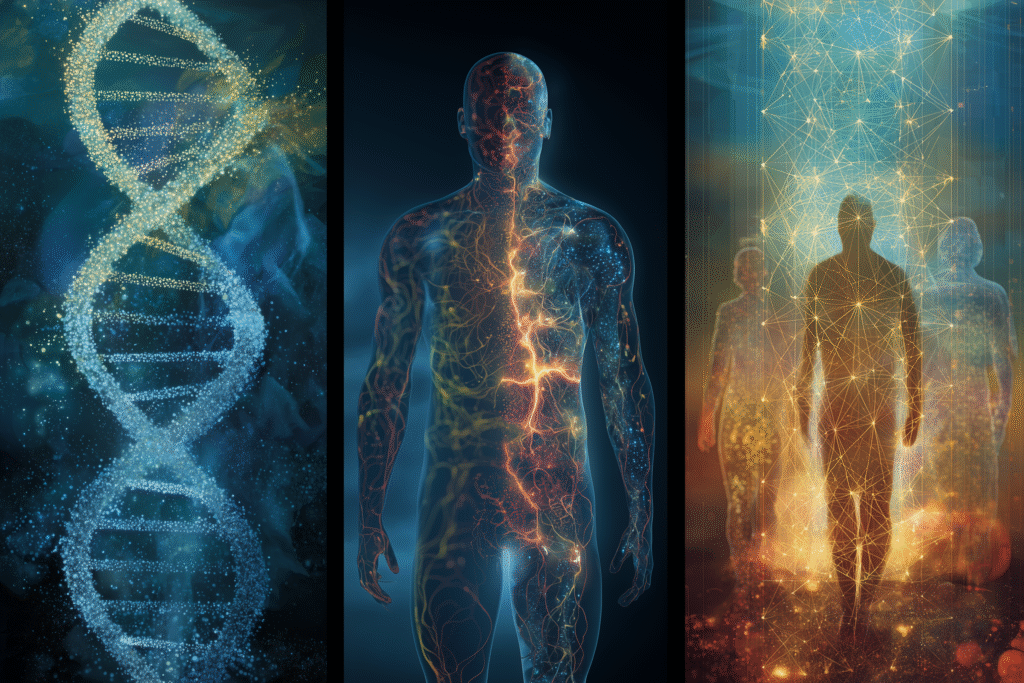
The question “what comes after Homo sapiens?” fractures into three distinct but interweaving paths, each representing a different mechanism of transformation that’s already beginning.
Biological Evolution: The Slowing Inheritance
Traditional Darwinian evolution hasn’t stopped, but it’s fundamentally altered. When half of British children died before age 21 in 1859, natural selection had abundant raw material. Today, with 99% survival to sexual maturity in developed nations, “survival of the fittest” operates with far less selective pressure [6].
The evolutionary game has changed. We’re getting taller—Dutch men now average 183cm, a height that may eventually spread globally through both reduced mortality and sexual preference [7]. But our brains? They’re actually shrinking. European brain size peaked 10,000-20,000 years ago, declining since the advent of agriculture [7]. Smaller brains may be more energy-efficient, consuming less of our daily calories while maintaining or even enhancing processing capability through better organization.
The biological future might feature humans who live dramatically longer—evolutionary selection could extend lifespans as mortality rates drop [7]. But here’s the paradox: the very conditions enabling us to survive better also remove the selective pressures that drove our cognitive expansion in the first place.
Technological Enhancement: Homo CRISPR Emerges
The second trajectory bypasses waiting for genetic drift entirely. CRISPR gene-editing technology enables modifications that would take millennia through natural selection to occur within a single generation. As one researcher provocatively suggests, what comes after Homo sapiens may be “Homo CRISPR”—with as many “flavors” as there are desires for physical appearance, cognitive skills, and personality traits [8].
This isn’t distant speculation. A 2022 Pew study found that 20% of people would consider computer chip implants in their baby’s brain for faster, more accurate processing [9]. Brain-computer interfaces like Neuralink and Synchron are advancing from healing applications toward enhancement, following the transhumanist principle of “from healing to enhancement” [9].
The technological path suggests multiple post-human species emerging simultaneously. Some modifications will maintain reproductive compatibility; others won’t, creating what amounts to speciation through design rather than geographic isolation [8]. We could witness an explosion of Homo variants within generations, not millennia.
Consciousness Evolution: The Planetary Awakening
The third and perhaps most profound trajectory involves consciousness itself evolving beyond individual biological containers. This isn’t about brain size or genetic code—it’s about the structure of awareness transforming.
Evidence suggests something unprecedented is emerging: between 1-5% of humans are already acquiring what researchers call “planetary consciousness”—an awareness that perceives one human family interconnected with all life and the planet [10]. This represents not just a philosophical shift but a potentially fundamental reorganization of how consciousness processes reality.
The concept draws from Teilhard de Chardin’s noosphere—a “sphere of human thinking” as the next evolutionary stage beyond the biosphere [4]. Unlike biological or technological evolution, this transformation happens through cultural transmission and individual awakening rather than genetic or surgical intervention.
What makes consciousness evolution distinctive is that it can propagate exponentially faster than genetic changes. An insight that transforms one person’s awareness can spread to millions through communication, creating evolutionary change measured in years rather than generations.
The Integration Question
Here’s where it gets genuinely interesting: these three trajectories aren’t separate. They’re converging.
Consider the transhumanist vision of mind-uploading and digital consciousness transfer [11]. This represents all three pathways simultaneously: biological evolution reaching a point where consciousness can exist independent of its original substrate, technological enhancement enabling the transfer, and consciousness itself evolving to comprehend and navigate existence across multiple forms.
Brain-computer interfaces bridge minds and machines, establishing direct communication channels that enhance cognitive abilities while fundamentally altering how we process information [11]. Are we enhancing human consciousness or creating something fundamentally different? The boundary becomes meaningless when the substrate changes.
Nick Bostrom, director of Oxford’s Future of Humanity Institute, points out that Darwinian evolution now happens “on a very slow time scale relative to other things that are leading to changes in the human condition”—including cloning, genetic enhancement, robotics, AI, and nanotechnology [6]. The future may belong to “unnatural selection.”
The Practical Present
While these trajectories sound speculative, they’re already manifesting in measurable ways:
Genetic Editing: CRISPR technology can correct genetic disorders and potentially enhance human capabilities within our current generation [12]. Parents face decisions about genetic modifications that were science fiction a decade ago.
Neural Enhancement: Brain-computer interfaces progress from experimental to therapeutic to enhancement applications. The question isn’t whether neural augmentation will happen, but who gets access and what it means for human identity [2].
Consciousness Research: Studies on collective intelligence and planetary awareness aren’t just philosophical musings—they’re tracking actual shifts in how humans perceive their relationship to each other and to planetary systems [10].
Cultural Evolution: We’re the first species whose evolution no longer depends solely on biological reproduction. Ideas, technologies, and consciousness frameworks propagate through cultural transmission faster than genes ever could [1].
The Consciousness Paradox
Here’s the fascinating contradiction at the heart of post-human evolution: consciousness itself appears to be causally potent—it evolved because being aware conferred survival advantage [3]. Yet the more conscious we become, the more we can intentionally direct our own evolution, potentially selecting against the very mechanisms that made consciousness adaptive in the first place.
We’re not just evolving anymore. We’re choosing what to evolve into. And that choice itself represents a level of consciousness that may be categorically different from what came before.
Philosophical posthumanism recognizes that human consciousness evolved from features beginning in the simplest living creatures, operating on a continuum [13]. But when symbolic relations combined with perspective-taking skills to become self-reflective, an additional evolutionary step occurred—one that carried humanity “into empty space on the cliff’s edge of the evolution of awareness, and everything that went before is now part of something fundamentally different” [5].
We’re that something fundamentally different. And we’re about to become different again.
Beyond the Species Boundary
The traditional definition of species involves reproductive isolation—members of different species cannot produce fertile offspring together. But what happens when consciousness itself becomes substrate-independent? When neural interfaces allow direct mind-to-mind communication? When genetic modifications create humans who literally cannot interbreed with unmodified populations?
The species question dissolves into something stranger: not “what comes after Homo sapiens” but “what happens when the category of discrete species no longer applies to consciousness-bearing entities?”
Consider: if consciousness can exist in biological brains, enhanced neural networks, digital substrates, and hybrid combinations, are we talking about different species or different instantiations of the same evolutionary phenomenon—awareness exploring the space of possible configurations?
Transhumanists envision superintelligent artificial beings potentially requiring humans to merge with machines for co-existence [9]. But merge into what? A new species? An uploaded consciousness? A hybrid entity that resists binary categorization [13]?
The Optimistic Provocation
This moment in human history is unprecedented: we’re conscious enough to recognize we’re evolving, technological enough to direct that evolution, and creative enough to imagine radically different forms of existence. We’re also humble enough—at least potentially—to question whether what we become will actually be better than what we are.
The emergence of planetary consciousness among a growing percentage of humanity suggests we might be developing the collective awareness necessary to navigate these transformations wisely [10]. When enough people perceive humanity as interconnected with all life, evolutionary choices shift from competitive advantage to collective flourishing.
This doesn’t mean the future is certain or necessarily positive. The same technologies enabling enhancement could exacerbate inequality, create new forms of suffering, or fundamentally alter human experience in ways we can’t predict. The same consciousness expansion that enables planetary awareness could fragment into incompatible reality frameworks.
But here’s the genuinely hopeful observation: we’re having this conversation. Consciousness is questioning its own evolution while evolution is happening. That recursive self-awareness—consciousness observing consciousness changing—may be exactly what’s needed to navigate becoming something we’ve never been.
The Question That Remains
So what comes after Homo sapiens?
Maybe the answer isn’t a single species or endpoint but a continuous unfolding—biological, technological, and conscious evolution interweaving into forms we’re only beginning to imagine. Maybe we’re not becoming something post-human so much as finally becoming fully conscious of what human actually means: an awareness capable of directing its own transformation.
The next species question might be less about what replaces us and more about what we choose to become when consciousness itself drives evolution.
We are, right now, in the midst of the most profound transformation in the 300,000-year history of Homo sapiens. Our descendants—whether biological, digital, hybrid, or something we don’t yet have words for—may look back at this moment as the inflection point where human consciousness recognized it was choosing its own future.
That recognition changes everything. Because once you know you’re evolving consciously, you can’t pretend evolution is something that just happens to you anymore.
You’re participants in what comes next. All of us. Together. Now.
And that might be the most important evolutionary development yet: the moment awareness recognized it could become whatever it chose to be—and understood the responsibility that comes with that power.
See you in the next insight.
Comprehensive Medical Disclaimer: The insights, frameworks, and recommendations shared in this article are for educational and informational purposes only. They represent a synthesis of research, technology applications, and personal optimization strategies, not medical advice. Individual health needs vary significantly, and what works for one person may not be appropriate for another. Always consult with qualified healthcare professionals before making any significant changes to your lifestyle, nutrition, exercise routine, supplement regimen, or medical treatments. This content does not replace professional medical diagnosis, treatment, or care. If you have specific health concerns or conditions, seek guidance from licensed healthcare practitioners familiar with your individual circumstances.
References
The references below are organized by study type. Peer-reviewed research provides the primary evidence base, while systematic reviews synthesize findings.
Peer-Reviewed / Academic Sources
- [1] PMC. (2024). Evolution of Consciousness. https://pmc.ncbi.nlm.nih.gov/articles/PMC10817314/
- [2] NCBI. (2014). Evolution of Consciousness: Phylogeny, Ontogeny, and Emergence from General Anesthesia. https://www.ncbi.nlm.nih.gov/books/NBK231624/
- [3] PNAS. (2013). Evolution of consciousness: Phylogeny, ontogeny, and emergence from general anesthesia. https://www.pnas.org/doi/10.1073/pnas.1301188110
- [4] ResearchGate. (2015). Convergent Quantification and Physical Support for Teilhard de Chardin’s Philosophy Concerning the Human Species and Evolutionary Consciousness. https://www.researchgate.net/publication/280647948_Convergent_Quantification_and_Physical_Support_for_Teilhard_de_Chardin’s_Philosophy_Concerning_the_Human_Species_and_Evolutionary_Consciousness
- [5] PMC. (2023). A biphasic relational approach to the evolution of human consciousness. https://pmc.ncbi.nlm.nih.gov/articles/PMC10017357/
Industry / Technology Sources
- [6] National Geographic. (2025). Future Humans: Four Ways We May, or May Not, Evolve. https://www.nationalgeographic.com/science/article/future-humans-four-ways-we-may-or-may-not-evolve
- [7] The Conversation. (2025). Future evolution: from looks to brains and personality, how will humans change in the next 10,000 years? https://theconversation.com/future-evolution-from-looks-to-brains-and-personality-how-will-humans-change-in-the-next-10-000-years-176997
- [8] Psychology Today. (2018). Where Will Evolution Take Humans Next? https://www.psychologytoday.com/us/blog/long-fuse-big-bang/201809/where-will-evolution-take-humans-next
- [9] Academy of Ideas. (2025). The Darkside of AI – Transhumanism and the War Against Humanity. https://academyofideas.com/2025/02/darkside-of-ai-transhumanism-and-the-war-against-humanity/
- [10] Frasier Retirement Community. (2023). Emerging World: The Evolution of Consciousness and The Future of Humanity. https://www.frasiermeadows.org/emerging-word-evolution-consciousness/
- [11] Tomorrow Bio. (2023). Digital Immortality: Exploring Singularity’s Role in Transhumanist Ambitions. https://www.tomorrow.bio/post/digital-immortality-exploring-singularity-s-role-in-transhumanist-ambitions-2023-09-5094275325-transhumanism
- [12] BrainApps. (2024). Transhumanism: Future, Aspirations, Self-Enhancement, Goals, Criticism, and Global Views. https://brainapps.io/blog/2025/04/transhumanism-future-aspirations-self-enhancement-goals/
- [13] Wikipedia. (2025). Posthuman. https://en.wikipedia.org/wiki/Posthuman