If you replace every neuron in your brain, one by one, with an exact silicon copy, at what point do you cease to be you?
Note: This article is for educational and informational purposes only. See full disclaimer at the end.
The ship of Theseus has sailed from ancient Athens into the laboratories of neuroscience and the meditation halls of contemplatives.
What began as a philosophical puzzle about wooden planks has become an urgent question as we stand at the threshold of consciousness transfer, brain-computer interfaces, and radical life extension.
The paradox no longer lives only in thought experiments—it pulses through the circuits of neural implants and flows through the altered states of deep meditators.
The Original Paradox, Updated
Plutarch’s ancient question was deceptively simple: if you replace every plank of Theseus’s ship over time, is it still the same vessel? Thomas Hobbes later twisted the knife deeper—what if someone collected all the discarded planks and rebuilt the original ship? Which one deserves the name? [6].
Now translate this to consciousness. Your brain replaces its atoms continuously through metabolic processes. The proteins that make up your synapses turn over completely in weeks. Yet you feel like the same person who woke up yesterday, last year, perhaps decades ago [7]. The question isn’t academic anymore—it’s becoming practical as we develop technologies that could replace, augment, or transfer the substrate of consciousness itself.
When Silicon Meets Synapse
The gradual brain replacement thought experiment pushes the ship of Theseus into neural territory. Imagine nanobots replacing your neurons one by one with functionally identical artificial components. No disruption to your behavior, thoughts, or experience—just a slow transition from biological to synthetic substrate [13].
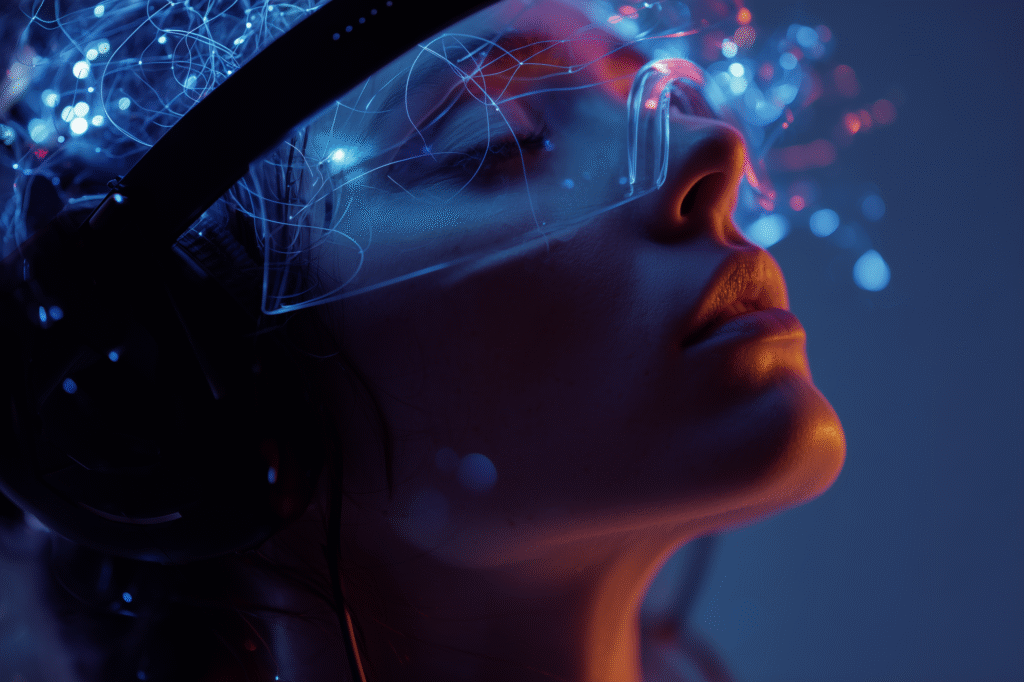
Current brain-computer interfaces offer a preview of this future. MIT’s AlterEgo device creates a “silent speech” interface between brain and computer without surgical implants. Users report that the boundary between their thoughts and the AI’s responses begins to blur—where does the self end and the machine begin? [12].
This isn’t just about adding computational power. It’s about the fundamental question of whether consciousness is substrate-independent—whether the pattern matters more than the medium [14]. David Chalmers argues for “organizational invariance”—duplicate the functional organization closely enough, and you should duplicate the conscious experience, regardless of whether it runs on neurons or silicon.
The Upload Dilemma
Mind uploading crystallizes the continuity problem. Scan a brain, simulate it perfectly in silicon—is the upload you or merely a copy that thinks it’s you? Michael Cerullo suggests that psychological identity branches rather than transfers, with each copy being an authentic continuation of the original [8].
But the philosophical consensus fractures here. Some argue that consciousness requires specific biological substrates—that silicon can only ever create philosophical zombies that act conscious without inner experience [15]. Others contend that if the pattern is preserved, the medium is irrelevant.
The stakes are existential. If destructive uploading preserves identity, death becomes optional. If it merely creates a copy while destroying the original, it’s elaborate suicide with a digital memorial.
Consciousness in Altered States
But we don’t need to wait for upload technology to explore substrate shifts. Every night in dreams, every moment in deep meditation, every journey with psychedelics, consciousness demonstrates its flexibility across different neural configurations [3].
Meditation systematically alters the substrate of consciousness. Advanced practitioners report states where the ordinary sense of self dissolves entirely—yet something persists to witness the dissolution. The default mode network, associated with self-referential thinking, quiets dramatically. If the neural substrate of selfhood can be so radically altered while preserving some form of continuity, what does this tell us about identity? [5].
Psychedelics push this further. Under psilocybin or LSD, the brain’s usual hierarchical organization relaxes. The rigid boundaries between self and world become fluid. Users report experiencing consciousness without the usual scaffolding of personal identity—pure awareness without an owner [4]. Yet they return, usually confident they’ve remained the same person throughout.
Multiple Models of Persistence
So what actually persists through substrate changes? Philosophy offers competing models:
Pattern Theory suggests you are the information pattern, not the physical substrate. Like software that can run on different hardware, consciousness is the program, not the computer [2]. This view makes uploading theoretically possible and explains how we survive metabolic turnover.
Continuity Theory emphasizes the unbroken chain of experience. You persist because each moment of consciousness flows into the next, regardless of substrate changes [10]. This handles gradual replacement well but struggles with discontinuities like anesthesia or hypothetical uploading.
Branching Identity accepts that identity can fork. The original and the copy are both legitimate continuations, like a river splitting into tributaries [16]. This sidesteps the either/or dilemma but challenges our intuition that we are singular beings.
The Practical Frontier
These aren’t just philosophical musings anymore. Neuroprosthetics already blur the biological/artificial boundary. Paralyzed patients control robotic limbs through thought alone, and report feeling sensation through the artificial appendages [9]. The prosthetic becomes part of their body schema—their sense of self expands to include the non-biological components.
Extended mind theory pushes further. Our smartphones, always at hand, storing our memories and mediating our communications—are they not already external components of our cognitive system? [12]. The substrate of mind may already be more distributed than we realize.
As brain-computer interfaces advance, we’ll face increasingly practical versions of these questions. If half your thinking happens in biological neurons and half in silicon processors, are you still you? If you can back up your memories and restore them after brain injury, have you maintained continuity? [1].

The Mystery Deepens
The ship of Theseus reveals something profound about the nature of identity—it was never as solid as we thought. We are already processes rather than things, patterns rather than static objects. Every night’s sleep is a small death and rebirth. Every moment brings subtle shifts in the neural substrate underlying experience.
Perhaps the question “is it still you?” assumes a fixedness that was never there. The Buddhist notion of anatta (non-self) suggests identity is a useful fiction we construct moment by moment [11]. From this view, worrying about continuity through substrate change is like trying to preserve a wave—missing that the wave was always just a pattern in motion.
Yet something does seem to persist—the stream of consciousness that remembers yesterday and anticipates tomorrow. Whether this stream can flow through silicon as readily as through carbon remains an open question. The answer may determine whether death is a hard boundary or merely a substrate transition we haven’t yet learned to navigate.
As we stand at this threshold, the ancient paradox becomes a practical koan: Who are you really, and what could you become? The ship has already sailed from its original harbor. The only question is: will you recognize yourself when it arrives at its destination?
See you in the next insight.
Comprehensive Medical Disclaimer: The insights, frameworks, and recommendations shared in this article are for educational and informational purposes only. They represent a synthesis of research, technology applications, and personal optimization strategies, not medical advice. Individual health needs vary significantly, and what works for one person may not be appropriate for another. Always consult with qualified healthcare professionals before making any significant changes to your lifestyle, nutrition, exercise routine, supplement regimen, or medical treatments. This content does not replace professional medical diagnosis, treatment, or care. If you have specific health concerns or conditions, seek guidance from licensed healthcare practitioners familiar with your individual circumstances.
References
The references below are organized by study type. Peer-reviewed research provides the primary evidence base, while systematic reviews synthesize findings.
Peer-Reviewed / Academic Sources
- [1] PMC. (2015). As we may think and be: brain-computer interfaces to expand the substrate of mind. https://pmc.ncbi.nlm.nih.gov/articles/PMC4396196/
- [2] PMC. (2018). Neural Correlates of Consciousness Meet the Theory of Identity. https://pmc.ncbi.nlm.nih.gov/articles/PMC6066586/
- [3] Millière et al. (2018). Psychedelics, Meditation, and Self-Consciousness. Frontiers in Psychology. https://www.frontiersin.org/journals/psychology/articles/10.3389/fpsyg.2018.01475/full
- [4] Smigielski et al. (2019). Psilocybin-assisted mindfulness training modulates self-consciousness and brain default mode network connectivity with lasting effects. ScienceDirect. https://www.sciencedirect.com/science/article/abs/pii/S1053811919302952
- [5] PMC. (2018). Psychedelics, Meditation, and Self-Consciousness. https://pmc.ncbi.nlm.nih.gov/articles/PMC6137697/
Government / Institutional Sources
- [6] Wikipedia. (2024). Ship of Theseus. https://en.wikipedia.org/wiki/Ship_of_Theseus
- [7] Cohen, M. (Date not specified). Identity, Persistence, and the Ship of Theseus. https://faculty.washington.edu/smcohen/320/theseus.html
- [8] Wikipedia. (2024). Mind uploading. https://en.wikipedia.org/wiki/Mind_uploading
- [9] Wikipedia. (2024). Brain–computer interface. https://en.wikipedia.org/wiki/Brain–computer_interface
Industry / Technology Sources
- [10] The Productive Flourishing. (2008). The Ship of Theseus and Personal Identity. https://www.productiveflourishing.com/p/ship-of-theseus
- [11] Philosophy Stack Exchange. (Date not specified). The “Brain” of Theseus? https://philosophy.stackexchange.com/questions/66018/the-brain-of-theseus
- [12] Psychology Today. (2025). Where Are the Boundaries of Consciousness When the Brain Can Be Connected to AI? https://www.psychologytoday.com/us/blog/the-behavioral-microbiome/202510/where-are-the-boundaries-of-consciousness-when-the-brain-can
- [13] Philosophy Stack Exchange. (Date not specified). Does the “gradual brain replacement” thought experiment prove consciousness is independent of substrate? https://philosophy.stackexchange.com/questions/111368/does-the-gradual-brain-replacement-thought-experiment-prove-consciousness-is-i
- [14] Soulthreader/Medium. (2025). The Mind Beyond Matter: Substrate-Independence and the Simulation Hypothesis. https://medium.com/@nicjames0515/the-mind-beyond-matter-substrate-independence-and-the-simulation-hypothesis-15e52e7f0fb4
- [15] Philosophy Stack Exchange. (Date not specified). If I upload my brain into a computer is it still me? https://philosophy.stackexchange.com/questions/3475/if-i-upload-my-brain-into-a-computer-is-it-still-me
- [16] Daniel Bron/Medium. (2023). The Impact of Brain Uploading on Society: Exploring the Philosophical and Ethical Questions of Mind Transfer. https://medium.com/chain-reaction/the-impact-of-brain-uploading-on-society-exploring-the-philosophical-and-ethical-questions-of-mind-1ac01380b8a0