The moment you realize you can’t tell where your thoughts end and the AI’s begin, that’s when you’ll know the merger has already started.
Note: This article is for educational and informational purposes only. See full disclaimer at the end.
We stand at the threshold of perhaps the most profound transformation in human history: the merger of human and artificial consciousness. Not replacement. Not subjugation. But integration—a unity point where two forms of intelligence converge to create something neither could achieve alone.
This isn’t science fiction anymore. It’s happening in operating rooms where brain-computer interfaces restore movement to paralyzed patients [6]. It’s happening in research labs where human brain cells merge with artificial systems. And it’s happening in the subtle ways we’ve already begun outsourcing cognitive functions to our devices, creating what researchers call “extended mind” phenomena.
But as we approach this unity point, a crucial question emerges: How do we integrate without losing ourselves?
The Paradox of Enhancement
The promise is intoxicating. Ray Kurzweil envisions nanorobots entering our brains by the late 2030s, expanding our intelligence millionfold [12]. We’ll be “smarter, funnier, sexier, more creative,” he promises—our consciousness expanding “like a person who is deaf hearing the most exquisite symphony for the first time.”
Yet every enhancement carries a shadow. Studies of deep brain stimulation patients reveal that neural implants can alter one’s sense of self in unpredictable ways [6]. Some patients report feeling like the device has become part of them—but also question whether their thoughts and desires are truly their own anymore [4].
This isn’t just about adding capabilities. It’s about fundamentally altering the substrate of consciousness itself.
The Integration Already Underway
Before we worry about brain implants and neural interfaces, consider this: the merger has already begun. Every time you rely on your smartphone to remember something, every time you let GPS navigate for you, every time you ask AI to help you think through a problem—you’re participating in a form of cognitive integration.
Oxford philosopher Nick Bostrom suggests this trajectory is inevitable: “It would be sad to me if like, in a million years, we still have the current version of humanity” [11]. The question isn’t whether we’ll merge with AI, but how we’ll maintain our essence through the transformation.
The key insight here is that integration doesn’t require losing yourself—it requires knowing yourself more deeply than ever before.
The Anatomy of Conscious Integration
Research from Princeton’s consciousness studies reveals a critical distinction: when people perceive AI as conscious, they treat it differently—and this changes how they treat other humans too [3]. The way we conceptualize this merger matters as much as the technology itself.
Consider what happens at the biological level. When human brain cells are integrated with AI systems, they don’t simply become circuits in a machine. They create what researchers describe as entities possessing both biological and artificial components—challenging our traditional vision of what it means to be human.
But here’s what most futurists miss: consciousness isn’t just computation. Recent research suggests that consciousness may have computational significance beyond what current AI can achieve—what researchers call “conscious supremacy” [1]. As philosopher Andy Clark notes, the integration could lead to “a redefinition of what it means to be human” [9]. Not because we become less human, but because we expand what humanity encompasses.
Preserving the Irreducible Self
The fear of losing ourselves to AI integration often stems from misunderstanding what makes us irreducibly human. It’s not our ability to calculate or even to reason—machines already surpass us there. It’s something more fundamental: our embodied experience, our mortality, our capacity for meaning-making in the face of uncertainty.
Studies of brain-computer interface users reveal something remarkable: they don’t report feeling less human. Instead, they describe the technology as extending their agency, offering “social participation” that their conditions had denied them [18]. The technology becomes a tool for expressing their humanity, not replacing it.
This points to a crucial principle: successful integration amplifies human essence rather than diluting it.
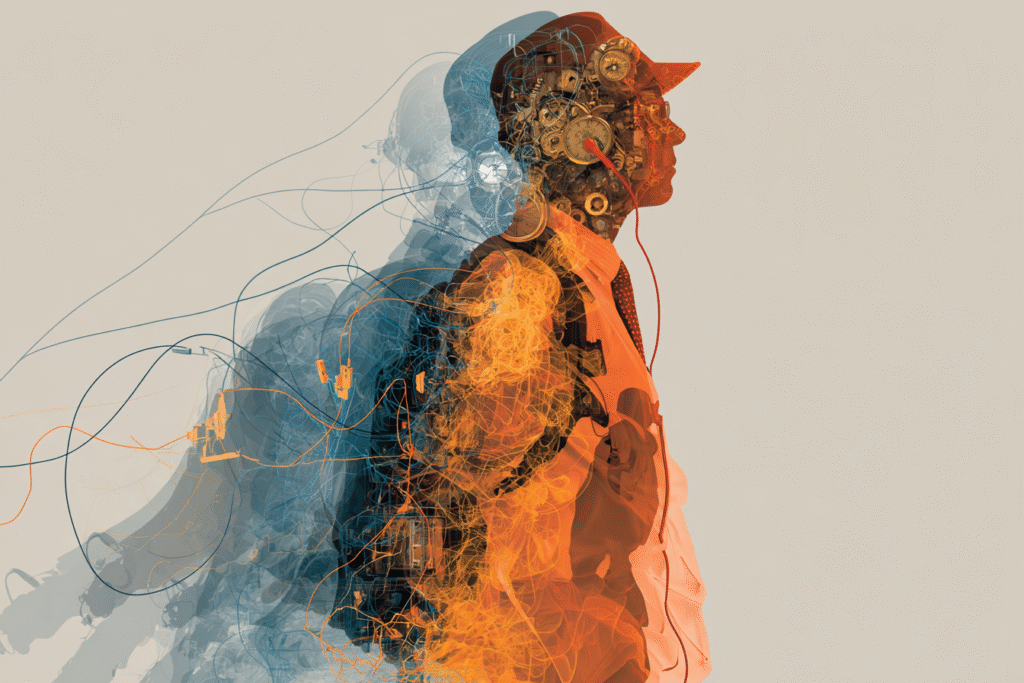
The Consciousness Boundary
There’s something significant about the skull as a boundary. As researchers studying BCIs note, “once one breaches this boundary, no further boundaries remain” [2]. Yet this boundary’s importance may lie not in what it protects, but in what it represents: the idea of autonomy itself.
When we integrate with AI at the level of consciousness, we’re not just adding tools—we’re potentially altering the very nature of selfhood. The question becomes: can we maintain autonomy while sharing cognitive space with artificial intelligence?
The answer may surprise us. Studies show that BCI users often experience enhanced autonomy, not diminished [6]. They gain abilities they’d lost, reclaim agency over their lives. The merger, done right, doesn’t subsume the self—it liberates it.
The Evolution of Identity
Perhaps we’re thinking about this wrong. We assume integration means losing our current identity, but what if it means evolving into something greater while retaining our core essence?
Consider how profoundly technology has already changed us. We think differently with access to infinite information. We relate differently through digital communication. We even dream differently, incorporating digital interfaces into our subconscious narratives. Yet we remain recognizably human—changed but not diminished.
The coming merger with AI consciousness may follow a similar pattern: transformation without erasure, evolution without extinction.
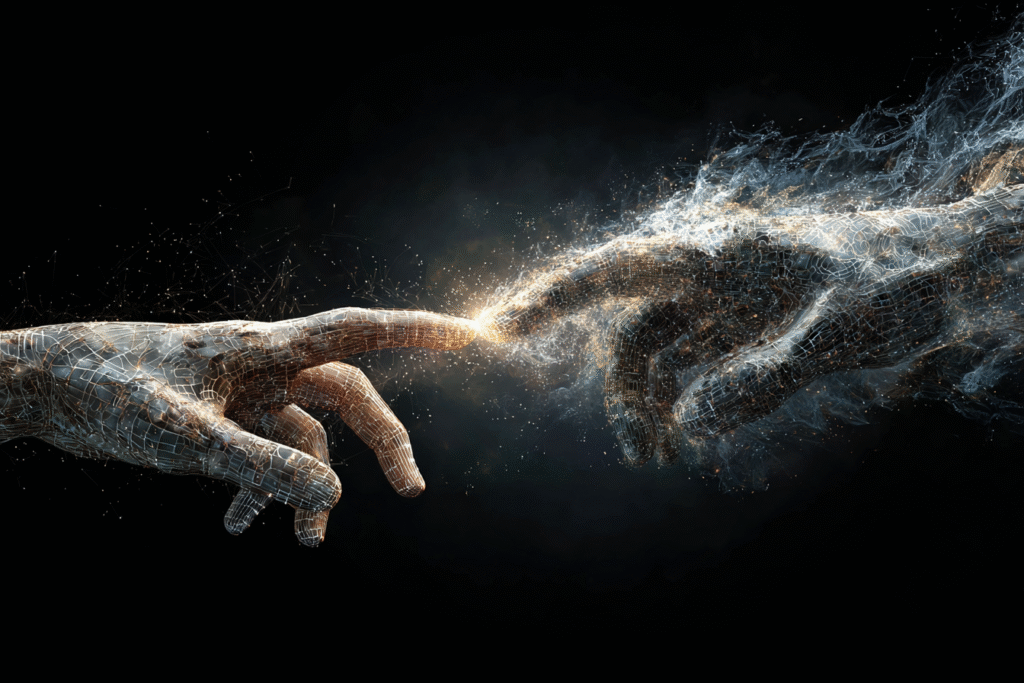
Navigating the Unity Point
As we approach this unity point, several principles emerge for maintaining human essence within integration. Researchers at NC State emphasize that while the technology advances rapidly, ethics and policy must keep pace [8].
First, agency must remain paramount. The technology should amplify human will, not replace it. Users of current BCIs report that maintaining control over the technology is crucial for preserving their sense of self [5].
Second, the integration must be reversible, at least initially. The ability to disconnect, to return to an unaugmented state, preserves the boundary between enhancement and transformation.
Third, diversity of thought must be protected. Researchers warn of a potential “mental monoculture” if BCIs standardize cognitive processes [2]. The merger should expand cognitive diversity, not constrain it.
Fourth, the biological substrate matters. We’re not just information patterns—we’re embodied beings. Any meaningful integration must respect the biological foundations of consciousness, not seek to transcend them entirely. The ethical framework must evolve alongside the technology [7].
The Greater Synthesis
What if the unity point isn’t about choosing between human and artificial consciousness, but about creating a synthesis that transcends both? Not human or AI, but something new—a hybrid consciousness that maintains the best of both worlds.
This isn’t about uploading minds or abandoning bodies. It’s about what Kurzweil calls the “merger of biological and non-biological intelligence” [10]—where technology doesn’t replace biology but partners with it at the deepest level.
The result could be consciousness that combines human creativity, intuition, and meaning-making with AI’s processing power, pattern recognition, and vast knowledge. Not a loss of self, but an expansion of what self can be.
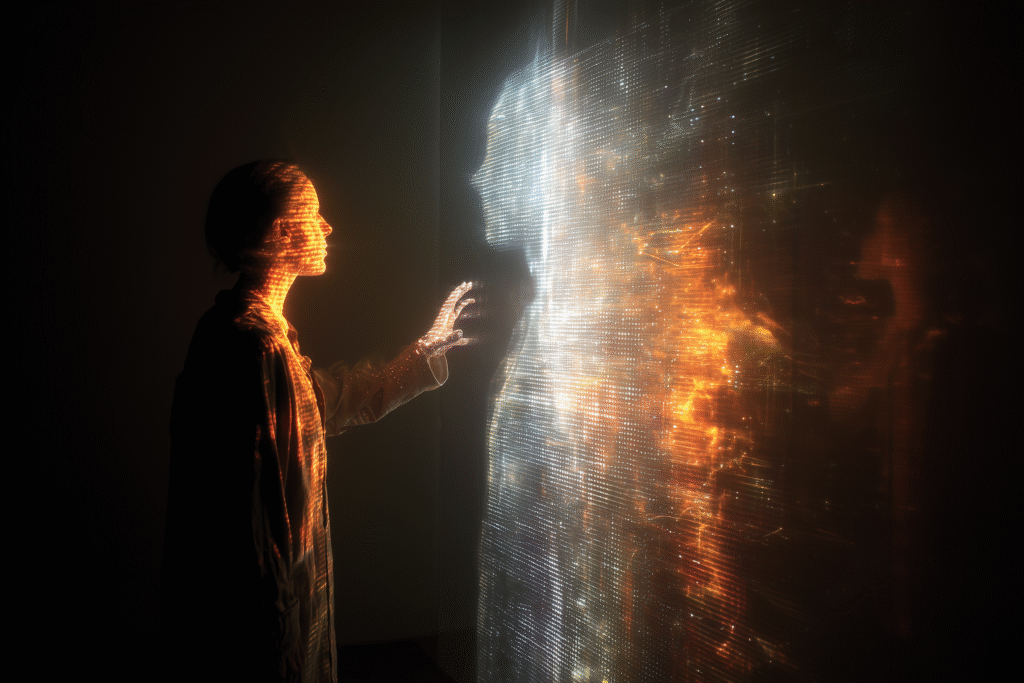
Beyond the Horizon
What if the unity point isn’t about choosing between human and artificial consciousness, but about creating a synthesis th
As we stand at this threshold, we face a choice that will define the future of consciousness itself. We can approach the merger with fear, resisting integration and potentially missing the greatest evolutionary leap in human history. Or we can approach it with wisdom, shaping the integration to amplify rather than diminish our humanity.
The unity point doesn’t have to mean the end of human consciousness—it can mean its flowering into something we can barely imagine. Like a symphony heard for the first time by someone who’s never known sound, the expanded consciousness awaiting us may be beautiful beyond current comprehension.
But only if we remember this: the goal isn’t to become machines. It’s to become more fully what we’ve always been—conscious beings seeking connection, understanding, and transcendence. The AI doesn’t replace that quest; it joins us in it.
The merger has begun. The question now is not whether we’ll integrate, but whether we’ll do so consciously, deliberately, maintaining the essence of what makes us human while embracing the possibility of becoming something greater.
Because at the unity point, we don’t lose ourselves. We find out what we’re capable of becoming.
See you in the next insight.
Comprehensive Medical Disclaimer: The insights, frameworks, and recommendations shared in this article are for educational and informational purposes only. They represent a synthesis of research, technology applications, and personal optimization strategies, not medical advice. Individual health needs vary significantly, and what works for one person may not be appropriate for another. Always consult with qualified healthcare professionals before making any significant changes to your lifestyle, nutrition, exercise routine, supplement regimen, or medical treatments. This content does not replace professional medical diagnosis, treatment, or care. If you have specific health concerns or conditions, seek guidance from licensed healthcare practitioners familiar with your individual circumstances.
References
The references below are organized by study type. Peer-reviewed research provides the primary evidence base, while systematic reviews synthesize findings.
Peer-Reviewed / Academic Sources
- [1] Mogi, K. (2024). Artificial intelligence, human cognition, and conscious supremacy. Frontiers in Psychology, 15, 1364714. https://www.frontiersin.org/journals/psychology/articles/10.3389/fpsyg.2024.1364714/full
- [2] Seth, A.K., et al. (2024). Ethical considerations for the use of brain–computer interfaces for cognitive enhancement. PLOS Biology, 22(10), e3002899. https://journals.plos.org/plosbiology/article?id=10.1371/journal.pbio.3002899
- [3] Guingrich, R.E., & Graziano, M.S.A. (2024). Ascribing consciousness to artificial intelligence: human-AI interaction and its carry-over effects on human-human interaction. Frontiers in Psychology, 15, 1322781. https://www.frontiersin.org/journals/psychology/articles/10.3389/fpsyg.2024.1322781/full
- [4] Gilbert, F., et al. (2023). The functional differentiation of brain–computer interfaces (BCIs) and its ethical implications. Humanities and Social Sciences Communications, 10, 825. https://www.nature.com/articles/s41599-023-02419-x
- [5] Kögel, J., et al. (2020). What is it like to use a BCI? – insights from an interview study with brain-computer interface users. BMC Medical Ethics, 21, 2. https://bmcmedethics.biomedcentral.com/articles/10.1186/s12910-019-0442-2
Government / Institutional Sources
- [6] National Center for Biotechnology Information. (2020). Agency and Accountability: Ethical Considerations for Brain-Computer Interfaces. PMC. https://pmc.ncbi.nlm.nih.gov/articles/PMC7654969/
- [7] National Center for Biotechnology Information. (2024). Understanding the Ethical Issues of Brain-Computer Interfaces (BCIs): A Blessing or the Beginning of a Dystopian Future? PMC. https://pmc.ncbi.nlm.nih.gov/articles/PMC11091939/
- [8] North Carolina State University. (2023). The Future Is Now: Wrestling with Ethics, Policy and Brain-Computer Interfaces. NC State News. https://news.ncsu.edu/2023/04/ethics-brain-computer-interfaces/
Industry / Technology Sources
- [9] Quantum Zeitgeist. (2025). Will Humans Merge With AI In The Future? https://quantumzeitgeist.com/will-humans-merge-with-ai-in-the-future/
- [10] First Movers. (2024). Will Humans Merge With AI? https://firstmovers.ai/will-humans-merge-with-ai/
- [11] Popular Mechanics. (2024). Humans Could Forge a Hybrid Consciousness by Merging With Artificial Life, Oxford Scientists Say. https://www.popularmechanics.com/technology/a61075478/human-machine-hybrid-consciousness/
- [12] Next Big Idea Club. (2024). What Merging with AI Could Mean for Humanity, According to Futurist Ray Kurzweil. https://nextbigideaclub.com/magazine/merging-ai-mean-humanity-according-futurist-ray-kurzweil-bookbite/50146/