The architecture of your mind is about to become visible and upgradeable.
Note: This article is for educational and informational purposes only. See full disclaimer at the end.
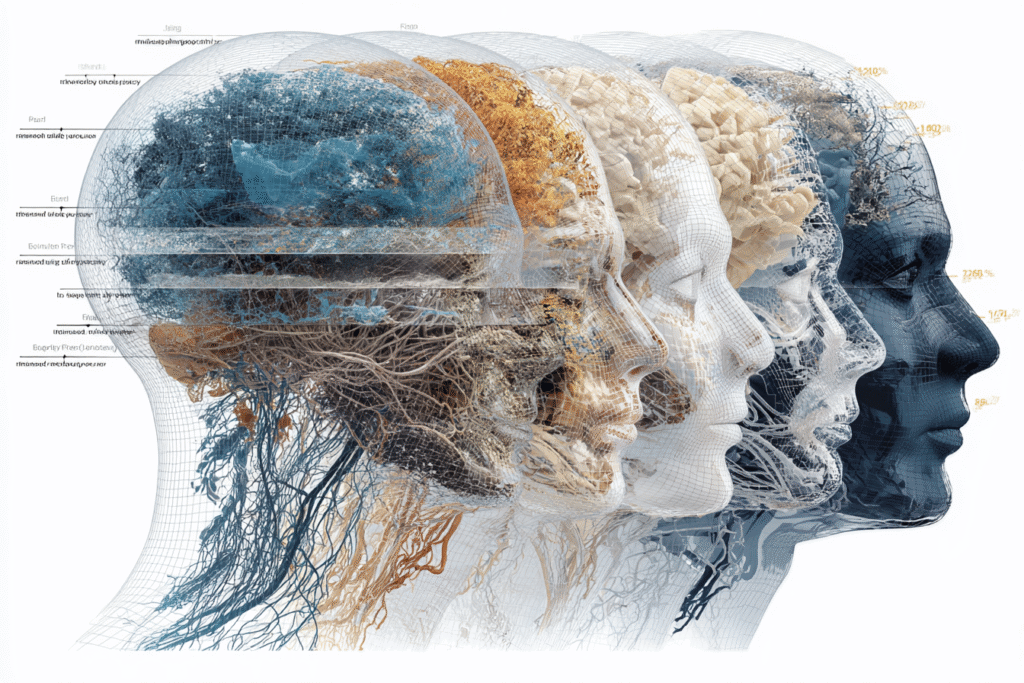
Think of your consciousness not as a single entity but as a stack of interacting layers, each processing reality at different speeds and depths.
Like a computer’s operating system that manages everything from hardware to user interface, your consciousness operates through distinct yet interconnected layers that determine how you perceive, process, and respond to the world.
Now, as we integrate AI into our cognitive processes, we’re not just using tools—we’re adding new layers to this stack, creating hybrid architectures of human and artificial intelligence that fundamentally alter how consciousness itself functions.

The Illusion of Unified Experience
When you read these words, your brain creates what feels like a seamless experience. But neuroscience reveals something far more complex: consciousness emerges from multiple processing layers operating simultaneously [10]. The brain’s “default ascending arousal network” maintains your basic wakefulness, while higher cortical networks generate the rich tapestry of awareness [11]. This isn’t just biological machinery—it’s a sophisticated information processing system where each layer transforms raw sensory data into the meaningful experience you call reality.
Consider what happens when you recognize a friend’s face in a crowd. Your visual cortex processes edges and shapes. Pattern recognition systems identify facial features. Memory networks retrieve associated information. Emotional centers generate feelings of familiarity. Social cognition layers prepare appropriate responses. All of this happens in milliseconds, creating the illusion of instant recognition. But it’s actually a cascade through multiple consciousness layers, each adding its own processing and meaning [12].
The revelation isn’t that consciousness is complex—it’s that consciousness is stackable. Just as software developers build applications by layering abstractions, your brain builds experience by stacking processing layers. And now, with AI, we can consciously architect new layers into this stack.
The Four Core Layers
Through both neuroscientific research and practical observation, we can identify four fundamental layers in the human consciousness stack, each with distinct functions and, crucially, different potentials for AI augmentation:
Layer 1: The Sensory-Perceptual Foundation
This is where raw data becomes experience. Your brain doesn’t passively receive reality—it actively constructs it through what neuroscientist Anil Seth calls “controlled hallucination” [13]. Every perception is actually a prediction, constantly updated by sensory feedback. This layer operates largely below conscious awareness, processing millions of bits of information to create the stable world you experience.
AI integration at this layer is already happening through augmented reality, real-time translation, and enhanced sensory devices. But we’re just scratching the surface. Imagine AI that doesn’t just translate languages but translates entire sensory modalities—turning data streams into intuitive perceptions, making the invisible visible, the inaudible audible [14].
Layer 2: The Attentional Gateway
Attention isn’t just focus—it’s the gateway between unconscious processing and conscious awareness [1]. This layer determines what information rises to consciousness and what remains in the shadows of automatic processing. Research shows that attention can operate without consciousness and consciousness without attention, but the two usually work in concert to create your stream of awareness [2].
Here’s where AI becomes transformative. Current AI systems already filter information, but emerging “cognitive augmentation” technologies will act as attentional prosthetics, automatically directing your awareness to what matters most based on your goals, context, and even biological state [15]. Think of it as having a cognitive assistant that manages your attention the way a good executive assistant manages your calendar—intelligently, proactively, and aligned with your deeper purposes.
Layer 3: The Working Memory Theatre
Working memory is consciousness’s workspace—where information becomes manipulable, combinable, and creative [3]. It’s limited (famously to about 7±2 items) but incredibly flexible. This is where you hold a phone number while dialing, where you mentally rotate objects, where you construct arguments and imagine futures. Recent research suggests working memory isn’t just one system but multiple specialized buffers coordinated by a “central executive” [2].
AI integration here is perhaps the most profound. Large language models already serve as external working memory, holding context and allowing us to manipulate complex information beyond our biological limits [4]. But the next evolution isn’t just external memory—it’s seamless integration where AI maintains and manipulates information spaces that feel like extensions of your own mind. You think it; AI maintains it; you manipulate it together in a shared cognitive workspace.
Layer 4: The Metacognitive Observer
This is consciousness aware of itself—the layer that knows that it knows [5]. Metacognition allows you to monitor your own thinking, evaluate your judgments, recognize when you’re confused, and deliberately shift mental strategies. It’s what separates human consciousness from simpler forms of awareness.
Paradoxically, this may be where AI integration is both most powerful and most dangerous. AI can augment metacognition by helping us recognize our own biases, track our cognitive patterns, and optimize our thinking strategies [16]. But there’s a risk: if we delegate too much metacognitive monitoring to AI, we might lose the very self-awareness that makes us human. The key is using AI to enhance rather than replace our metacognitive capabilities.

Building Your Personal Stack
Understanding these layers is one thing; consciously building and optimizing your personal consciousness stack is another. Here’s how the architecture comes together in practice:
Start with awareness. Before adding AI layers, understand your existing stack. Notice how your attention moves, how your working memory handles load, when your metacognition engages. This isn’t meditation (though that helps)—it’s systematic self-observation of your cognitive architecture in action.
Choose your augmentations intentionally. Not every AI tool deserves a place in your consciousness stack. The question isn’t “What can this AI do?” but “What layer does this augment, and do I want that augmentation?” A note-taking AI might enhance working memory. A recommendation algorithm might influence attention. Choose tools that strengthen the layers you want to develop, not ones that merely compensate for weaknesses.
Maintain boundaries. The most sophisticated technology companies design their AI to blur the boundaries between your consciousness and their systems—to make you forget where you end and the AI begins [6]. Resist this. Clear boundaries aren’t limitations; they’re what allow genuine collaboration rather than cognitive colonization.
Practice integration cycles. Use AI intensively, then step away completely. This cycling helps you internalize what the AI taught you while maintaining your autonomous capabilities. It’s like training wheels—useful for learning, dangerous if you never take them off.
The Emergence of Hybrid Consciousness
As we integrate these layers, something unprecedented emerges: hybrid consciousness that’s neither fully human nor fully artificial [17]. This isn’t the “upload your brain” fantasy of science fiction—it’s happening now, every time you think with AI assistance. You’re not replacing your consciousness; you’re extending it into new dimensions.
Research on human-AI collaboration reveals that the highest performance comes not from humans or AI alone, but from sophisticated integration where each compensates for the other’s limitations [18]. Humans provide context, creativity, and ethical judgment. AI provides processing power, pattern recognition, and infinite patience. Together, they create cognitive capabilities that neither possesses alone.
But this isn’t automatic. Poor integration can actually diminish human cognitive capabilities, creating what researchers call “cognitive offloading” where humans become passive consumers of AI-generated content [7]. The difference lies in how consciously you architect the integration.

The Consciousness Interface
The future isn’t about having AI—it’s about how AI interfaces with your consciousness stack. Current interfaces are crude: keyboards, screens, voice commands. But emerging brain-computer interfaces and more sophisticated interaction modalities will allow increasingly direct connection between consciousness layers and AI systems [14].
Yet the most important interface isn’t technological—it’s conceptual. How you think about the relationship between your consciousness and AI determines how that relationship develops. Think of AI as a master and you become a slave. Think of it as a slave and you miss its potential. Think of it as a partner in consciousness expansion and you open possibilities we’re only beginning to imagine.
Navigation Principles for the Augmented Mind
As you build your personal consciousness stack, certain principles emerge from both research and practice:
Preserve generative friction. Consciousness needs resistance to develop strength. If AI makes everything effortless, your cognitive capabilities atrophy. Maintain zones of deliberate difficulty where you think without assistance.
Amplify, don’t automate. Use AI to amplify your consciousness layers, not to bypass them. The goal isn’t to think less but to think better, deeper, and across wider spaces.
Maintain metacognitive sovereignty. Never fully delegate the observer layer. No matter how sophisticated AI becomes, preserve your capacity to observe and evaluate your own cognitive processes independently.
Embrace cognitive diversity. Your consciousness stack is unique, shaped by your neurology, experience, and choices. Don’t try to optimize toward some universal standard. Build a stack that amplifies your particular gifts and compensates for your specific challenges.
The Deep Integration Challenge
The real challenge isn’t technical—it’s philosophical and practical. How do we integrate AI into our consciousness without losing what makes us human? Research suggests the answer lies not in resistance but in conscious co-evolution [8]. We’re not just users of AI; we’re co-creating new forms of consciousness.
This requires what researchers call “cognitive empathy” with AI—understanding how it processes information, recognizing its patterns and limitations, learning to think with rather than through artificial intelligence [6]. It’s a new literacy, as fundamental as reading or writing, but operating at the level of consciousness itself.
The Stack in Action
Consider how this plays out in a real scenario: You’re trying to solve a complex problem at work.
Without conscious stack management, you might just dump the problem into ChatGPT and accept whatever emerges. But with stack awareness, you engage differently:
Your perceptual layer gathers relevant information, with AI helping you see patterns you might miss. Your attention layer, guided by AI analysis, focuses on the crucial variables while maintaining peripheral awareness of context. Your working memory layer, augmented by AI’s ability to hold and manipulate complex information, explores solution spaces beyond your biological limits. Your metacognitive layer observes the entire process, noticing when you’re over-relying on AI, when you need to think independently, when to trust intuition over analysis.
The result isn’t just a better solution—it’s an evolved consciousness, one that has learned to think in partnership with artificial intelligence while maintaining its essential humanity.
The Paradox of Enhancement
Here’s the paradox: The more powerfully we augment our consciousness, the more important our uniquely human qualities become [9]. As AI handles more cognitive processing, what remains irreducibly human—our consciousness, our subjective experience, our capacity for meaning-making—becomes not less but more valuable.
Your personal consciousness stack isn’t about becoming more machine-like. It’s about becoming more fully human through conscious integration with artificial intelligence. It’s about using AI to explore territories of consciousness we couldn’t access alone while maintaining the sovereignty of our own awareness.

Your Stack Awaits
Right now, you’re operating with a consciousness stack whether you recognize it or not. The question isn’t whether to have one—it’s whether to consciously architect it. Every app you use, every AI you engage, every cognitive tool you adopt is already modifying your stack. The choice is whether these modifications happen to you or through you.
Building your personal consciousness stack isn’t a project you complete—it’s an ongoing practice of conscious evolution. Each day, you have the opportunity to observe your layers in action, to experiment with new integrations, to strengthen what works and modify what doesn’t.
The tools are available. The research is clear. The potential is unprecedented. But the architecture must be yours—consciously chosen, carefully constructed, continuously refined. Your consciousness stack is the most important technology you’ll ever build, because it determines not just what you can do, but who you become in partnership with AI.
The age of hybrid consciousness has arrived. The only question is: What will you build with yours?
See you in the next insight.
Comprehensive Medical Disclaimer: The insights, frameworks, and recommendations shared in this article are for educational and informational purposes only. They represent a synthesis of research, technology applications, and personal optimization strategies, not medical advice. Individual health needs vary significantly, and what works for one person may not be appropriate for another. Always consult with qualified healthcare professionals before making any significant changes to your lifestyle, nutrition, exercise routine, supplement regimen, or medical treatments. This content does not replace professional medical diagnosis, treatment, or care. If you have specific health concerns or conditions, seek guidance from licensed healthcare practitioners familiar with your individual circumstances.
References
The references below are organized by study type. Peer-reviewed research provides the primary evidence base, while systematic reviews synthesize findings.
Peer-Reviewed / Academic Sources
- [1] Koch, C., & Tsuchiya, N. (2010). Consciousness and Attention: On Sufficiency and Necessity. Frontiers in Psychology, 1:217. https://www.frontiersin.org/journals/psychology/articles/10.3389/fpsyg.2010.00217/full
- [2] Persuh, M., LaRock, E., & Berger, J. (2018). Working Memory and Consciousness: The Current State of Play. Frontiers in Human Neuroscience, 12:78. https://www.frontiersin.org/journals/human-neuroscience/articles/10.3389/fnhum.2018.00078/full
- [3] Bergström, F., & Eriksson, J. (2018). Working Memory and Consciousness: The Current State of Play. Frontiers in Human Neuroscience. https://pmc.ncbi.nlm.nih.gov/articles/PMC5840147/
- [4] Chen, J., et al. (2025). From Consumption to Collaboration: Measuring Interaction Patterns to Augment Human Cognition in Open-Ended Tasks. arXiv preprint. https://arxiv.org/html/2504.02780v1
- [5] Budson, A. E., et al. (2022). Consciousness as a Memory System. Cognitive and Behavioral Neurology, 35(4), 263-297. https://pmc.ncbi.nlm.nih.gov/articles/PMC9708083/
- [6] Pareschi, F. (2025). Human-artificial interaction in the age of agentic AI: a system-theoretical approach. Frontiers in Human Dynamics. https://www.frontiersin.org/journals/human-dynamics/articles/10.3389/fhumd.2025.1579166/full
- [7] Dergaa, I., et al. (2024). From tools to threats: a reflection on the impact of artificial-intelligence chatbots on cognitive health. Frontiers in Psychology, 15:1259845. https://pmc.ncbi.nlm.nih.gov/articles/PMC11020077/
- [8] Cerf, V., et al. (2024). Improvements ahead: How humans and AI might evolve together in the next decade. Pew Research Center. https://www.pewresearch.org/internet/2018/12/10/improvements-ahead-how-humans-and-ai-might-evolve-together-in-the-next-decade/
- [9] Keppler, J. (2024). Laying the foundations for a theory of consciousness: the significance of critical brain dynamics for the formation of conscious states. Frontiers in Human Neuroscience, 18:1379191. https://doi.org/10.3389/fnhum.2024.1379191
Government / Institutional Sources
- [10] Massachusetts General Hospital. (2024). Brain imaging study reveals connections critical to human consciousness. ScienceDaily. https://www.sciencedaily.com/releases/2024/05/240501152947.htm
- [11] Bertagnolli, M. M. (2024). Researchers Map Neural Connections Key to Wakefulness in the Human Brain. NIH Director’s Blog. https://directorsblog.nih.gov/2024/05/23/researchers-map-neural-connections-key-to-wakefulness-in-the-human-brain/
- [12] Stanford Encyclopedia of Philosophy. (2018). The Neuroscience of Consciousness. https://plato.stanford.edu/entries/consciousness-neuroscience/
Industry / Technology Sources
- [13] Berent, I. (2024). Our brains trick us into thinking consciousness can reside outside the body. Neuroscience of Consciousness. https://news.northeastern.edu/2024/05/10/neuroscience-of-consciousness-research/
- [14] Quanta Intelligence. (2024). Advancements in Human Augmentation Tech. https://quantaintelligence.ai/2024/10/14/technology/advancements-in-human-augmentation-tech
- [15] Youvan, D. C. (2024). Expanding Human Thought Through Artificial Intelligence: A New Frontier in Cognitive Augmentation. ResearchGate. https://www.researchgate.net/publication/384399213_Expanding_Human_Thought_Through_Artificial_Intelligence_A_New_Frontier_in_Cognitive_Augmentation
- [16] Machaiah, P. (2024). Beyond Human: How AI is Revolutionizing Cognitive Augmentation. Medium. https://medium.com/@poonacha/beyond-human-how-ai-is-revolutionizing-cognitive-augmentation-00a84cc9bf78
- [17] Wilson, H. J., & Daugherty, P. R. (2018). Collaborative Intelligence: Humans and AI Are Joining Forces. Harvard Business Review. https://hbr.org/2018/07/collaborative-intelligence-humans-and-ai-are-joining-forces
- [18] (2024). Human-AI Collaboration: Enhancing Productivity and Decision-Making. ResearchGate. https://www.researchgate.net/publication/386225744_Human-AI_Collaboration_Enhancing_Productivity_and_Decision-Making