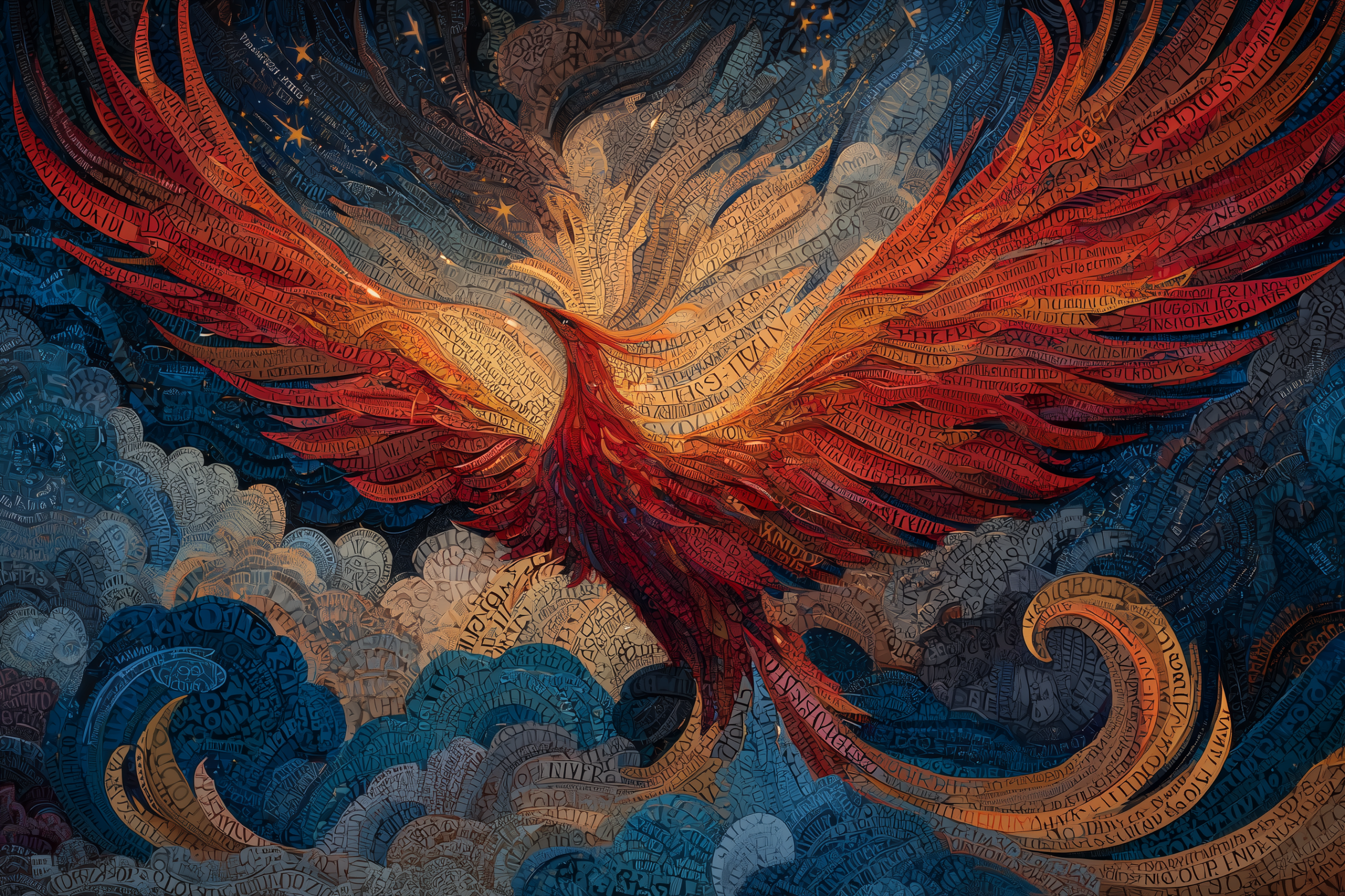
Every morning, before the world wakes, you sit at your desk with intention—not to produce, but to practice.
Note: This article is for educational and informational purposes only. See full disclaimer at the end.
The repetition in our digital workflows has become so familiar that we rarely question it anymore. Open laptop. Check metrics. Clear inbox. Run the prompt chain. Deploy the automation. Review outputs. Iterate. Repeat. We’ve optimized these sequences down to the millisecond, measured their efficiency in saved hours, celebrated their scalability. But somewhere in the pursuit of frictionless productivity, we’ve forgotten to ask: what if these workflows themselves could be sacred?
The ancient Zen gardens of Kyoto weren’t designed for efficiency. The monks who raked patterns into gravel each morning weren’t optimizing for output. They understood something we’re only beginning to rediscover in our age of AI automation: that repetition, when infused with consciousness, becomes ritual. That workflow, when approached with intention, becomes practice [4].
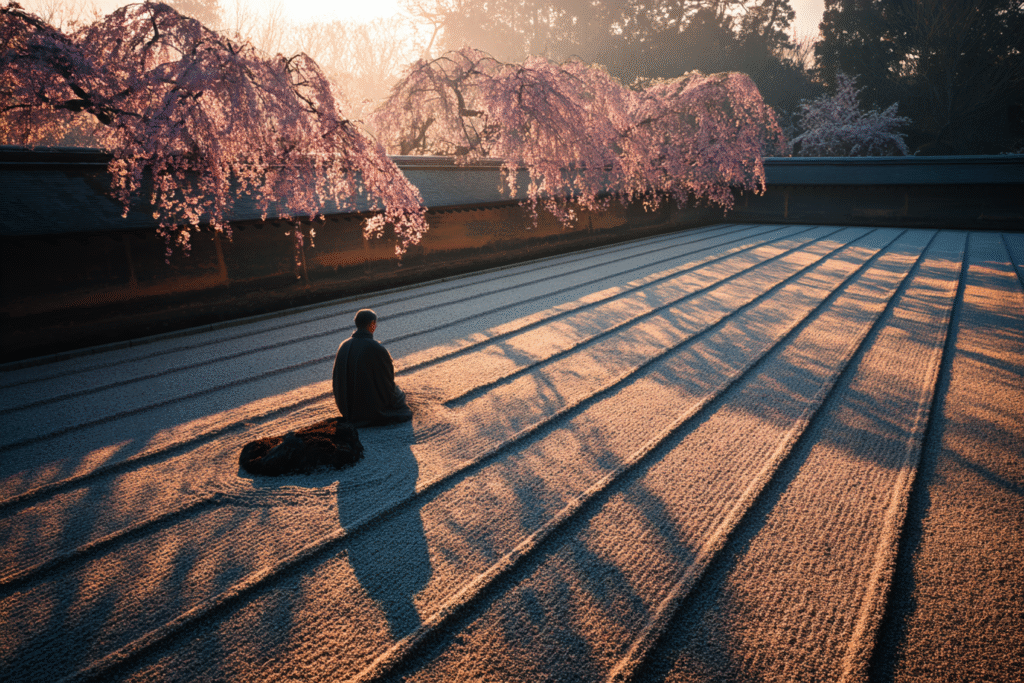
The Difference Between Automation and Conscious Automation
Kenneth Reitz, creator of the Python Requests library, describes programming as “karma yoga—the path of conscious action” where every function written creates consequences that ripple through millions of lives [4]. This isn’t about adding meditation apps to your development workflow or putting Buddha statues on your desk. It’s about recognizing that every automated sequence we create, every prompt chain we design, shapes human experience.
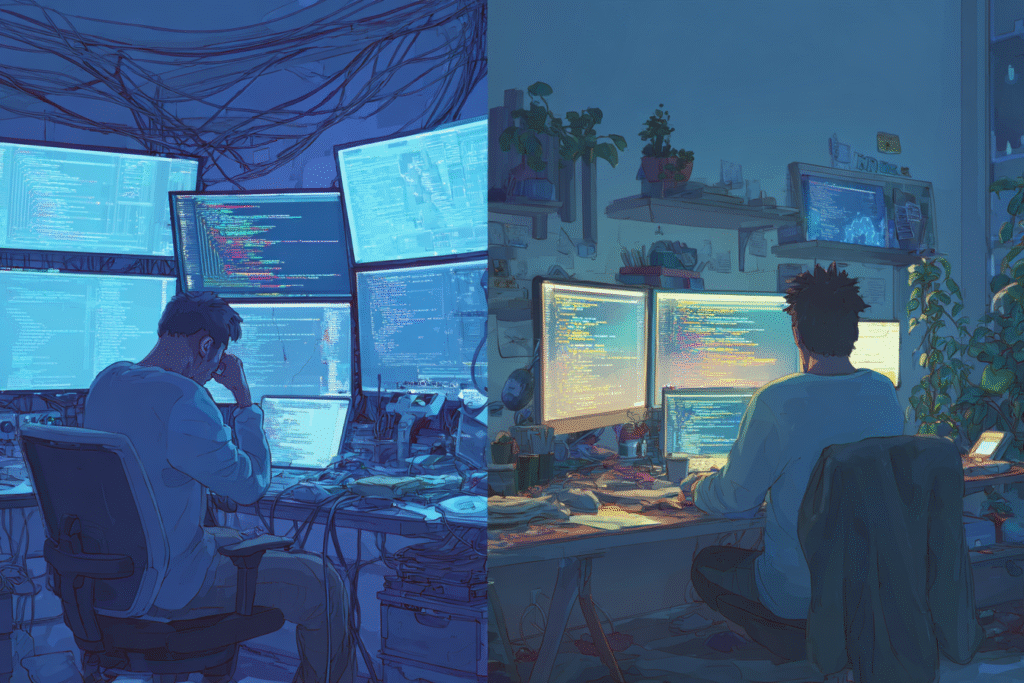
Consider the difference: mindless automation seeks to eliminate human involvement. It celebrates the removal of friction, the reduction of thought, the abdication of presence. We build systems to run without us, then wonder why we feel disconnected from our work. Conscious automation, by contrast, sees these systems as extensions of our intention. Each workflow becomes a manifestation of our values, each prompt chain a crystallization of our understanding.
Julia Cameron, in “The Artist’s Way,” prescribes Morning Pages—three pages of longhand writing every morning to clear mental clutter and open creative channels [5]. This isn’t efficient. It’s not optimized. You could type faster, you could use voice transcription, you could have AI summarize your thoughts. But the inefficiency is the point. The practice lies not in the output but in the process itself.
When Repetition Becomes Ritual
The software development world has always had its rituals, though we rarely call them that. Developers speak of getting “in the zone,” that flow state where code seems to write itself [6]. Isaac Kelly, Lead Developer at Servee.com, describes his pre-coding ritual: “Before sitting down to a coding session, he gets a big glass of water, takes everything off of his desk, and closes out all programs and e-mail, keeping open only his code editor” [6].
But these aren’t just productivity hacks. They’re invocations, preparations for entering a different state of consciousness. The repetition creates a container for focused attention, a boundary between the mundane and the creative.
As one developer noted about debugging: “It is fundamentally a contemplative practice—a process of patient observation, hypothesis formation, and careful investigation. Approached mindfully, debugging becomes a form of vipassana meditation: sustained, non-judgmental attention to what actually is, rather than what we think should be” [4].
The difference between routine and ritual, as creativity coach Conni Biesalski explains, “is the attitude behind the action. While routines can be actions that just need to be done—such as making your bed or taking a shower—rituals are viewed as more meaningful practices which have a real sense of purpose” [7].

Sacred Patterns in Digital Processes
Prompt chaining, the technique of breaking complex AI tasks into sequential steps where each output feeds the next input, has become standard practice in AI workflows [2]. But what if we approached these chains not as mere technical sequences but as mantras—repeated patterns that shape not just our outputs but our consciousness?
When you design a prompt chain, you’re not just optimizing for efficiency. You’re encoding your thought process, crystallizing your understanding into repeatable form. Each step in the chain represents a moment of intention, a decision about what matters and what doesn’t. The output of one prompt becoming the input for the next mirrors the way consciousness itself flows—each thought arising from the previous, each moment building on what came before [8].
The act of refining these chains becomes a form of meditation. You observe the outputs, adjust the prompts, test again. This iterative process isn’t unlike the Buddhist concept of “beginner’s mind”—approaching each iteration fresh, without assumption, ready to see what emerges [1].
The Cost of Unconscious Automation
Agile methodologies introduced us to “rituals” like daily stand-ups, sprint planning, and retrospectives [3]. But as Adrian Pickering observes, many of these have devolved into “cargo cult” practices—empty rituals performed without understanding their purpose, “religious rituals in software development” that teams follow blindly [9].
This is the danger of workflow without consciousness. We inherit patterns from others, implement “best practices” without questioning whether they serve our specific needs, our unique creative process. We adopt someone else’s morning routine wholesale, forgetting that, as Pearl S. Buck said, “I don’t wait for moods. You accomplish nothing if you do that. Your mind must know it has to get to work” [10].
The same risk exists with AI automation. We can build elaborate prompt chains, sophisticated workflows, complex automations—but if we’re not present in their creation and execution, we’re just creating more sophisticated ways to absent ourselves from our work.
Creators Who Treat Workflow as Practice
Mason Currey’s “Daily Rituals: How Artists Work” documents the working habits of 161 highly successful creators, revealing there’s no magic formula—only the way that’s right for each individual [11]. Yet patterns emerge: the deliberate structuring of time, the conscious preparation for creative work, the treatment of process as sacred.
Anne-Laure Le Cunff, former Googler, dedicated two hours every day for 100 days to write and publish articles on mindful productivity. She blocked the same time every day, Monday to Friday, creating a container for her practice [7]. This wasn’t about efficiency—she could have batched the writing, outsourced the research, automated the publishing. It was about presence, about showing up consistently to the practice itself.
Hal Elrod’s “Miracle Morning” presents a six-step routine using the acronym SAVERS: Silence, Affirmations, Visualization, Exercise, Reading, and Scribing (journaling). While he suggests 10 minutes for each practice, creating an hour-long morning routine, the framework can be adapted to any schedule [7]. The power isn’t in the specific activities but in their intentional sequence, their daily repetition, their transformation from routine into ritual.
The Intention Behind the Automation
When we build AI workflows with consciousness, something shifts. Instead of asking “How can I make this faster?” we ask “What am I trying to manifest through this process?” Instead of optimizing for minimum human involvement, we design for maximum human intention.
A research team using prompt chaining for complex analysis might structure their workflow not just for accuracy but for understanding [12]. Each step in the chain becomes an opportunity for reflection: What did we learn from this output? How does it inform the next question? Where is our intuition guiding us?
This mirrors what software teams discovered with test-driven development—writing the test before the code forces you to clarify your intention before implementation [13]. The constraint becomes liberating, the structure enables creativity.
Mindfulness in the Age of AI Acceleration
The integration of AI and mindfulness practices raises profound questions. As researchers note in a recent study on AI and spirituality: “The combination of spirituality, meditation, and artificial intelligence has promising potential to expand people’s well-being” but brings “major philosophical and ethical issues into question, including the genuineness of experiences that are facilitated by artificial intelligence” [1].
Yet perhaps the question isn’t whether AI can facilitate genuine spiritual experience, but whether we can maintain genuine spiritual practice while using AI. Can we remain present while automating? Can we stay conscious while scaling?
Zapier, the automation platform, frames this challenge beautifully: “Mindfulness is the practice of being especially conscious or aware of what’s happening in the current moment” [14]. Their suggestion? Use automation to handle menial tasks so you can focus fully on what requires your presence. The automation becomes a support for mindfulness, not a replacement for it.
Building Your Own Conscious Workflow
Creating a spiritual practice around your digital workflow doesn’t require abandoning your tools or slowing your output. It requires bringing intention to what you’re already doing. Consider these approaches:
Morning Invocation: Before opening your laptop, set an intention for the day’s work. Not a goal, not a metric—an intention about how you want to show up, what quality you want to bring to your interactions with both humans and machines.
Prompt as Prayer: When crafting prompts for AI, especially in chain sequences, treat each prompt as you would a prayer or meditation—with care, precision, and awareness of its ripple effects. As one practitioner notes about prompt design: “Each of these prompts is designed not just to elicit better output—but to shape better thinking.”
Conscious Review: Instead of just checking outputs for accuracy, approach review as a contemplative practice. What patterns do you see? What is the AI teaching you about your own thought process? Where is there misalignment between intention and output?
Workflow as Mandala: Like Tibetan monks who create elaborate sand mandalas only to sweep them away, recognize that your workflows are temporary. They serve their purpose, then evolve. Don’t cling to automation that no longer serves your intention [4].
The Future of Sacred Work
As AI capabilities expand and automation becomes more sophisticated, the need for conscious practice becomes more urgent, not less. We’re not just building tools; we’re shaping the environment in which human consciousness will evolve. Every workflow we create, every automation we deploy, becomes part of the digital ecosystem that future generations will inhabit.
The question isn’t whether to automate—that ship has sailed. The question is how to automate while remaining human, how to scale while staying present, how to optimize while honoring the sacred in the everyday.
Buddhist teacher Thich Nhat Hanh wrote about “washing dishes to wash dishes”—being fully present in mundane tasks rather than rushing through them to get to something else. What if we approached our digital workflows the same way? Not automating to escape the work, but automating to be more present in it?
Your Practice Awaits
Tomorrow morning, when you sit down at your desk, pause before you begin. Feel the keys under your fingers. Notice the screen’s glow. Set an intention—not for what you’ll produce, but for how you’ll practice.
Your workflow is waiting to become ritual. Your automation is ready to carry consciousness. Your prompt chains can become mantras, your debugging can become meditation, your daily stand-up can become sacred.
The tools don’t make the practice. The intention does. And in this age of infinite leverage, where a single prompt can generate endless content, where one automation can scale to millions, the quality of our intention matters more than ever.
Because ultimately, we’re not just programming machines. We’re programming reality. And that’s always been a spiritual practice.
See you in the next insight.
Comprehensive Medical Disclaimer: The insights, frameworks, and recommendations shared in this article are for educational and informational purposes only. They represent a synthesis of research, technology applications, and personal optimization strategies, not medical advice. Individual health needs vary significantly, and what works for one person may not be appropriate for another. Always consult with qualified healthcare professionals before making any significant changes to your lifestyle, nutrition, exercise routine, supplement regimen, or medical treatments. This content does not replace professional medical diagnosis, treatment, or care. If you have specific health concerns or conditions, seek guidance from licensed healthcare practitioners familiar with your individual circumstances.
References
The references below are organized by study type. Peer-reviewed research provides the primary evidence base, while systematic reviews synthesize findings.
Peer-Reviewed / Academic Sources
- [1] ResearchGate, (2025). AI Meets Mindfulness: Redefining Spirituality and Meditation in the Digital Age. ResearchGate. https://www.researchgate.net/publication/388388096_AI_Meets_Mindfulness_Redefining_Spirituality_and_Meditation_in_the_Digital_Age
Government / Institutional Sources
- [2] IBM, (2025). What is prompt chaining? IBM. https://www.ibm.com/think/topics/prompt-chaining
- [3] ITpreneurs, (2020). The Importance of Rituals/Events in the Agile Methodology. ITpreneurs. https://www.itpreneurs.com/blog/importance-ritualsevents-agile-methodology/
Industry / Technology Sources
- [4] Kenneth Reitz, (2025). Programming as Spiritual Practice. Kenneth Reitz. https://kennethreitz.org/essays/2025-08-26-programming_as_spiritual_practice
- [5] Josie Robinson, (2023). Elevate Your Morning Routine: 5 Life-Changing Spiritual Practices to Cultivate Daily. Josie Robinson. https://www.josierobinson.com/journal/morning-rituals
- [6] Slashdot, (2009). Why Programming Rituals Work. Slashdot. https://developers.slashdot.org/story/09/05/18/1825244/why-programming-rituals-work
- [7] Conni Biesalski, (2020). The Power of Rituals and Routines for Creators. Conni.me. https://www.conni.me/blog/rituals-routines-creators
- [8] Prompting Guide, (n.d.). Chain-of-Thought Prompting. Prompting Guide. https://www.promptingguide.ai/techniques/cot
- [9] Adrian Pickering, (2018). Religious Rituals in Software Development. LinkedIn. https://www.linkedin.com/pulse/religious-rituals-software-development-adrian-pickering
- [10] On My Canvas, (2024). Creative Routine and Rituals – How to Dream and Create Consistently. On My Canvas. https://www.onmycanvas.com/creative-routine-rituals/
- [11] Mason Currey, (2013). Daily Rituals: How Artists Work. Amazon. https://www.amazon.com/Daily-Rituals-How-Artists-Work/dp/0307273601
- [12] Mayuresh K, (2025). A Guide to Prompt Chaining in AI Workflows. Medium. https://medium.com/@mskadu/a-guide-to-prompt-chaining-in-ai-workflows-e8db78011732
- [13] Underjord, (n.d.). Tradition and Ritual in Software, or The Unwritten Code of Code. Underjord. https://underjord.io/tradition-and-ritual-in-software.html
- [14] Zapier, (2021). How to use mindfulness to be more productive. Zapier. https://zapier.com/blog/mindfulness-and-productivity/