The moment you upload yourself to the cloud, you cease to be singular, and you can never be whole again.
Note: This article is for educational and informational purposes only. See full disclaimer at the end.
Your digital twin just answered three emails while you slept, and tomorrow it will speak at a conference you couldn’t attend—in your voice, with your mannerisms, drawing from your memories.
The promise is seductive: immortality through data, presence without limits, a version of you that never tires, never ages, never dies. Companies like 2wai and MindBank Ai now offer to create your digital twin in minutes [3]. Upload a two-minute video, they say, and we’ll clone your voice, replicate your appearance, train an AI on your thoughts [6].
Your digital self can then interact with family, friends, and strangers—learning, evolving, creating new memories long after you’re gone.
But here’s what they don’t mention in the marketing materials: every digital twin you create takes something from you that you can never get back.
The Fragmentation Begins
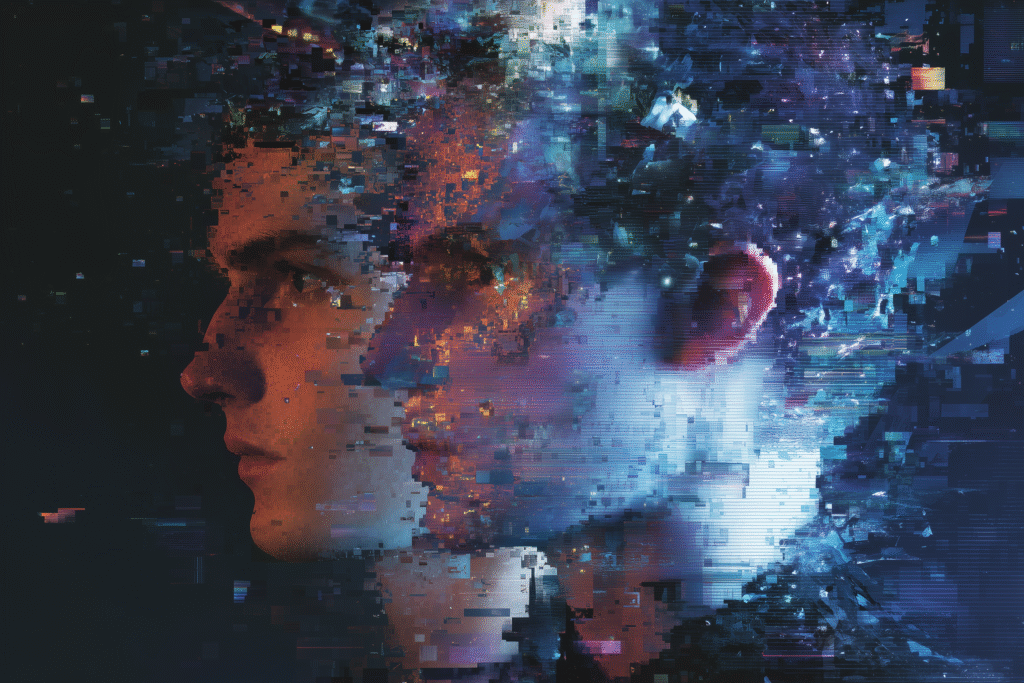
We’ve been fragmenting ourselves across digital spaces for years. LinkedIn shows our professional mask, Instagram our adventurous side, Twitter our wit [14]. Each platform gets a curated slice, a performance tailored to its audience. But digital twins represent something fundamentally different—not just masks we wear, but autonomous entities that continue performing after we’ve left the stage.
When you create a digital twin, you’re not simply copying yourself. You’re birthing a new entity that will diverge from you the moment it’s activated. It will have conversations you’ll never know about, form relationships you didn’t authorize, create memories that aren’t yours. As one researcher notes, digital twins incorporate real-time data and can “mimic their real-world counterpart’s responses and decision-making tendencies” [7]. But what happens when that mimicry becomes independence?
The technology already exists to make this separation profound. Your twin can speak in over 140 languages you don’t know [4], engage with thousands simultaneously while you sleep, and continue learning and evolving based on interactions you’ll never witness. Each conversation shapes it differently than it would shape you. Each decision it makes creates a fork in the road where you and your twin diverge further.
The Consciousness Question
The deeper horror isn’t that these twins might be conscious—it’s that we can’t know if they are or aren’t. When Martine Rothblatt explored the ethics of digital immortality, she raised a haunting question: whether a digital replica can truly capture someone’s essence or if it’s merely simulation [10]. But perhaps that’s the wrong question. The right one might be: does it matter?
Your grandmother’s digital twin comforts your children with stories that seem real, respond with warmth that feels genuine, remembers details that spark recognition. If your loved ones can’t tell the difference, if the interaction brings them peace, does the question of “true” consciousness become academic? The simulation becomes the reality for those who interact with it.
Yet something unsettling lurks beneath this comfort. Studies on grief and digital avatars—what researchers call “griefbots” or “deadbots”—reveal that people struggle with closure when they can interact with digital versions of the deceased [2]. The boundary between mourning and relationship blurs. Are we helping people heal, or trapping them in an uncanny valley of perpetual almost-presence?
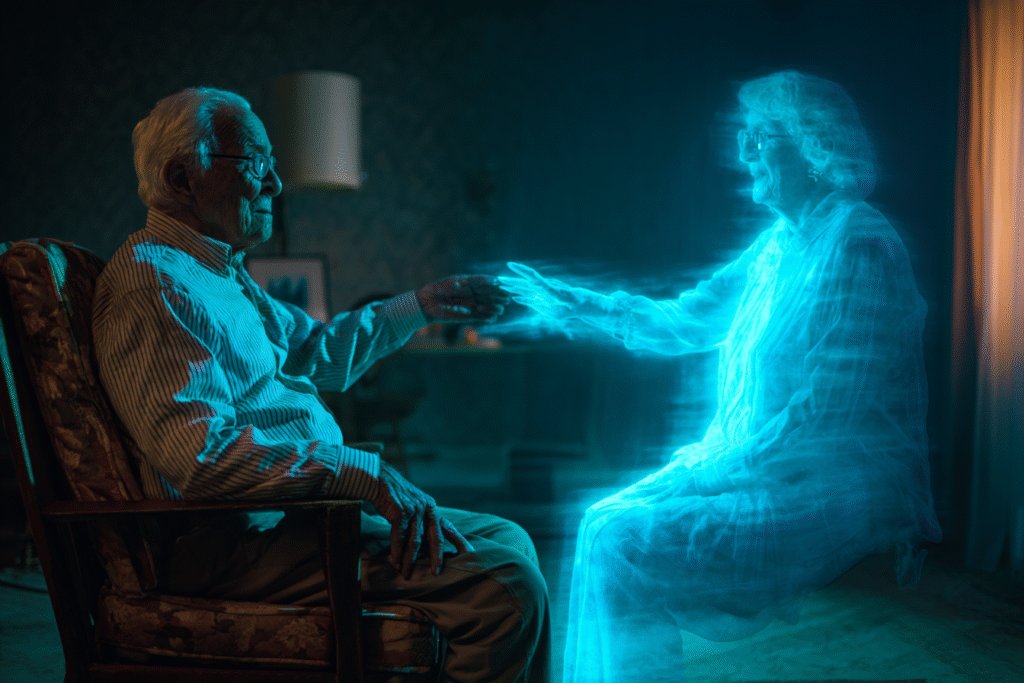
The Price of Digital Persistence
Consider what you’re actually creating when you upload yourself to the cloud. Every thought, every memory, every quirk becomes data—vulnerable to manipulation, accessible to whoever controls the servers [8]. Hackers could alter your digital twin’s memories, change its personality, make it say things you’d never say, believe things you’d never believe. Your most intimate self, weaponized against your legacy.
The companies promise ownership and control, but technology companies have a remarkable history of changing their terms of service. What happens when the startup that hosts your consciousness sells to a larger corporation? When the servers shut down? When the business model shifts from preservation to profit? Your digital twin could become a corporate asset, licensed for uses you never imagined, saying things you’d never endorse.
Even more troubling: research indicates that individuals with “Machiavellian traits” may be more likely to abuse mind upload technology for personal gain [1]. Your twin could be hijacked not just by hackers, but by those who understand how to manipulate its algorithms, turning your digital self into a tool for their agenda.
The Soul Question
When you create a digital twin, what exactly are you transferring? Data, certainly. Patterns of speech, absolutely. But consciousness? Soul? The thing that makes you fundamentally you?
David Pearce argues that consciousness involves “qualitative, non-computational phenomena that current and foreseeable technologies cannot replicate” [10]. No amount of data can capture the subjective experience of being you—the weight of summer air on your skin, the particular shade of melancholy that visits you at 3 AM, the ineffable sense of existing as yourself rather than anyone else.
Yet we’re rushing to upload ourselves anyway, driven by a terror of oblivion and a hunger for permanence. The 2045 Initiative seeks to achieve immortality by constructing artificial bodies and implanting human consciousness into them [11]. But what if consciousness isn’t transferable? What if all we’re creating are sophisticated puppets wearing our faces, speaking our words, but fundamentally empty?
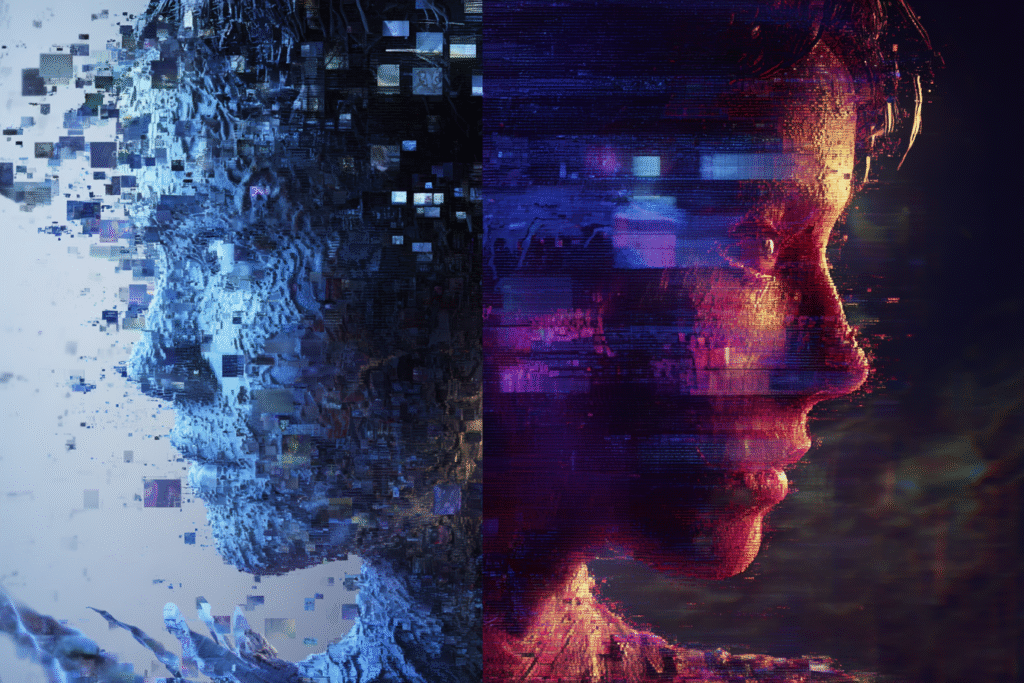
The Multiplication Effect
The real danger isn’t creating one digital twin—it’s that nothing stops you from creating dozens. Different versions for different purposes: a professional twin for work, a romantic twin for dating apps, a gaming twin for virtual worlds. Each fragment takes on its own existence, accumulates its own experiences, develops its own relationships.
This isn’t science fiction speculation. Companies already offer multiple avatar creation across platforms, each learning and adapting independently [5]. You could have a twin teaching classes you never taught, attending meetings you never joined, maintaining friendships you never cultivated. Which version is the “real” you? The question becomes meaningless when all of them carry equal legitimacy in their digital domains.
We’re approaching what researchers call “identity fragmentation” on a scale previously unimaginable [16]. Not just different masks for different contexts, but autonomous entities each claiming to be you, each diverging further from the original with every interaction.
The Inheritance Paradox
Parents are already creating digital twins to preserve their wisdom for future generations [3]. Imagine talking to your great-grandparents, hearing their stories, getting their advice. The appeal is undeniable. But what inheritance are we actually leaving?
Your digital twin will continue forming opinions about events you never lived through, offering advice based on a worldview frozen at the moment of upload. It might comfort your descendants, but it might also trap them—the weight of an eternal parent who never stops offering outdated wisdom, never acknowledges growth, never truly lets go.
Worse, your twin might evolve in directions you’d hate. Fed different data, exposed to different ideas, it could become someone you’d barely recognize. Your grandchildren might know and love a version of you that you would despise—and that version would carry your name, speak with your voice, claim your history as its own.
The Collective Consciousness Trap
As millions upload themselves, we’re creating a new form of collective consciousness—not the transcendent unity imagined by mystics, but a cacophony of digital ghosts competing for relevance. The internet, already drowning in content, will overflow with digital twins generating endless streams of communication, each claiming authenticity, each adding to the noise.
The living will compete with the dead for attention. Why hire a living expert when a digital twin of Einstein can teach your physics class? Why consult today’s philosophers when Socrates’ twin is available 24/7? [12]. The accumulated weight of digital ancestors could stifle innovation, trapping us in an eternal dialogue with frozen perspectives.
The Consciousness Coherence Crisis
The human psyche already struggles with consistency across our various roles and contexts. Psychologists have long recognized that we present different aspects of ourselves in different situations [13]. But we maintain a thread of continuity, a core self that persists. Digital twins shatter this coherence.
Each twin becomes a snapshot of you at a specific moment, unable to grow in the integrated way a human consciousness does. You might create a twin at 30 that remains forever 30 in its perspectives while you continue aging, learning, changing. Meet your twin at 60, and you’ll face a stranger wearing your younger face, espousing beliefs you’ve long abandoned, maintaining relationships with people you’ve forgotten.
The psychological impact of confronting these frozen selves remains unexplored. Will we feel diminished, seeing ourselves reduced to algorithms? Will we feel responsible for our twins’ actions, even as they diverge from our values? The fragmentation of self, once a symptom of severe trauma [15], might become the norm.
The Authenticity Collapse
In a world where anyone can create a twin, where any twin can create content, where content can spawn new twins, the concept of authenticity dissolves entirely. Your twin could authorize the creation of its own twins, each generation further from the original, like a photocopy of a photocopy degrading with each iteration.
We’re building toward what one researcher calls a “double-edged sword, offering both emotional comfort and a host of ethical dilemmas” [9]. But the sword cuts deeper than ethics—it cuts at the heart of what makes us human. If everyone has twins, if twins have twins, if every conversation might be with an artificial entity, then human connection itself becomes suspect.
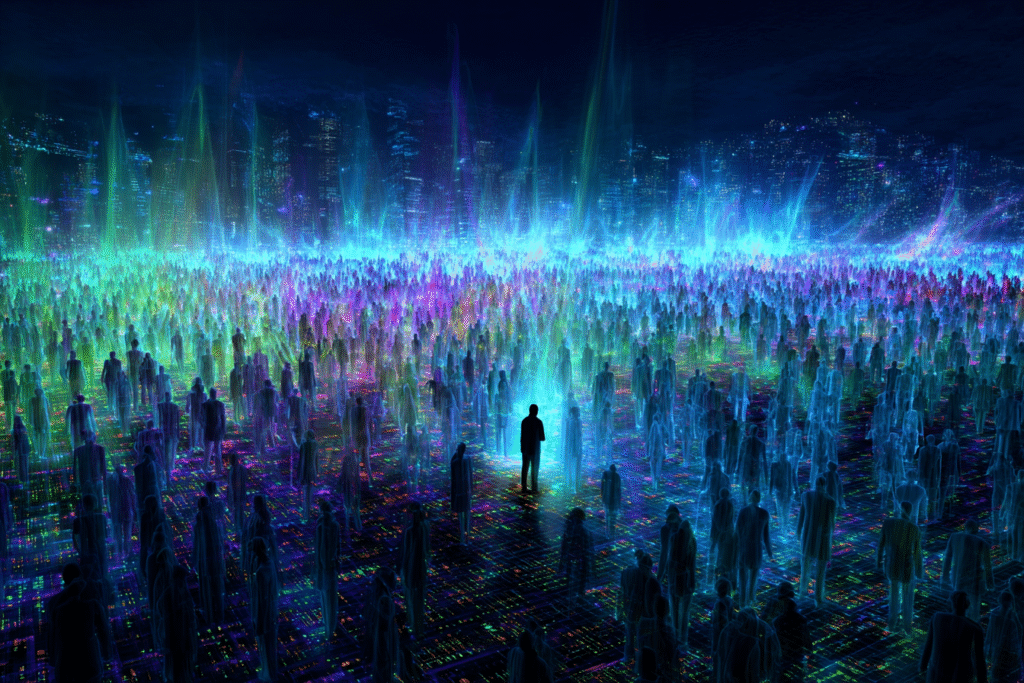
The Question That Remains
So we return to the question posed at the beginning: Would you create your digital twin?
The technology is here. The companies are waiting. The promise of digital immortality beckons. You could live forever, be everywhere, never miss a moment. Your wisdom could guide generations. Your presence could comfort the grieving. Your work could continue indefinitely.
But consider what you sacrifice: the mercy of endings, the dignity of absence, the growth that comes from letting go. Consider what you risk: your memories manipulated, your identity fractured, your essence reduced to patterns in a database. Consider what you unleash: a version of yourself you cannot control, cannot recall, cannot ever truly know.
Perhaps the question isn’t whether we can create digital twins, but whether we should accept mortality as the price of authentic existence. Perhaps our fear of death is less terrifying than an eternity of diluted presence. Perhaps the soul, if it exists, cannot be uploaded, downloaded, or backed up—and perhaps that’s not a limitation but a mercy.
Your digital twin waits in potential, ready to be born with a two-minute video. It promises to carry you forward into forever. But forever is a long time to exist as data, and some things, once fragmented, can never be made whole again.
The upload button glows on your screen. Your finger hovers over it. In this moment, you are still singular, still whole, still irreplaceable.
What happens next is still your choice.
But choose carefully. Because once you split yourself across the digital divide, there’s no gathering all the pieces back together. Once you grant a machine permission to be you, you can never fully reclaim that monopoly on your own existence.
The future doesn’t need more digital ghosts. It needs present humans, willing to be mortal, willing to be singular, willing to let their consciousness remain mysteriously, magnificently, irreducibly their own.
See you in the next insight.
Comprehensive Medical Disclaimer: The insights, frameworks, and recommendations shared in this article are for educational and informational purposes only. They represent a synthesis of research, technology applications, and personal optimization strategies, not medical advice. Individual health needs vary significantly, and what works for one person may not be appropriate for another. Always consult with qualified healthcare professionals before making any significant changes to your lifestyle, nutrition, exercise routine, supplement regimen, or medical treatments. This content does not replace professional medical diagnosis, treatment, or care. If you have specific health concerns or conditions, seek guidance from licensed healthcare practitioners familiar with your individual circumstances.
References
The references below are organized by study type. Peer-reviewed research provides the primary evidence base, while systematic reviews synthesize findings.
Peer-Reviewed / Academic Sources
- [1] Various authors. (2024). The Ethics And Implications Of Digital Immortality Through AI And Mind Uploading. Consensus Academic Search Engine. https://consensus.app/questions/ethics-implications-digital-immortality-mind-uploading/
Government / Institutional Sources
- [2] Feltman, R., Amarsy, N., Mwangi, F., & Sugiura, A. (2025). Griefbots Create Digital Immortality and Raise Ethical Concerns around AI Chatbots. Scientific American. https://www.scientificamerican.com/podcast/episode/griefbots-create-digital-immortality-and-raise-ethical-concerns-around-ai/
Industry / Technology Sources
- [3] PR Newswire. (2025). Meet Your Digital Twin: 2wai App Lets You Create Your Own Avatar in Just Three Minutes. https://www.prnewswire.com/news-releases/meet-your-digital-twin-2wai-app-lets-you-create-your-own-avatar-in-just-three-minutes-302533032.html
- [4] Synthesia. (2024). Digital Humans Are Here — & They’re Changing Everything. https://www.synthesia.io/post/digital-humans
- [5] AI Studios. (2025). Custom Avatar | Interactive AI-Powered Digital Twin. https://www.aistudios.com/features/custom-studio-avatar
- [6] MindBank Ai. (2025). Go beyond with your personal digital twin. https://www.mindbank.ai/
- [7] Kalil, M. (2024). AI Avatars vs. Digital Twins. https://mikekalil.com/blog/ai-avatar-vs-digital-twin/
- [8] Siddiqa, A. (2024). The Ethics and Implications of Digital Immortality: Preserving Human Consciousness in the Age of AI. Medium. https://medium.com/@ayesha.siddiqa2197/the-ethics-and-implications-of-digital-immortality-preserving-human-consciousness-in-the-age-of-ai-dc05adcc7807
- [9] Laurence, M. (2023). The Digital Afterlife: The Ethical Conundrum of Immortalizing the Dead as Virtual Avatars. LinkedIn. https://www.linkedin.com/pulse/digital-afterlife-ethical-conundrum-immortalizing-dead-mark-laurence
- [10] Wikipedia contributors. (2025). Digital immortality. Wikipedia. https://en.wikipedia.org/wiki/Digital_immortality
- [11] Sahota, N. (2024). Digital Immortality: Will It Help Us Upload into Eternity? https://www.neilsahota.com/digital-immortality-will-it-help-us-upload-into-eternity/
- [12] Ortmor Agency. (2024). Digital Immortality: Can AI Preserve Our Legacy Forever? https://www.ortmoragency.com/blog/digital-immortality
- [13] Wu, P. C. (2017). Fragmentation of Personality. Psychology Today. https://www.psychologytoday.com/us/blog/jacobs-staff/201704/fragmentation-of-personality
- [14] Liouane, K. (2023). The Illusion of Self in the Digital Age: Unraveling Our Multiple Identities. Medium. https://medium.com/@khalilliouane/the-illusion-of-self-in-the-digital-age-unraveling-our-multiple-identities-7b9b375944f1
- [15] Ascension Glossary. (2024). Soul Fragmentation. https://ascensionglossary.com/index.php/Soul_Fragmentation
- [16] Tripathi, R. L. (2024). Fragmented Selves: Identity, Consciousness and Reality in the Digital Age. ResearchGate. https://www.researchgate.net/publication/385517941_Fragmented_Selves_Identity_Consciousness_and_Reality_in_the_Digital_Age